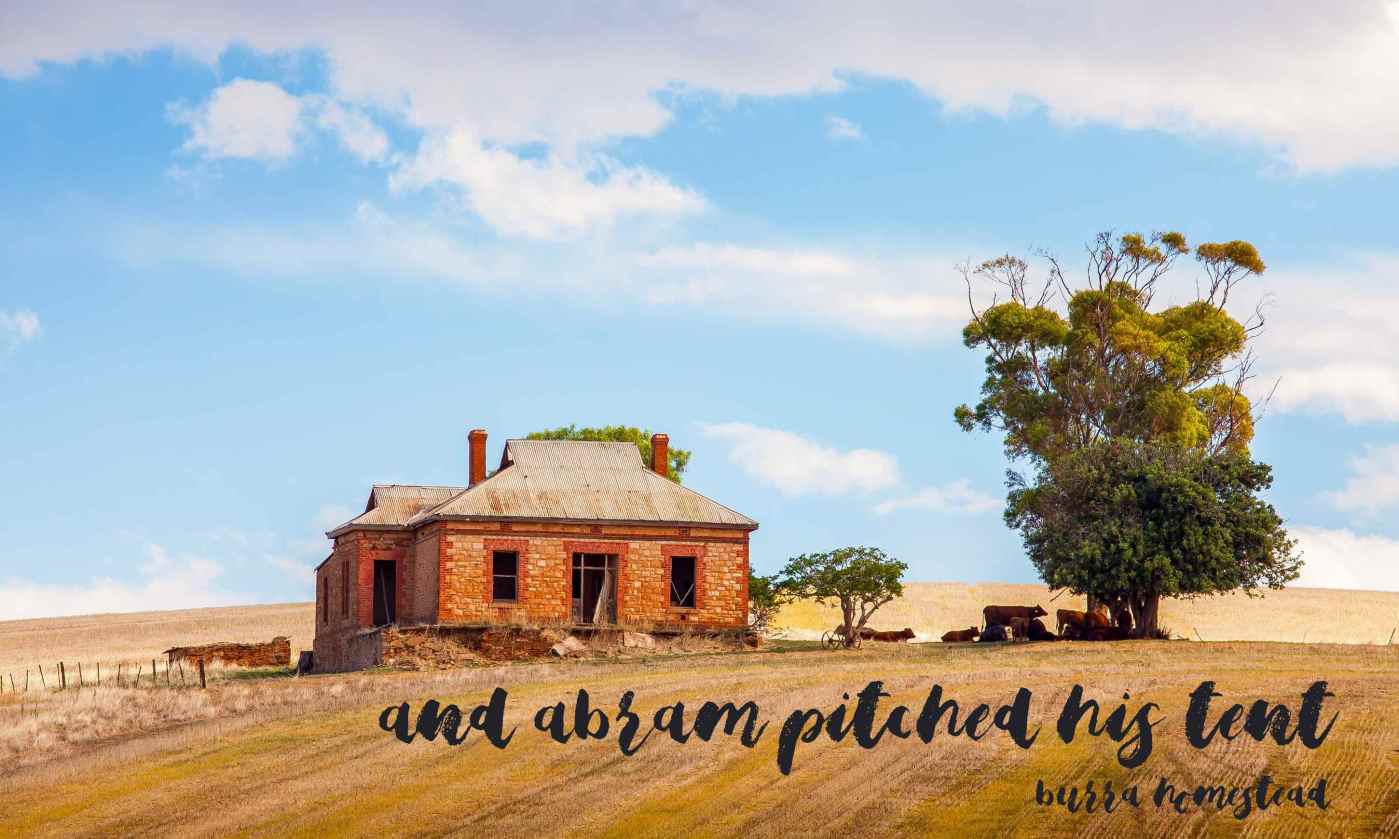
The story of Abram points to a more just settlement, paving the way to Voice and Treaty. (Listen.)
Leave your country, your kin, and your ancestral home, you poverty-stricken Cornishfolk, for a land which I will show you. It’s the colony of South Australia, Burra to be precise; and it needs people like you to chop down trees and lay out farms and work the mines and subdue the earth.
It’ll be hard work, but I will bless you: for you’ll find a bit of gold, and plenty of land for the taking. You’ll build houses and plant vegetable gardens, and raise children into adulthood. In the wide open spaces, dry mines, warm sun, you’ll escape the worst ravages of dysentery and typhoid. And if you don’t have your own servants, there’s always the people of the land.
And you’ll be a blessing to those peoples. You’ll take the Bible, and hymns, and good Methodist preaching, and you’ll convert the heathen. You’ll make them speak English so they will learn to fear God. You’ll teach them not to murder or steal, nor to covet what belongs to another; you’ll teach them respect.
You’ll take young boys and girls into your households and raise them properly, showing them right from wrong. You’ll teach them how to worship, how to farm, how to dress, how to eat, and how to live civilized, cultured lives. And when they run away from your good ministrations, you will discipline them in God’s name.
At least, that’s the story I grew up with.
It’s a story which explains why I’m here: like Abram, my family was called to a new country.
It’s also a story of blessings received. Life in Cornwall was hard. Between malnutrition, mining accidents and water borne disease, the life expectancy in some villages was as low as 19. But in South Australia, with its dry mines, meat and vegetables, the life expectancy was 45. Colonization for my family meant health and wealth, longevity and opportunity: abundant blessings, indeed.
And it’s a story which justifies colonization, because it claims that colonizers bring only blessing, a theme which only last week was explicitly articulated by a Victorian Liberal MP.
My ancestors were ministers and miners and fifth sons and government clerks, and almost all were staunch members of the church. If they were like most colonizers, then they probably believed that this was a godless place; such ideas were common in sermons of the time. They probably also believed that it was their Christian duty to convert people; and they almost certainly believed that conversion meant obedience to empire, the white man, his subduing of the earth, and the laws of private property. Whether they perceived the irony of preaching the ten commandments at people who had seen their own men murdered, their land, women and children coveted and stolen, and their Elders and sacred sites disrespected and far worse, I really cannot say.
But what I can do is name the truth of my origins, and its entanglement with the stories of Genesis. And what I can also do is notice a couple of things about the Abram story which are suggestive for people with a backstory like my own.
The first thing I notice in the Abram story is that God says all peoples will be blessed through Abram. It’s a jarring claim when I think about my own family’s presence in this land. Whatever their intentions, it’s hard to pretend that my family was a blessing. Simply by bringing their diseases, their mining tools, their farming methods, their economic system and a faith intertwined with empire caused enormous if unacknowledged harm.
More specific harms I had to dig to find: the ancestor who was mayor of Burra, who dispassionately observed the almost complete ‘disappearance’ of the people of the land but made no further comment; the rumour that a sideways member of the family was involved in a massacre in South Australia now memorialized at Tyrendarra IPA; the clear-felling and farming methods which within a few years led to erosion, floods and species loss on an ancestor’s property; the unnamed and possibly unwaged Aboriginal woman who worked in one ancestor’s home. These little snippets are all part of my heritage, and they’re not a blessing at all.
The second thing I notice in the Abram story is that God will bless Abram: but that the blessing itself comes a bit later. It comes, in fact, two chapters later through a priest-king of the Canaanite creator-ancestor, El-Elyon.
What happened was this. Abram’s nephew Lot was seized in an intertribal war, along with many other people and possessions. So Abram worked with local allies to recover Lot and all the plunder. When he returned, two kings came out to meet him. One was Melchizedek, the priest-king of Salem; the other, the king of Sodom. Melchizedek served Abram bread and wine, and blessed him, and received a tithe of the plunder; the king of Sodom received the rest of the plunder as returned through treaty. For Abram said to him, ‘I have sworn to Yahweh and El-Elyon, creator of sky and land, this solemn oath: that I’ll take nothing from you. Nobody can say, “I have made Abram rich.” I’ll take nothing except the share due to the men who went with me to recover Lot and the plunder, plus the men’s rations.’ (Genesis 14:22-24).
So Abram worked with local allies to recover his nephew and others. God’s blessing came through a Canaanite priest-king, that is, an Indigenous tribal leader who stood in a different spiritual tradition, and it was given in the name of the Indigenous creator-ancestor, El-Elyon. Abram responded not by forcing Melchizedek to swear allegiance to Yahweh nor by dismissing him as a pagan, but by accepting the blessing and giving him a tithe of the recovered goods. Abram then swore an oath to a second Indigenous tribal leader in the name of both Yahweh and El-Elyon, promising to hand over the rest of the plunder and to take nothing beyond a fair share.
Let’s hear that again:
When he moved into the land, Abram became an ally of local people.
He was blessed in the name of an Indigenous creator-ancestor.
In this creator-ancestor, he recognized his own god and acknowledged this.
He handed over goods and possessions to Indigenous tribal leaders.
He promised to take nothing beyond a negotiated settlement.
It’s the antithesis of how most colonizers act, and the antithesis of how my own ancestors acted. Of course, the Abram story is not uncomplicated. There are things that I hate and there are times when Abram does things which are appalling. Even so, this story suggests a spaciousness to me. In this time of Voice and Treaty, it shows that colonizers can do better. The way I think of it, our ancestors claimed the promises of Abram yet seized the land using the genocidal tactics of Joshua: and these tactics continue today. We see it in the news every day. Racist policing, and mass incarceration of Aboriginal folk. Record levels of Indigenous deaths in custody. Secretive race-based reporting against pregnant Aboriginal women. Continuing mass removal of Aboriginal children. Government approvals for resource extraction from significant sacred sites. And so on and so forth.
Yet Joshua is not the recognized ancestor of our faith: Abram is. So those of us who are Christian colonizers could lean into our identity as children of Abram. We could use this story as a guide and walk towards a more just coexistence with the people of the land.
Like Abram, we could offer ourselves as allies in the struggle to take back what has been stolen.
Like Abram, we could learn from Indigenous Elders and stories, coming to glimpse our god in the creator-ancestors and spirit of this land.
Like Abram, we could hand over a share of our goods and possessions to Indigenous-led organizations.
And like Abram, we could negotiate a settlement, which means at the very least Voice and Treaty.
None of us can change our history, however hard or shameful; but what we can do is speak truth and bring it to the light. And what we can do is engage with people, processes and organizations which work towards more just ends. And if we do these things then, like Abram, perhaps we might know new and surprising blessings. And perhaps, like Abram, we might even become a blessing ourselves to the peoples and families of this land. May justice be done, may love be shown. Amen. Ω
Reflect: What narratives were told about your family’s settler history? What assumptions were made? How does the Abram story uphold, challenge or disrupt these narratives and assumptions?
A reflection by Alison Sampson on Genesis 12:1-9 and beyond, given to Sanctuary on 11 June 2023 © Alison Sampson 2023 (Year A Proper 5).
 Alison and the whale