The following is an homage to Targum, that is, a translation of scripture interspersed with additional material and commentary. Just as the Apostle Paul quotes and reinterprets scripture for a new context, this reading of Romans 8 quotes and reinterprets his words for our context, during the hottest month on record. (Listen.)
5Those who live according to the flesh set their minds on the things of the flesh
Indeed, they set their minds on fulfilling their own desires, whatever the cost. They treat all people, indeed all creation, as a resource to be extracted, exploited, sucked dry.
They encourage business as usual, that is, personal wealth creation, fossil fuel industries, extractive agribusiness, global tourism, and all the rest, and they turn a blind eye to the effects on the planet; they maintain destructive relationships between corporate and political power. They get rich claiming technology will save us then party on the proceeds while Rhodes burns; they establish private refuges with climate-proof shelters, and plan a post-collapse colony on Mars.
but those who live according to the Spirit set their minds on the things of the Spirit
and move with the unforced rhythms of grace. They aren’t afraid of challenge and change; they trust in the power of self-giving love. They allow the Spirit to stir them up and open their hearts to visions and possibilities. They are filled with the Spirit’s power and they follow her lead in healing, reconciling and repairing the world.
6To set the mind on the flesh is death
and we see this all around us. In the last weeks, we have seen the highest mean temperatures ever recorded on the planet. We are no longer in a time of global warming, but global boiling. People and the beyond-human creation are suffering and dying. Borders are closed as nations are reporting conditions inhospitable to life; Rhodes is burning.
To set the mind on the flesh means accepting this situation. It means accepting that the Gulf Stream may collapse this century, or even this decade, and accepting the end of agriculture as we know it. It means accepting the death of the Great Barrier Reef, the collapse in insect numbers, the destruction of entire ecosystems; it means accepting the terrible grief of species loss and the silencing of voices in the cosmic choir. It means settling for catastrophic sea level rises and famines and wildfires; it means settling for unprecedented waves of human migration as people desperately seek refuge. Indeed, to set the mind on the flesh is death
but to set the mind on the Spirit is life and peace.
For when we set our minds on the Spirit, we are led to right relationship with God, each other and the land. Fullness of life and shalom are ours. And when we refuse to settle for death but instead work together for change, we generate hope and are filled with joy, even in the face of devastation.
18 I consider that the sufferings of this present time are not worth comparing with the glory about to be revealed to us.
Because our faith insists that God makes all things new. God sings seeds into saplings, brings rivers to the desert, and turns fallen trees into a haven for multitudes. God makes even the grave a bed from which life can rise renewed. We are facing a time of terrible suffering: ecocide, climate wars, species loss, widespread famine. And yet one day even these will seem small in comparison to God’s infinite creativity and goodness.
19For the creation waits with eager longing for the revealing of the children of God;
those people who take seriously our fundamental commission to tend and serve the soil. The creation longs for those who care for the earth, who sequester carbon through intelligent, sustainable agriculture or who engage in the complexities of food production with Indigenous knowledge and skill. The creation yearns for people who embody shalom by living in harmony with the land. Children of God don’t deplete the earth, but like their Creator engender fruitfulness; they see and celebrate the goodness of creation and know that all life is connected.
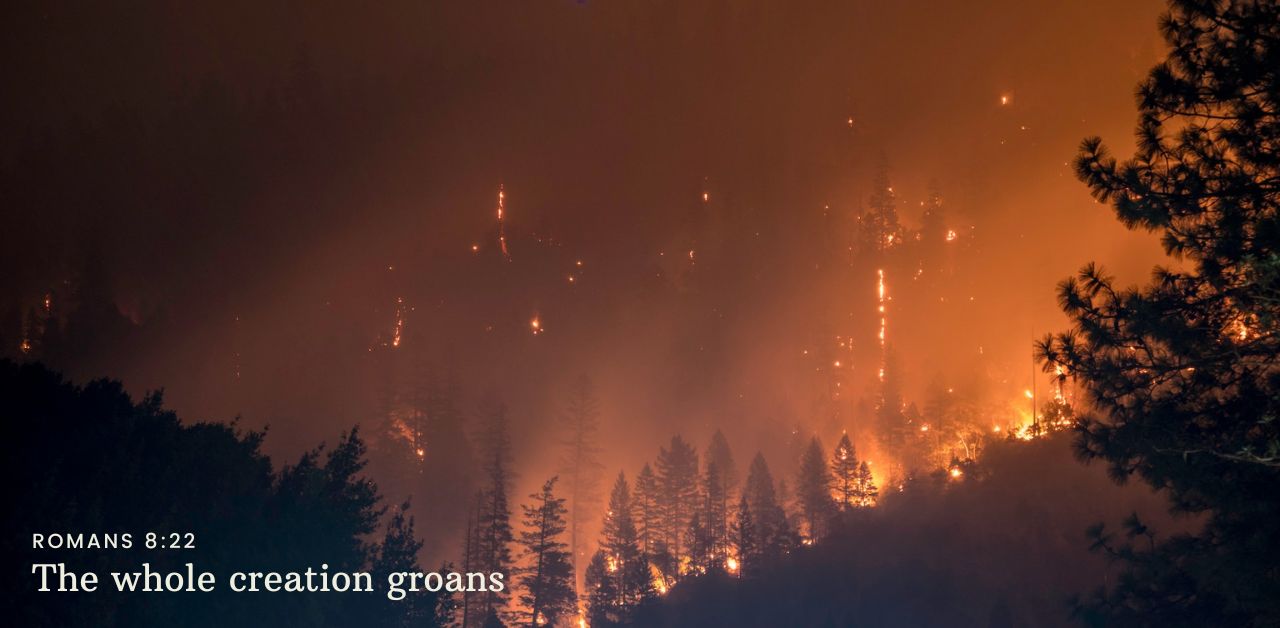
22We know that the whole creation has been groaning in labour pains until now;
We can see it; we can feel it. From the depleted deserts of China to the scarified place we call Israel, from the deforested British Isles to the razed and ruptured land we call home, we see how centuries of war and deforestation and resource extraction have brought creation to her knees. Right now, heat waves wash over her; her belly pulses; her body shakes; her ocean waters are breaking forth as Mother Earth groans
23and not just Mother Earth, but we ourselves, who have the first fruits of the Spirit, groan inwardly while we wait for adoption, the redemption of our bodies,
our integration with the land. For until we embrace our fundamental commission to tend and serve the soil; until we embody right relationship with Mother Earth and what the Lakota call ‘all our relations’, that is, all of creation, we will continue to live in pain. For we are made of earth, and when we wound the earth, we also wound ourselves. And so we groan, we lament, we wait anxiously for our deliverance, and when the pressure mounts and it seems too much to bear
26 The Spirit helps us in our weakness;
When we see extreme heat in Europe and North Africa and North America, and the turbocharged heating of the oceans; when we dread bushfires and droughts and rising sea levels and all the rest; when despair for the world grows in us and we wake in the night overcome with fear, the Spirit helps us in our weakness …
for we do not know how to pray as we ought
Do we pray for political change? Corporate collapse? Do we pray for the transformation of our own hearts and lives? Do we pray for the protection of the people and other life forms who are dying in this climate catastrophe? Do we pray in public in prophetic protest, or in words of radical blessing? Do we give thanks for good food and for what we still have, or do we lament and sing the blues? Do we plant gardens, lobby governments, or glue ourselves to busy roads, and all in a spirit of prayer? We don’t really know how to pray as we ought, or how to offer our lives in prayer
but that very Spirit intercedes with groans too deep for words. 27And God, who searches the heart, knows what is the mind of the Spirit, because the Spirit intercedes for the saints according to God’s will. 28 We know that all things work together for good
but it’s very difficult to believe. Our timelines are too small, our imaginations too meagre, our focus too fixed on the human, to trust that God may yet bring about newness of life. Yet at the heart of our faith stands a crucified Christ, and so we remember: not only death but the death of the innocent can lead to resurrection, and glimpses of the Risen One can galvanize a movement for change. So in faith we insist that all things work together for the good
for those who love God, who are called according to his purpose.
And this purpose is not personal growth or morality, nor health, wealth and happiness, nor even a human focus. Instead, in the beginning, God. Then many other things until finally we are formed and given a purpose: to tend and serve the soil, to participate in the earth’s creativity and fruitfulness, to dwell in Christ and be filled with the Spirit, and to contribute to the healing of the world.
29For those whom he foreknew he also predestined to be conformed to the image of his son,
the one who emptied himself of power, let go of his own privilege, rejected all forms of entitlement, and gave his life for the last and least. He healed those treated as expendable, exploitable; he lived and died for Bangladeshi beggars, Brazilian waste pickers, seniors dying of heatstroke and even little birds. And God predestined the chosen ones to be conformed to the image of this son
in order that the son might be the firstborn within a large family.
a family so large it will ultimately gather up all people, indeed ‘all our relations’, that is, the whole of creation.
30And those whom he predestined he also called;
to dwell in the son and be shaped by him and work alongside him
and those whom he called he also made just;
by placing a spirit of justice in their hearts.
and those whom he made just he also glorified
by revealing in them the image of God as they creatively care for this good earth in a spirit of justice and joy.
35Who will separate us from the love of Christ? Will hardship, or distress, or persecution, or famine, or nakedness, or peril, or sword?
Will climate waters, water wars, wildfires or plague? Will floods or droughts or mass movements of people? Things will become hard, very hard: but I am convinced that Christ’s self-giving love will endure.
36As it is written, ‘For your sake we are being killed all day long; we are accounted as sheep to be slaughtered.’
Because death is part of this story. Our addiction to the things of the flesh means death is everywhere: of people, of plants, of species, of ecosystems. So, should we choose callousness, or be overwhelmed by fear? Should we become the living dead, grabbing what we can then bunkering down and letting it all unravel?
37No, in all these things we are more than conquerors through him who loved us.
Indeed, we see just how pathetic conquerors are, those global chiefs hollowed out by lies, excited by violence, and threatening personal cage fights. They are willing to destroy all life on earth to bolster their own egos and maximise financial gain. Their hearts are shrivelled; they have no compassion; they care not for the last or the least; for they are fixated on things of the flesh.
But we are more than conquerors; we are bigger than that. The one who loved us descended into the grave and defeated sin and death once and for all. So those of us who dwell in him know that death is unavoidable, and sin is inevitable, yet they do not control us nor have the last word. Indeed, in the grand arc of history, all things shall be reconciled in Christ, and ‘all shall be well, and all shall be well, and all manner of thing shall be well.’ (Julian of Norwich).
38For I am convinced that neither death,
with its cruelty, suffering, terror and pain;
nor life,
with its addiction to things of the flesh and its misplaced confidence that ‘she’ll be right, mate’;
nor messengers of God,
who shake things up and ask us to change and call it good news;
nor rulers,
nor politicians in the pockets of industry nor media titans who stir up hatred nor corporate bosses who feed our greed and lead us all to destruction;
nor things present,
the extreme heat, the vast hurricanes, the emptiness which is ecocide;
nor things to come,
whether bushfires or droughts or fish kills or even the collapse of the Gulf Stream;
nor powers,
and the lies they whisper, the anxiety they provoke, the hopelessness they encourage, the violence they foment,
39nor height, nor depth,
nor cinder-filled skies nor rising seas,
nor anything else in all creation, will be able to separate us from the love of God in Christ Jesus our Lord.
For in that love, death does not have the last word. In that love, despite all evidence to the contrary, we trust in the infinite possibilities of God’s creativity and newness. In that love, we are more than conquerors; for we are filled with the Spirit and called to participate, not in domination and destruction, but in the grace-filled healing of the world.
Children of God, Mother Earth waits with eager longing: so let’s get to work. God’s will be done; God’s love be shown. Amen. Ω
Reflect: What is one way you already care for the earth? What more are you called to now?
A reflection by Alison Sampson on Romans 8 (selected verses), given to Sanctuary on 30 July 2023 © Alison Sampson 2023 (Year A Proper 12). Photo by Matt Howard on Unsplash (edited).
 Alison and the whale