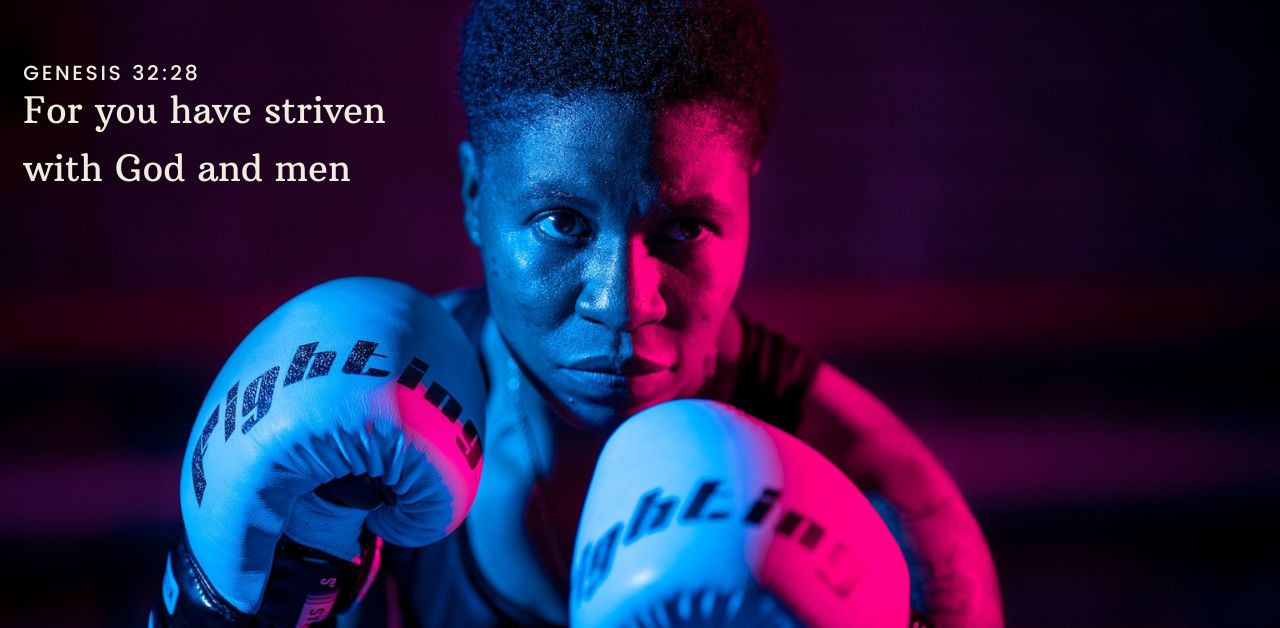
Sometimes, you gotta fight for a blessing; sometimes, it’ll cost you. (Listen.)
A few weeks ago, I organised and hosted a ministers’ gathering. Near the end of the session, one of the ministers suddenly went on a rant about the failings of the church in the West. The church is collapsing, he said, because of the blurring of gender roles that began in the 1960’s and continues to this day. And there was I, sitting in a room full of men with my boots and jeans, close cropped hair, zero make up, and not a floral in sight—and all the authority which was conferred upon me through the rite of ordination (which in Baptistland is, admittedly, not much).
My colleagues were left to conclude that the church is failing because of people like me. Outspoken women. Preaching women. Women in leadership making decisions. Women who refuse to perform femininity; women who don’t automatically defer to the authority of men. Women who share power in a marriage and expect to be equal participants; women who laugh raucously and don’t give a fig what anyone thinks. And I suppose this minister also believes the church is failing because of all those foolish men who empty themselves of power in Christlike ways and live for the flourishing of others.
His rant was so patently stupid that I won’t dignify it with an argument. I mention it simply as the latest in an endless string of episodes where men have made it abundantly clear that there is no place for me in the church, and so it came to mind when I was reflecting on tonight’s story.
I wouldn’t be a person of faith without the stories of Jacob, in particular without this story of Jacob wrestling a stranger. Like his flamboyantly dressed son Joseph*, the judge and prophet Deborah, the prophet Mary, and even our Lord Jesus, who took on the role of the lowliest slave girl as he washed his disciples’ feet, Jacob is someone who blurs gender lines and who yet finds their place in God’s story.
His brother Esau is a manly man, full of testosterone and super-hairy; but Jacob is soft and smooth. Esau likes nothing better than huntin’ and shootin’ and fishin’, and spends his time in the wilderness killing things. Jacob, on the other hand, is a man of the tents; he’s more domestically inclined. While his brother goes hunting, Jacob hangs around with the women and children and makes vegetable soup.
More, in a big no-no in a patriarchal society, he places himself under the authority not of his father, but his mum. ‘Jacob,’ says Rebekah, ‘dress up like your brother. Strap goatskins to your arms, make ‘em real hairy. Go trick your old man and take the blessing that’s meant for Esau.’ Jacob does as she says, and when his blind old father asks who it is, he lies and says, ‘Esau.’
Then when all is discovered and Esau breathes threats and murder, ‘Jacob,’ says Rebekah, ‘Don’t get yourself killed. Get outta here. Run for my homeland, find a wife – and stay well away from your brother.’ Again, Jacob does as his mother says. And when he arrives, like his mother before him he draws water for the flocks; and when he meets his uncle, he introduces himself not as ben-Isaac, but as Rebekah’s son. Truly, he blurs gender lines.
Today’s story catches up with him twenty years later. He’s unhappily married, with quarrelling wives and concubines and slaves and children, and great flocks of mottled, speckled, and spotted sheep; and he is finally returning home. Yet he’s terrified of how his brother will receive him. He’s so afraid that he sends a delegation of slaves and gifts ahead of the party, then shoos everyone else across the creek before sleeping alone on the banks of the Jabbok. Like me all too often, he’s not sure how he’ll be received: and perhaps he’s never been sure. Perhaps there’s never been much room for Jacob to be Jacob in his father’s house: for his father loves manly Esau best.
Jacob is alone when, in the night, a stranger comes and tackles him: and they begin to wrestle. The stranger is strong, but Jacob is determined. The stranger persists, but Jacob will not give up. All through the night they grapple and twist and grab and roll, neither Jacob nor the stranger prevailing. At last, in the first light of dawn, the stranger slips under Jacob’s guard and, with a low blow, dislocates his hip. The stranger then tries to leave. But in agony, gasping, Jacob still holds on. He asks the stranger’s name, and demands a blessing. He’s not sure if there are any blessings coming his way, at least, any that he doesn’t have to fight for, so he hangs on for dear life and insists.
And this is why I love Jacob so much: because he dares insist on a blessing, whether or not anyone thinks he is worthy. Earlier, he grabbed at his father’s blessing, though Esau was the favourite. Now he holds on through darkness and pain, even though he has been wounded. He doesn’t give up, he doesn’t lay off, but clings to the stranger he suspects might be God and insists on a share of God’s benevolence.
The stranger responds with a question. ‘What’s your name?’ he asks. Jacob has a choice. So far in this story, Jacob has been evasive. ‘Who’s that?’ asked his father: and Jacob muttered, ‘Esau.’ ‘Who are you?’ asked his uncle: and Jacob said, ‘Rebekah’s son.’ At birth he was named Jacob, the Grabber, the one who seized onto his brother’s heel and everything else in his path; but so far in Genesis, he has not yet named himself.
Until now. For here at last, in a stranglehold with God, Jacob finally claims his own name. ‘It’s me,’ he says. ‘Jacob. The grabby one, the one who grabbed his brother’s heel and who holds you now in a headlock. The one who won’t let go; the one who demands a blessing.’ Then Jacob receives an answer, and it’s not what he expects. For now he’s finally acknowledged who he is, the stranger gives him a new name. ‘You shall be called Israel,’ says the stranger, ‘for you have striven with God and with men, and have prevailed.’ Then he blesses him and they separate at last, Israel now and forevermore limping.
So this is a story for a woman like me, who has had to strive with God and men to claim her vocation, even her faith at times. ‘It’s me,’ I say, ‘Alison. The outspoken woman. The thinker, the preacher, the grumping Jonah, the sometime angry prophet. It’s the short-haired woman in unisex boots who rejects suffocating gender roles and demands her place in this story.’ And because I dare insist that this is my faith, too, and that I belong in this story and have a role to play, some people take exception, and so I experience a never-ending series of hostilities and rejections and aggressions and wounds. Like Jacob, my struggle has given me a new name, ‘Reverend’; like Jacob, I will always be limping.
It’s also a story for those trans people who have retained their faith and who, despite everything, have insisted they belong: and when dawn breaks and they speak their truth, they receive a new name, a transformed body, and a revised role in their community.
Indeed, this is a story for anyone who has ever had to fight for their faith and demand a share in the blessing. And so it’s also a story for many others of us here at Sanctuary. This seven-year experiment has been making space for questioners, questers and seekers, and hurting folk and queer folk and outspoken women and all the rest. Some of us were turned away from church, others of us ran screaming, but all of us have found our way here. And together we have glimpsed the communion of heaven and earth, the stairway of Jacob’s dream. We have had plenty of chances to wrestle with God, and many of us have had our confidence restored that we, too, have a place in God’s story.
Yet we are facing a hard conversation about our future, and we’re not sure what morning will bring. Maybe a blessing. Maybe a new name or direction. Maybe a reunion with an old foe, or a debilitating wound, or even death and resurrection. I really don’t know. But I do know this: it’s when we are at our limits, vulnerable and even fearful, forced to leave the old ways behind us and facing an uncertain future, that we are more attentive to God’s presence, more likely to be honest, and more open to God’s transforming power.
Of course, we can shy away from it. Thanks to busy-ness and shallowness and a million shiny distractions, we can avoid real engagement. Or we can put up a token fight, then throw up our hands in defeat and stop asking. ‘Actually, we never really wanted a blessing,’ we might say. ‘You can keep it.’
Because wrestling and demanding is hard, even painful at times. It’s easier to keep being the scallywag, or the disenchanted young adult, or the rejected person, or the post church Christian. It’s easier to walk away, just as it would be so much easier for a woman like me to operate far from the bounds of the church. But I want more than ease from this life, and I trust in the wisdom of the struggle and the possibility of change and the foolishness of wounded healers.
And in my own experience of struggle, I have discovered new depths of endurance, courage, and independence of thought. In struggle, I have learned wisdom and patience, compassion and strength. Through struggle, I am being slowly transformed. Through struggle, I get to grow up.
So I believe that when we, like Jacob, engage in the struggle, we might find ourselves in pain and gasping. But we might also come away with new self-knowledge, and a new awareness of God’s intimacy, presence and grace. And we might come away limping but, as far as I’m concerned, it’s a small price to pay for this wisdom, these gifts, this blessing. Ω
Reflect: South African theologian and anti-apartheid activist Allan Boesak tells a story: When we go before Him, God will ask, “Where are your wounds?” And we will say, “I have no wounds.” And God will ask, “Was there nothing worth fighting for?”― So, what is worth fighting for? What has it cost you? Where are your wounds?
*Interesting note: Commonly translated as a ‘coat of many colours’, Joseph was given a ketonet passim. Such a garment is described more fully in 2 Samuel 13:18-19 as a dress worn by virgin daughters of the king.
A reflection by Alison Sampson on Genesis 32:22-31, given to Sanctuary on 6 August 2023 © Alison Sampson 2023 (Year A Proper 13). Photo by Zachary Kadolph on Unsplash (edited).
 Alison and the whale