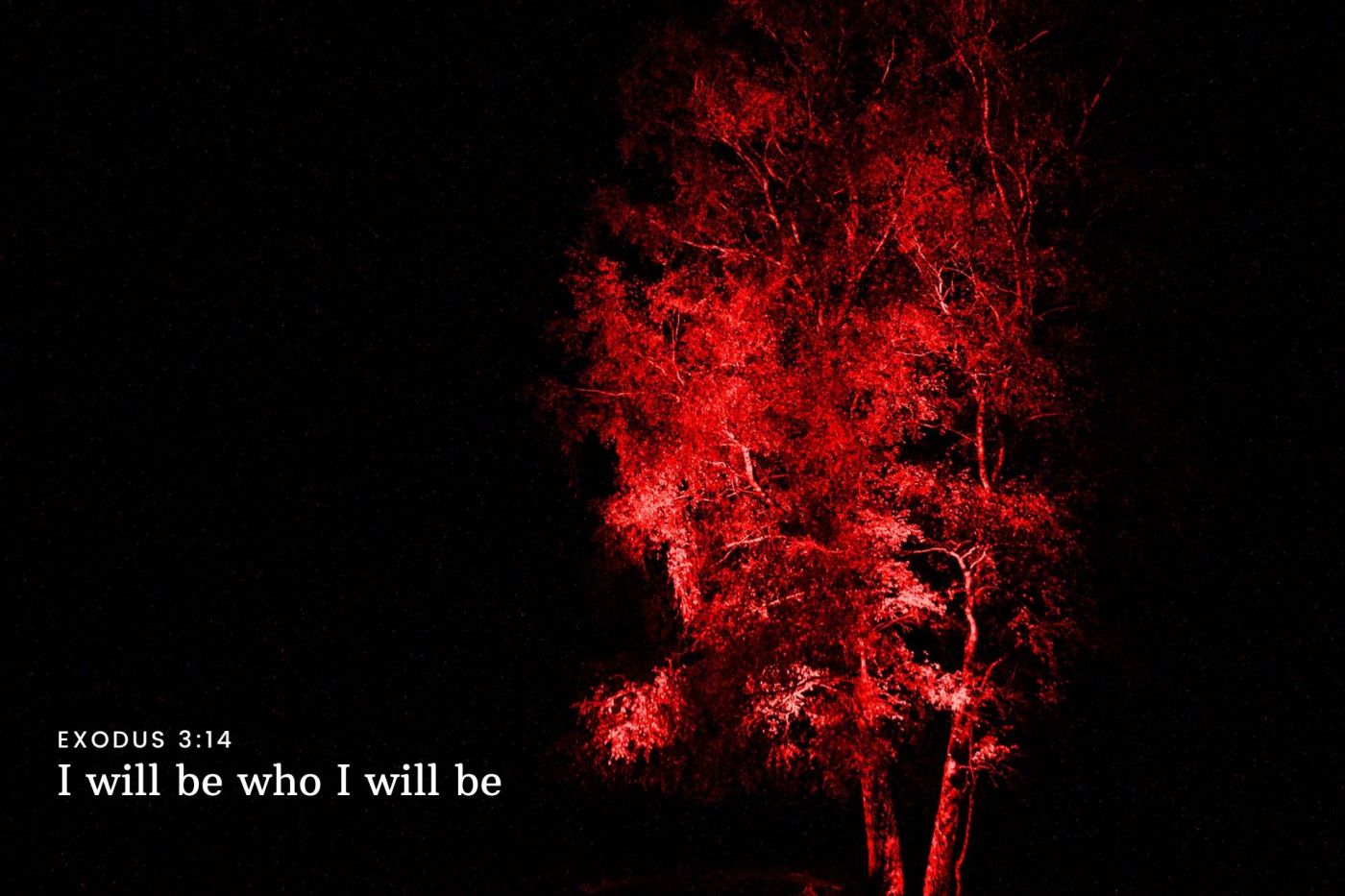
The God of freedom calls us to shape the future through our collective choices. (Listen.)
At the burning bush, Moses asks God’s name. God replies, “Ehyeh asher Ehyeh.” Thanks to a long history of translation, from Hebrew to Greek to Latin to English, and thanks to the Greek philosophical tradition which has shaped our language and worldview, this is usually translated as “I am who I am.” We come away with an idea of God as a timeless, unchangeable essence, as far from the mess of human life as possible.
But this idea of a removed, remote, impersonal God is a Greek idea. It’s not Hebrew. And the Hebrew phrase is in the future tense. “Ehyeh asher Ehyeh,” says God: “I will be who and how I choose to be.”
In other words, “I am the God of freedom, and I will always be free.” I am free to respond to your prayer, or not. You can’t pin me down. You cannot control me with spells or witchcraft or animal sacrifice, nor even with your good behaviour or most earnest prayers: but I will listen to your cry, then decide.
And when I decide, I am free to interact with history, and to change it. All is not settled in this world; your fate is not predetermined.
My people were enslaved and I heard their cry. I decided to intervene, and changed history.
I told Isaiah to prepare King Hezekiah for his death. But Hezekiah turned his face to the wall and prayed earnestly. I changed my mind, and he lived (2 Kings 20:1-5).
I decided to overthrow the city of Nineveh. But the people turned their lives around; and I repented of my plan and did not destroy that city (Jonah 3:10).
Indeed, I am free to make my own decisions, and I am open to change. “Ehyeh asher Ehyeh”: “I will be who and how I choose to be.”
And because people are made in God’s image, and because God is free, people are free, too. God is free to lead Israel into the land of other peoples: and Israel is free to interpret this as an invitation to treaty, like Abram, or to genocide, like Joshua (more here). It’s not that these choices don’t matter—they matter a lot!—but Israel is free to make these choices and to live out the consequences.
And later, through the person of Jesus, God is free to reject the Joshua tradition and to bring respect, bread and healing to the Indigenous people of the land: and we are free to accept or reject this interpretation and its implications (more here).
Because we are all free, in each and every thing that we do. Free to say “Yes” to the Voice referendum and walk into a new future; free to uphold the status quo and say “No.” Free to adopt a posture of fear, and free to live with confidence. Free to clutch onto privilege and power, and free to give our lives away.
This brings me to the second part of God’s utterance: “I will be who and how I CHOOSE to be.” If we are made in God’s image, and we are, then God is saying that we make the future by our choices. We are free to live however we want: but our choices make a difference. Our choices shape the future. Our choices matter.
In Deuteronomy, God says, “I set before you the ways of life and death.” (30:15-18). Because we are free, we can go either way. But, says God, “Choose life.” Choose love. Choose justice. Choose generosity. Choose neighbourliness. Choose compassion. Choose creation care. Because God wants you and the earth to flourish.
We here at Sanctuary are faced with some big questions. Voice, climate, the future of the church, and more. As we seek to address such questions, I suggest that we don’t try finding the so-called ‘right’ answers. Let’s not be paralysed by unattainable ideals or waste time arguing about perfection. That is what the ancient Greeks would have us do: but we worship a different God.
We worship an intimate, responsive, changing God who gets involved in the mess of human history and calls us to shape the future by our choices. Some choices are better than others, sure. But because the future is not yet set, there is no single path. Instead, the future will emerge out of the choices we make now.
So when it comes to our questions, let us think about the kind of future that we want. For example, when it comes to Voice, do we want to be a defensive nation which denies its dark history? Or do we want to be a nation of truth-tellers, which faces its demons and heals its wounds and dances into new ways of being? Because if the latter, then Voice is by no means perfect, but it’s a step along the way.
When it comes to climate, do we want to be temporarily enriched through offshore gas extraction and the fracking of agricultural land? Or do we want to live more humbly and remain a whale nursery, a breadbasket, a cornucopia of life? How we now act, or fail to act, creates our future: which way do we choose?
And when it comes to church, do we want to turn up only when there’s nothing more pressing, and privately access spiritual content at other times? Do we want a consumer experience? Or do we long to become a sign of the kingdom, the garden city, the wedding banquet, the economy of God, a gift to the world? What do we imagine for children and elders, queer folk and autistic folk, friends and strangers, and how might we bring this about?
Who do you want to be? What world do you want to live in? What church do you want to belong to? What future do you dream of, and which paths lead to life?
We are free to answer these questions in whichever ways we choose. We are even free to ignore them, because that is a decision, too, with its own consequences. But however we exercise our freedom, let us always do so in light of the future that we long for.
God’s will be done; God’s love be shown; God’s freedom be known. Amen. Ω
Reflect: Do you find the idea of freedom exciting, encouraging, or challenging? What are your resistances to it? How can oppressed people be free? How can so-called free people be living in slavery? What does all this suggest about God, church, people, faith, or suffering?
A reflection by Alison Sampson on Exodus 3:1-15 given to Sanctuary on 3 September 2023 © Alison Sampson 2023 (Year A Proper 17). Thinking shaped by Rabbi Sacks, and some phrases cheerfully stolen from my friend Rev. Katrina Lambert (with her permission) after discussing these ideas! Photo by Birger Strahl on Unsplash (edited).
 Alison and the whale