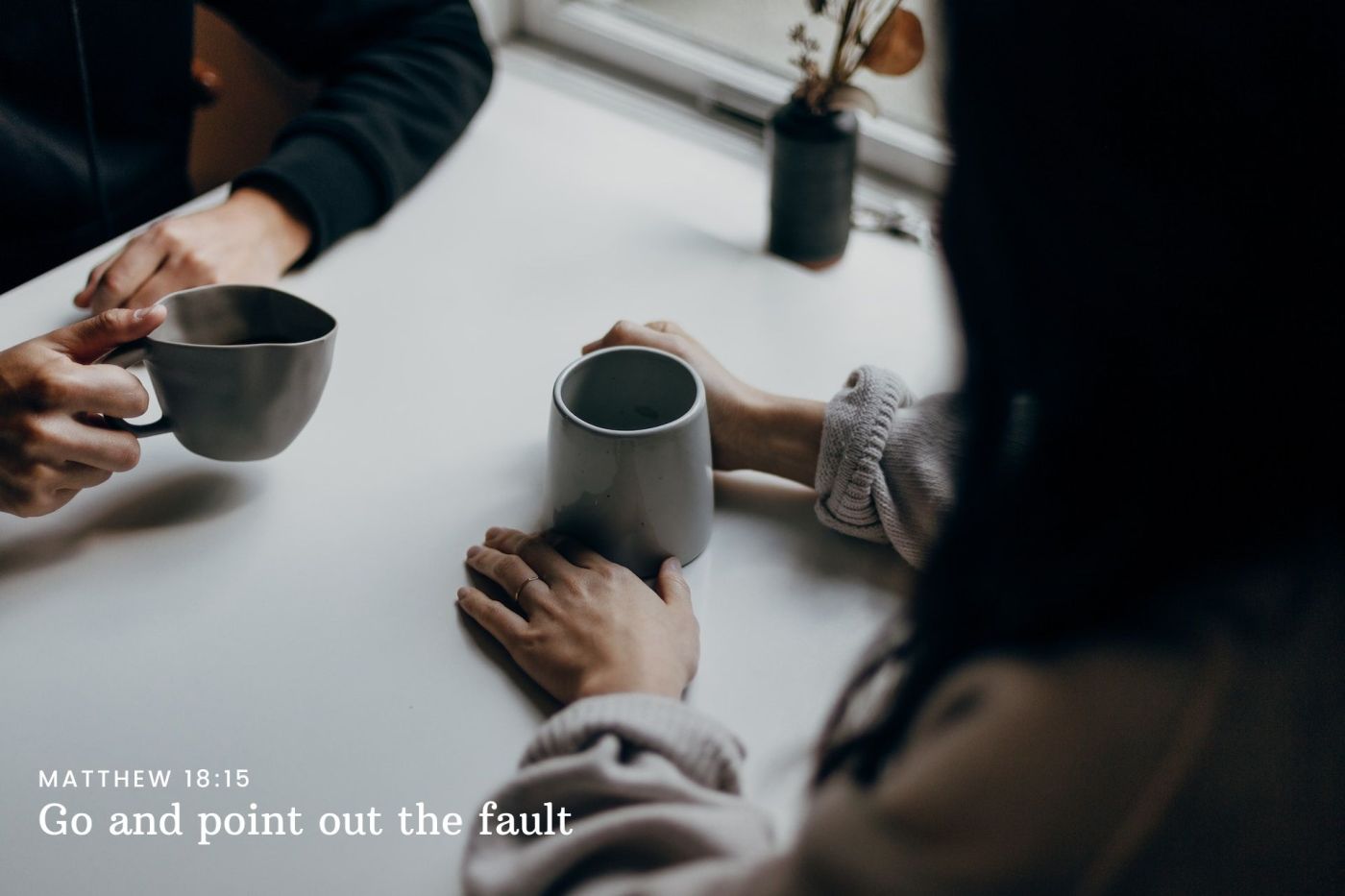
If another member of the faith community sins against you, go and point out the fault when the two of you are alone. (Matthew 18:15)
I hate conflict, but I know I am not alone. And while it’s all very well for Jesus to tell us to point out faults, the question we’re left with is … how? That is, how do we approach someone without damaging relationship further?
Self-awareness is crucial. When we can find the space between feeling and acting, we are more likely to bring curiosity, compassion and creativity to the dialogue. If we go in with no real forethought, or simply react, we are more likely to make things worse. The trick, then, is to find this moment of pause.
The following is a tool that I have found helpful in doing this. Asking myself these five questions helps create the space between feeling and responding, and points to my responsibility to help find a way forward in any situation of conflict. Perhaps you will find it helpful, too.
1. I notice …
First, consider what is triggering a sense of hurt or injury. What’s going on? Name it to yourself.
2. I feel …
Now work out how you feeling in response. Are you glad, sad, mad, bad, or dangerous to know? Working this out may involve doing a quick mental body-scan. See, for example, this map of where emotions sit in the body to help work out what you’re feeling. Whatever you feel is fine; our emotions simply tell us that something needs attention. It’s what we do next that matters.
3. I think …
The next step is to work out what you’re telling yourself about the situation, and to own it. That is, what story have you made up about yourself and the other person? Is this the best story, or is there another explanation? Which explanation tends to resentment? Which is realistic? Which is generous, hopeful, loving or kind?
4. I want …
Now ask yourself what you want to happen. This could be practical, or it could be relational. As someone said on Sunday, consider whether you want to be happy or right. That is, are you willing to bend in order to remain relationally well connected? As someone else said, How important are your principles? Are they more important than people? Do the pegs really need to be brought in for this marriage to survive? Of course, some things are not negotiable; not everything can be compromised.
5. I will …
Finally, work out what you will do to help make your preferred outcome happen. Get creative; get curious. And who knows? Maybe in going through this process you’ll resolve the issue without needing to address the other person at all! And if not, then when it’s time to talk, you’ll be clearly communicating not only what you want, but that you’re committed to working towards a good outcome.
Here’s a simple example putting these steps into practice:
- I notice my sister is crunching very loudly.
- I feel grossed out and enraged by the sound.
- I think she is doing it to annoy me // I think she’s forgotten I’m in the room and how much I hate the sound // I think I have misophonia and my brain drives me nuts and it’s really, really annoying // I think [whatever].
- I want to *not* hear the sound anymore. Also, I don’t want to scream at her.
- I will ask her to please chew with her mouth shut // I will go into another room and close the door so I can’t hear her // I will offer her a bowl of ice cream to eat in place of potato chips // [whatever].
Finally, there’s a little phrase called ‘pinch-crunch.’ It just means, address the pinch before it becomes a crunch. Deal with the pinches, that is, the small stuff. Don’t store them up and, with any luck, by the time big stuff emerges you’ll have practiced so often at the small stuff that you’ll be able to work through the big stuff really well. So if someone sins against you, don’t panic. Instead, think of it as an opportunity to practice conflict resolution and to grow in intimacy and love.
Shalom,
Alison
Emailed to Sanctuary 13 September 2023 © Alison Sampson, 2023. Adapted for Sanctuary from Living in Balance, Levey & Levey (1988), as presented by Future Work Design, We Love Conflict: Wheel of Mindfulness (here). Photo by Priscilla Du Preez on Unsplash (edited).
 Alison and the whale