Jesus says, “As for the resurrection of the dead, haven’t you read what was said to you by God, “I am the God of Abraham, the God of Isaac, and the God of Jacob”? He is God not of the dead, but of the living.” (Matthew 22:31-32)
The night Great-Aunty Pete died, she came to my mother in a dream and said goodbye. After Lindsay died, he appeared in my kitchen while I was cooking dinner. In life, he was intellectually and emotionally limited; when I saw him after death, he was wise and mature and laughing. It was the same old Lindsay, only transformed: and he radiated reassurance into the room. I know some of you have similar stories, where the dead have presented themselves to the living and shared love and encouragement.
One of the weirder aspects of our faith is the idea that, in Christ, death is no barrier to relationship, and that the dead continue to love and encourage us. We sometimes call this the communion of saints. That is, whenever we gather to worship God, we do not do so alone but as members of a great company: saints before us (i.e. dead) and beside us (i.e. alive), as well as siblings in faith from all over the world.
Now, saints aren’t hyper-holy people whose feet never touch the ground. They’re ordinary flawed people, who hand their ordinary flawed lives over to God for God to shape and use for God’s purpose. In other words, they are people like us. And we claim that, to God and through Christ, in life and in death, all of them are alive: for death has no meaning in God.
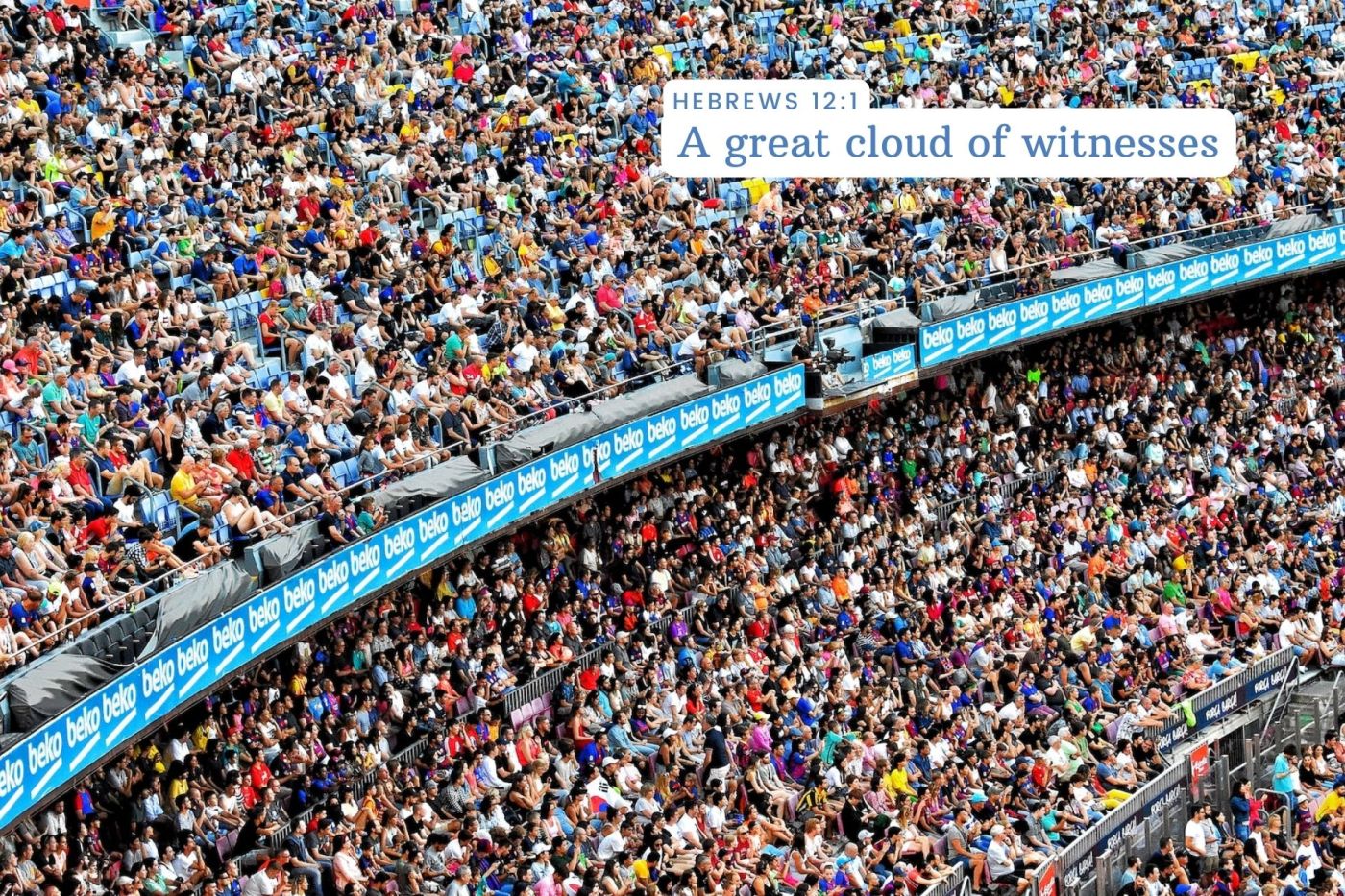
Of course, to anyone who prides themselves on their rationalism, this is all superstitious mumbo-jumbo. But to those of us living the faith and who have experienced its truth, it fills us with courage. For the life of faith is a marathon; it takes perseverence to run this race. Yet we are being cheered on by a ‘great cloud of witnesses’ (Hebrews 12:1). Whenever we begin to tire and lose heart, we can recall those witnesses whose races ran earlier, and who are now standing trackside encouraging us towards the finish line, that is, our mortal death. This is the moment that our baptism is completed in Christ and we enter full and perfect communion with God. And at that moment, we too join the crowds standing trackside, cheering on others who are still running the race.
With this promise of a joyful life beyond death, marked by intimacy with God and the company of saints, is there any wonder the Apostle Paul asks, “Where, O death, is your victory? Where, O death, is your sting?” (1 Corinthians 15:55). And is there any wonder that those who embrace this promise are freed to live full, wholehearted lives? For when death loses its sting, people are liberated from fear. They take risks; they live boldly; they carry their cross wisely; and they entrust their life to God’s future. It doesn’t mean they don’t grieve the loss of loved ones, or rage against violent or untimely deaths; but it does mean that death does not have the final word. Indeed, “In this life, in death, and in life beyond death, God is with us. We are not alone: Thanks be to God.”
Shalom,
Alison
Emailed to Sanctuary on 25 October 2023 © Alison Sampson, 2023; an earlier version appeared on 30 October 2019. Photo by Ekansh Saxena on Unsplash (alt’d).
 Alison and the whale