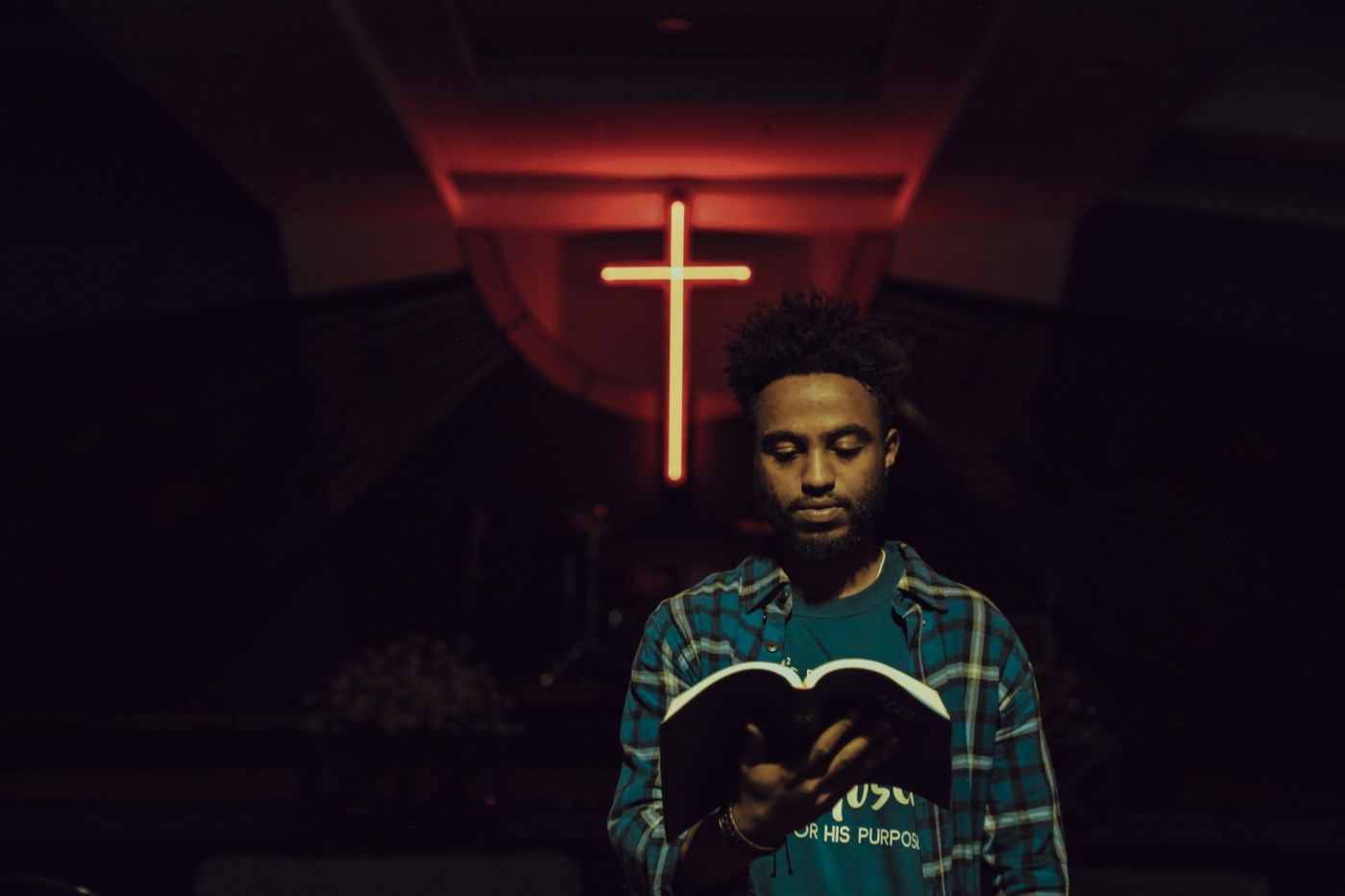
As followers of Jesus, we must always interpret scripture through his lens. A response to God’s Big Picture by Vaughan Roberts, given to West Preston Baptist Church on 12 May 2024. You can also watch it here.
So I was out walking with my fifteen-year-old one dark night, when this guy got out of a car parked in the shadows and made a beeline for us. Naturally I thought, ‘A weirdo, oh help!’ Then a voice said, ‘Ali? Ali, is that you?’ and I realised it was your minister.
He said something like, ‘Wow! What are you doing here? It’s been years! This is so weird. Because I was thinking about you today, I’m planning a new sermon series and you came to mind—I kept thinking you should preach—but I didn’t know where you were living or how to get in touch with you!’ And I said something like, ‘Okay, that’s amazing. Also weird. And, um, just be aware, whatever your series is, I won’t mean to but I’ll probably disrupt it.’
He rolled his eyes and we swapped numbers and went our separate ways. And then my fifteen-year-old said, ‘I’d like to think that was a coincidence but, yeah, probably not.’
Anyway, I had a look at the material, and then I had to tell your minister that yes, I will disrupt the series. But Paul told me that you are a congregation that values relationship over being right, and that you enjoy hearing different points of view. So, given how Paul and I connected in such a surprising way down in Parkville, and given your beautiful and very Baptist priority of relationship over agreement, I trust that the Holy Spirit is in our encounter today. So I am here to offer new relationship and a different point of view, bringing a way of reading the Bible that is a bit different to your current series.
My hope is that it will show you a way of engaging not just with the set texts, but with what lies beneath and beyond. I also hope it might suggest where you might raise an eyebrow and how you might push back, so you too can stand proudly in the great biblical tradition of asking good questions, reflecting on the context of teller, interpreter and audience, unearthing new insights, and telling new God-stories filled with the power of the Spirit.
As for how you receive it? Take it or leave it—it’s up to you. But know that what I offer you, I offer prayerfully and with love, and with the deep conviction that it is faithful to the good news in Jesus Christ. So let’s begin.
I’m not sure if it’s that I have a restless mind or what, but when people tell me that the Bible has a single author, God, I raise an eyebrow. And when they say it has a single narrative arc pointing to Jesus, I think of my Jewish friends and feel doubtful. And when this way of reading happens to justify violence and oppression, I get suspicious. And if it also happens to reinforce the interpreter’s social location, then this suspicion is fanned into a flame. And so suspicion is how I approach God’s Big Picture series, by Vaughan Roberts.
In this series, we are told that the Bible is *one* connected story with *one* author, God. And, we are told, everything in scripture points to Jesus and salvation through him. But if this is true, that is, if all the statements in the Bible are authored by God and point to Jesus, then we must conclude that what happens in Numbers through Chronicles is God-ordained and God-blessed. Even the invasion of the land as described in Joshua. Even the genocide of the local peoples. Even the slaughter of their animals. Apparently, this is all part of a single story and God’s big plan paving the way to Jesus.
What I also notice is that we are told this by a white Anglican priest. Roberts is the rector of a beautiful old church in Oxford, and this church has recently been extended in a very costly award-winning renovation. To state it plainly, both church and rector are part of the Church of England. And the Church of England—a state church—continues to be funded through vast reserves which were accumulated through centuries of slavery and colonisation.
As has been made so clear at the Yoorrook Justice Commission, much of the wealth of the church, both here and abroad, is rooted in stolen land, stolen bodies, stolen labour and stolen resources. And so for me this awareness all sits in the background as Roberts erases the Jewishness of the scriptures, the arguments within scripture, and the effects of colonisation and even genocide on local people.
Of course, we can gloss over all this, and you’d think that I would on Mothers Day. Only, we live in a country where many thousands of children were stolen from their mothers in the name of God and goodness. Many thousands of people still live with the scars of having been torn away from family, culture, language and land. Many thousands of people can’t sleep nights because of the harms they experienced in foster homes or state care, or at the hands of merciless priests. And this was all done in the name of the British Empire, for its expansion and enrichment; and wealth flowed back from the colonies to England to build more beautiful buildings and fatten already overflowing treasuries.
So if Jesus is truly the salvation of the world—and salvation is a word meaning liberation, freedom, and healing—then it’s hard for me to agree with Roberts when he says that the conquest of Canaan was part of God’s plan. Because conquest is the opposite of salvation. Conquest means enslavement, abuse and trauma which flows through the generations. In other words, it creates the very conditions from which people need salvation. And so I profoundly disagree with Roberts, and I think with a little work we can do better.
It’s not that I don’t have faith in Christ Jesus. I deeply trust that in him we will know the liberation, healing and reconciliation of all things. It’s just that I believe we do violence to the text, and to real, actual people, when we try to insist that everything in the Bible is part of God’s plan and points to Jesus.
What do I mean by this? Well, it’s often said that the Bible can be used to prove anything. Take a verse here, and take a verse there, and hey presto! women should be silent in the church and submit to their husbands. But take another couple of verses instead, and ta-da! women are ministers, apostles, and co-workers in the gospel. So which is it? Which way do you go?
Or, to take another example, you can use the Bible to argue that colonisation, even genocide, are biblically sanctioned, which is indeed how many European Christians justified all that happened here. There are sermons equating Aboriginal people with the Canaanites or with the children of Ham, and European Christianity with Israel, and justifying murder, dispossession and erasure on this basis. Alternatively, you can use the Bible to argue that invasion, slavery, murder, and theft are all abominations to God, and that repentance, restitution and justice-making are urgent tasks for the church. Again, which way do you go?
In order to make sense of this chaos, we have to make choices as we read the Bible. Because whenever we claim something is biblical, we are usually ignoring or contradicting something else. The inconvenient reality is that there is no single reading. Instead, every reading is an interpretation.
This doesn’t mean that every reading is equally valid; for followers of Jesus, our interpretations must be guided by him. To be clear, I am not saying that everything in Bible points to Jesus. What I am saying is that we must approach everything in the Bible using Jesus’ own interpretive methods, while praying for the Holy Spirit to guide us.
I find permission to read this way from Jesus himself. In the Emmaus story, two disciples encounter a stranger who opens their minds to the scriptures and sets their hearts burning within them. Eventually they realise they have encountered the Risen Christ. But notice that this stranger who is Christ doesn’t claim that every scripture points to him. Instead, and I quote, ‘Beginning with Moses and all the prophets, he interpreted to them the things *about himself* in all the scriptures.’ (Luke 24:27). Hear that? ‘About himself.’ In other words, there are words in the scriptures which are not about him. As followers of Jesus, we would do well to notice this, and to think about how he and the gospel writers raised up some scriptures, and reinterpreted or even erased others.
To give an example, when Jesus begins his public ministry he goes to the synagogue. There he unrolls the Isaiah scroll and interprets a passage to apply to himself, but edits out the line about the coming day of vengeance (Luke 4:16-20). This sets up both his approach to scripture and to life. It tells us that we, too, are free to interpret scripture as it relates to Jesus, and we, too, are called to a life of nonretaliation and nonviolence.
To give another example of Jesus’ choices and what he left out, not once does he quote from the most violent book of the Bible, the book of Judges; and the only thing he ever thought worth quoting from Leviticus was not the male-to-male gay thing, but the commandment to love.
As his followers, then, we don’t need to insist that every bit of the Bible is equally valid, nor do we need to force every bit of the Bible into proving that Jesus is the messiah. Instead, we are called to bring his interpretive lens to scripture, and to let it guide our reading and our lives.
What does this mean for this unit in the series? I’m not going to address all the content, because Roberts makes his claims by picking out verses here and there drawn from hundreds of pages of scripture; it would be like playing Whac-A-Mole. Instead, I will focus on the conquest of Canaan, approached through the lens of Jesus.
Two weeks ago, you looked at the story of Abram (later Abraham), and how God’s people were called to be a blessing to the world. And yes, they were promised land, but how that comes about is interesting. If you read onwards from Genesis chapter 12, it’s not all sunshine and roses. Even so, you will find stories of negotiation, of treaty, and of purchase; you will find a relatively peaceful settlement.
This week, however, the focus is on selected verses from Numbers through Chronicles, which are used to argue that the conquest of Canaan was all part of God’s plan in establishing God’s kingdom. As I said above, you can use the Bible to prove anything. But if you zoom out from the selected verses and take a look around, things get really interesting.
Abram entered the land with conversation, with negotiation, with treaty: but Joshua takes a different approach. He announces that the land is under a holy curse. Then he declares that all men, all women, all children and all livestock must be slaughtered, and all valuables stolen and added to God’s treasury. In other words, Joshua enters with the extreme violence we now call genocide. And if you were a Canaanite, then Israel doesn’t look much like the blessing to all nations as promised through Abram. Instead, Israel looks like a freaking nightmare.
Go to the land that I will show you, says God to Abram. But will God give it, or must Israel steal it? All peoples on earth will be blessed by you, says God to Abram. But, ‘No mercy,’ says the God we find in Joshua. The land is under a holy curse, and in God’s name everything and everyone must be slaughtered.
So, which is it? To answer this, we look to Jesus: and in Matthew chapter 15, we find a story about Jesus and a mother. This mother is a Canaanite woman. In other words, she is Indigenous. Her people have already experienced invasion and genocide under Joshua; survivors have been shoved to a marginal existence on their own land; her daughter is deeply, deeply disturbed; so she looks to a person with resource to help her. And that person is Jesus.
Jesus, whose name is actually Joshua. That is, we read a Bible which was written by different people over many generations in several languages, and which then passed through other languages to get to us. So Jesus is the English rendition of the Greek version of a Hebrew name which in English is also rendered Joshua. Yeshua – Iesous – Jesus – Joshua: they’re all the same name. And you might like to think it’s a coincidence, but, yeah, probably not.
So in this story, the Canaanite mother reaches out to Joshua-Jesus. ‘Have mercy on me, Lord, Son of David,’ she cries. ‘My daughter is tormented by a demon.’
And he did not answer her at all.
Maybe he was thinking, I’m from one of the oldest families. A son of Abraham, from the tribe of Judah, descended from King David himself, and sharing a name with the great general, Joshua. And maybe he was thinking, this is the promised land: we’ve been here since the beginning. And with that he effectively erased tens of thousands of years of continuous Canaanite culture, and dismissed this woman from his awareness.
But she persisted. And his disciples came and urged him, ‘Send her away, for she keeps shouting after us.’ He replied, ‘I was sent only to the lost sheep of the house of Israel.’ He still wasn’t talking directly to her; perhaps he was confused or even offended by her demand.
For he knew that his namesake had carried out a holy war against people like her. And he knew this had been justified through Torah. As it is written in Deuteronomy: “When the Lord your God brings you into the land you are entering to possess and drives out before you many nations — the Hittites, Girgashites, Amorites, Canaanites, Perizzites, Hivites, and Jebusites, seven nations larger and stronger than you — and when the Lord your God has delivered them over to you and you have defeated them, then you must destroy them totally. Make no treaty with them, and show them no mercy.” (Deuteronomy 7:1-2). End quote.
Hundreds of years earlier, his namesake had tried to fulfil this. Enter, drive out, and destroy the seven nations living in the land; show no mercy. Yet here was this woman, very much alive, forcing herself into his consciousness as she shouted and demanded mercy.
She came and knelt before him, saying, ‘Lord, help me.’
And the reason most scholars think this is a genuine story is that it’s so offensive. We’d prefer Jesus to be infinitely loving, infinitely compassionate, infinitely kind. But perhaps that’s the Jesus at the end of the story: he’s certainly not there yet. Instead, he threw a gut-punch, saying, ‘It’s not fair to take the children’s food and throw it to the dogs.’
In Mark’s version, she’s the Syro-Phoenician woman. The Yorta Yorta woman, perhaps, or the Wurundjeri woman. But Matthew uses what was by then an anachronism: the Canaanite woman. He’s reminding his Jewish audience exactly who she is in their history. Someone who should be driven out, destroyed, shown no mercy. Someone who tempts Israel to forsake their god and go after idols. Someone for whom no true blue Israelite ever has compassion or a kind word. A filthy dog, a contaminating bitch, a louse-ridden scavenger to be avoided at all costs.
She said, ‘Yes, Lord.’ Whatever. ‘But even the dogs eat the crumbs that fall from their master’s table.’ Yes, Master, but who made me a dog? Who took my land, my language, my means of production, my children? Who sets the rules and limits on my life and sends my men to jail even now? Who keeps me poor and dependent, who afflicts my daughter with demons? You’re the master, you have power: just look what you have wrought.
And in that moment, Joshua-Jesus repented, and he healed her daughter. Salvation? It means liberation. It means freedom. And it also means healing: healing for the woman’s daughter, yes, but also maybe for Jesus’ own heart.
Because he changed. He grew in wisdom and generosity, realising his salvation was for all people. For then he stayed in the Gentile region for some time. Great crowds came to him and he lavished God’s healing upon them, and they were amazed and praised the God of Israel. And when he fed the hungry crowd, there were seven baskets left over, signalling the seven gentile nations that Joshua had once sought to destroy.
Earlier, there had been another picnic, with twelve baskets left: one for each tribe of Israel. Shaped by his ancestry, culturally conditioned, My bread is only for Israel, he’d said. Dog, he’d said. Twelve baskets. But changed by his encounter with the Canaanite woman, now he found plenty for everyone.
So, Joshua or Abram? Genocide or treaty? Conquest, or vulnerability? No mercy, or a picnic where there’s bread for all people? Which is the way of Jesus? Which way do you choose?
You can use the Bible to prove anything: but our way must always be Jesus’ way. And so I reject the claim that the conquest of Canaan was all part of God’s plan leading to Jesus’ salvation, because it’s incompatible with the witness of Jesus. Salvation is a word meaning liberation, freedom, and healing: and what we see is that the God made known in Jesus Christ rejects all domination, all enslavement, and all violence. He doesn’t create the conditions from which people need salvation: he is salvation. He doesn’t cause trauma, but heals it.
As for the conquest of Canaan, I would say that the author of Joshua was convinced that it was God’s plan and made these claims, and that it was convenient to building a nation. I would also say that the teller of this story was only one author in a many-authored collection of competing texts; that our interpretations must always be shaped by the life, witness, death and resurrection of Jesus; and that this means seeking the word which is life-giving, loving, nonviolent and above all healing to the most marginalised person in the room. And in our context on Mothers Day, this means stolen children, shattered families, and every person who is a victim-survivor of violence—which all too often means those people who are mothers and wives and girlfriends and daughters.
This, then, is how I read the Bible. Not as a detective novel laced with clues solving the mystery of the messiah. We’re already here, in a church, because we have been convicted of the goodness and grace of a life shaped by dwelling in Christ and being led by his Spirit. We don’t need convincing.
And there’s no single narrative arc, no one theology. Instead, it’s a curated collection of stories, poems, histories, theologies, sermons, proverbs, songs and prayers addressing a wide-ranging series of concerns. It’s diverse, because it was written by passionate people over many generations in different contexts, and this led to differing points of view. And it’s hospitable, because the authors trusted their audience to enter into the conversation and find the readings which are faithful: the readings which bring life, liberation and healing to the most vulnerable; the readings which are a blessing, and make us a blessing, to all peoples.
Joshua justifies violent conquest, and so does the Big Picture series by the very English Vaughan Roberts. But I place my faith in a bigger picture, where through engaging in text and context, seeking the lifegiving reading, and even, like Jesus did with the Canaanite mother, occasionally changing our minds, we will know and encounter the Living Word: and this will liberate and heal us.
So as Jesus’ disciples, let us always always always reject violence, and instead choose dialogue. And let us listen carefully to the stranger and invite them to our table: for all too often it is the stranger—the Indigenous mother, the marginalised person, the victim of terrible violence—who opens our eyes afresh to the scriptures and sets out hearts burning within us.
Let us pray.
God of freedom,
you set before us
the way of life and the way of death,
and you ask us to choose.
At each crossroads, give us clarity.
Help us choose wisely.
Help us choose boldly
the way which leads only to you.
We pray this through our Saviour:
Jesus Christ, Amen. Ω
A response to the God’s Big Picture series by Vaughan Roberts, given to West Preston Baptist Church on 12 May 2024 © Alison Sampson 2024. Photo by Gift Habeshaw on Unsplash. This reflection was prepared on the lands of the Wurundjeri Woi Wurrung people of the Kulin Nation.
 Alison and the whale