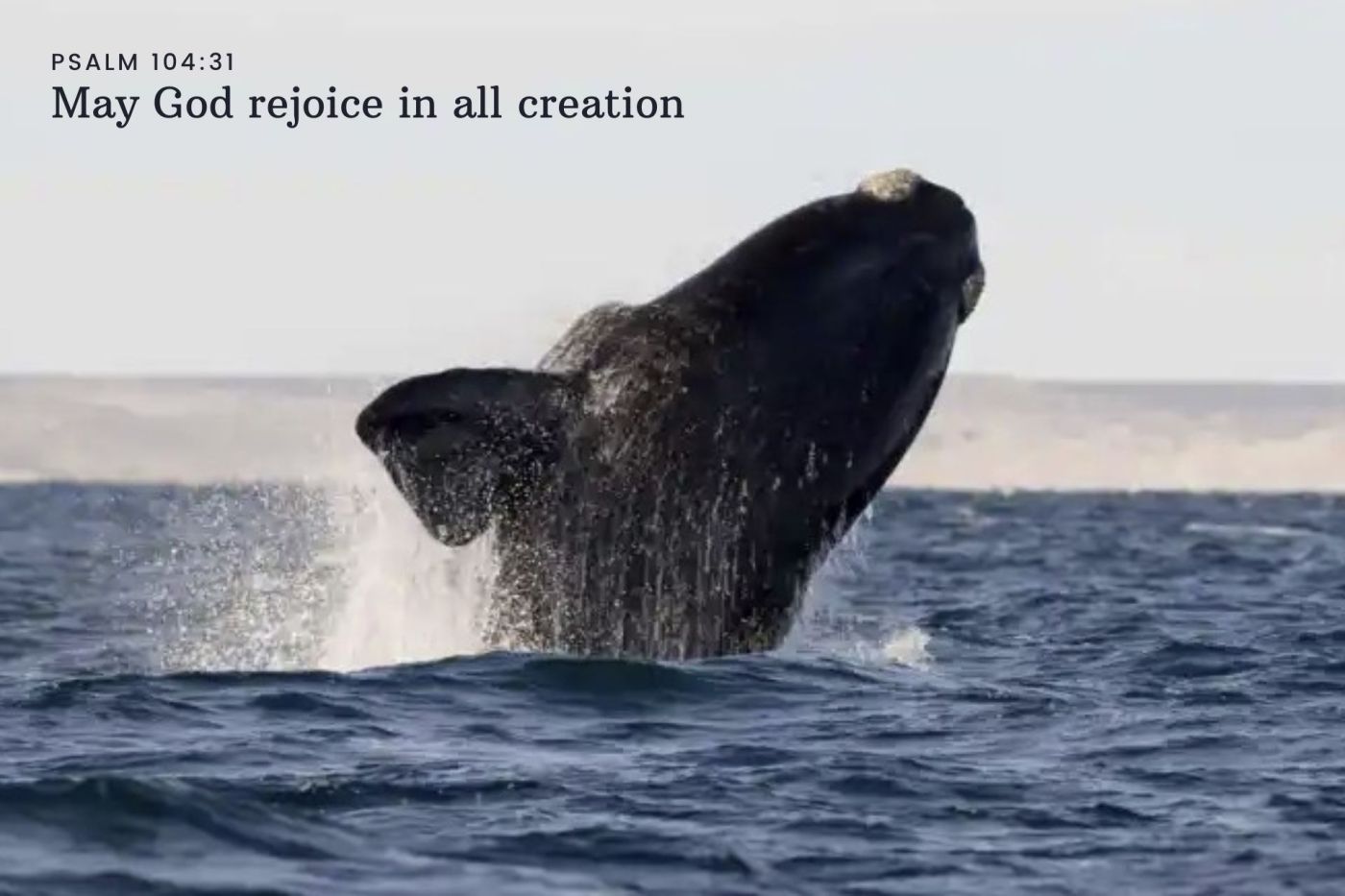
I was walking along the beach path when I noticed it: a vastness, bobbing like a bus doesn’t bob just below the breakers. It was a koontapool, or southern right whale, come to the birthing grounds just off the coast at Warrnambool.
Most years they come, and I have watched them alone and with their calves, rolling, lobtailing, splashing, playing or simply floating below the waves. One breathtaking day, a young calf breached the surface a half dozen, a dozen, two dozen times. I was reminded of my own childhood and long afternoons in a friend’s pool; I would shoot up from the bottom and into the air over and over and over again for sheer joy.
The English called them southern right whales because they were the ‘right’ sort of whale for oil. But when we call them koontapool, from the Gunditjmara languages, we acknowledge that they exist not for what humans can get out of them but for their own sake, on their own terms, and for joy. As the psalmist declares, God creates and delights in koontapool and all creatures. Indeed, God rejoices in all creation. And God has a relationship with earth, sea and sky, and with everything that grows and dies, creeps and leaps, flies and flows and scuttles and swims: and this relationship is not centred on humans.
We are part of creation, certainly; we share the life breath. But we are not the centre; it doesn’t exist for our sake. Instead, according to Genesis we were created for the sake of creation, to tend and to serve it; and, as creatures made in God’s own image, we are called to participate in God’s ongoing work of renewal.
Like all creation, we are also called to praise the god to whom this vast, wild, endlessly interconnected world bears witness. For this world is extraordinary. It is complex. It is beautiful, and it is good. Stars sing; koontapool lobtail; the earth trembles; the hills erupt with joy: and we too are called to join our voices to the planet’s praise. Psalm 104 gives us words to celebrate its goodness, and to name the breath of God which flows between you and me and a young koontapool breaching just off the coast of Warrnambool.
Today is Pentecost: a day to celebrate this breath of God, this Holy Spirit, which gives life to the world and to the church. So take a deep breath. Give thanks. Exhale. And know that every breath you take is the same air which—who knows?—a pterodactyl breathed and a kangaroo puffed and a plane tree sighed just outside the door.
Holy Spirit: Sacred Breath: it’s the source and fullness and song of the planet, it weaves all things together, it fills the earth with life and joy. So with the mountains, the rivers, the koontapool and the psalmist, let us look to the Creator and sing Hallelujah! And let us bless God’s name.
PREPARE: Make yourself comfortable. Uncross your legs; relax your body; uncomplicate your heart. Ask God to help you surrender to whatever it is that God wants to do in you or say to you today. Breathe slowly and deeply in, then out.
2. READ: Read the following passage aloud at least three times through, slowly. Listen carefully. Notice anything which captures your attention.
O God, how manifold are your works!
In wisdom you have made them all:
the earth is full of your creatures.
Yonder is the great and wide sea,
with its living things too many to number,
creatures both small and great.
There move the ships,
and there is that Leviathan which you made for sport.
All of them look to you,
to give them their food in due season.
You give it to them; they gather it;
you open your hand, and they are filled with good things.
Hide your face, and they are terrified;
you take away their breath, and they die,
returning to dust.
Send forth your Spirit, and they are created,
and you renew the face of the earth.
May the glory of God endure forever;
may God rejoice in all works.
God looks at the earth and it trembles;
God touches the mountains and they smoke.
I will sing to God as long as I live;
I will praise my God while I have breath.
May these words of mine be pleasing;
I will rejoice in God.
Let sinners be consumed out of the earth,
and the wicked be no more.
Bless God, O my soul.
Hallelujah! (Psalm 104:25-34)
3. REFLECT: Allow a word, phrase or image to speak to you. What do you notice? What emotions do you feel? What questions are bubbling up? Reflect in silence.
4. RELATE: Now wonder: What does this text say about God, people, the earth and prayer? Does this uphold, challenge or disrupt any of your attitudes or expectations? Does it change your understanding of sin? When have you felt connected with the life-breath of another living being? How do you participate in God’s work of renewal? What do you praise God for today?
5. RESPOND: What is God calling you to now? Pray about this, and tell God about anything which is emerging. If you feel called to action, ask God to show you the next step.
6. REST: When you feel ‘done’, rest awhile. Savour the conversation you are having with God, and God’s loving presence. Close with a gesture of thanks: perhaps a simple bow. As you prepare to leave this space, if any word, phrase or image persists, let it guide you. Or if nothing in particular arises, remember this:
- I will praise God while I have breath …
Recently I was fascinated to learn that, when a whale dies, it sinks to the ocean floor. The whalefall becomes habitat for countless sea creatures. The flesh is stripped by sleeper sharks, hagfish, rattails and other scavengers. The bone marrow is consumed by shrimp and sea worms. Finally, the fats in the bones are broken down by great blooms of bacteria, and tiny clams, and creatures with wild names like the bone-eating snot flower. The whole process takes about a hundred years. But sometimes, in the deep ocean, the bones go through a fourth stage: they become a reef for suspension feeders. One such reef has been dated at over 10,000 years old. Indeed, the world is wonderful, wild and intricately connected not only in life, but in death.
Shalom,
Alison
Reflection on Psalm 104:24-34 prepared for Flemington Ark / Essendon Baptist for 12 May 2024 © Alison Sampson, 2024. Photo shows a koontapool breaching off the coast at Warrnambool. I learned about whalefall from My Life in Sea Creatures, by Sabrina Imbler, a strange and moving and very beautiful book.
 Alison and the whale