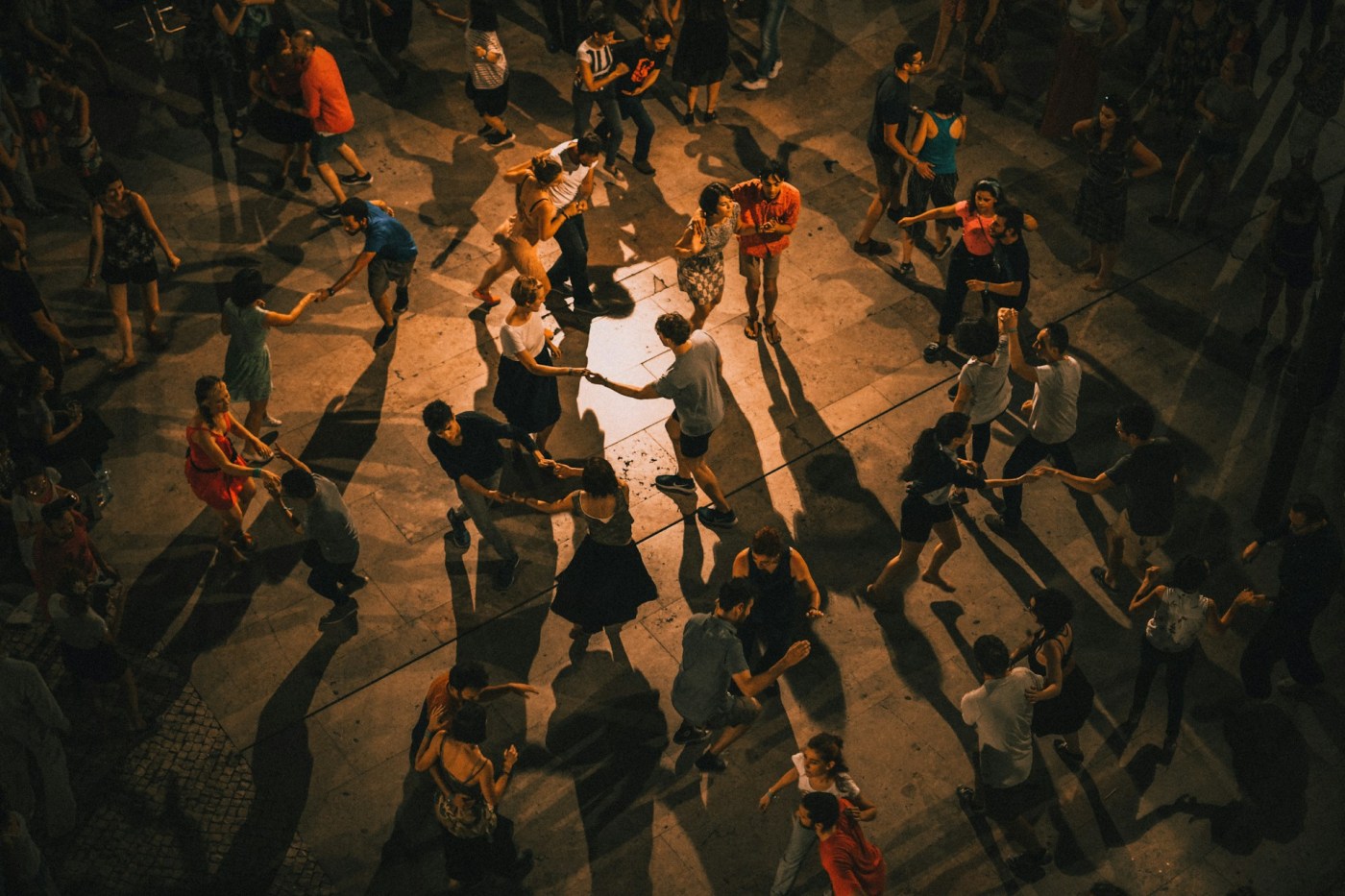
The dance of the liturgy heals and transforms us: but to receive its gifts, we must participate. Listen here.
One of my happiest childhood memories were church barn dances. Once or twice a year on a Saturday night, we’d gather in the hall with a dance caller and bush band, and off we’d go with a do-se-do and twirl your partner! People of all ages skipped and galloped, wove and spun, stumbling and laughing and moving down the reel.
Towering blokes swung little kids around; teenagers dominated the Nutbush; and the oldest folk clapped along from the sidelines. It was the peasant version of what you might see in Pride & Prejudice or, god forbid, Bridgerton: it was crowded, chaotic, joyful. Some of us were wonderful dancers, most of us were not. It didn’t matter. The dance held us all.
At the end of the night, a magnificent supper would be laid out, and we’d eat and drink together, and laugh some more. Then dozing toddlers and yawning children would be carried to waiting cars. Adults would stand in the street, chatting for just a few more minutes, then eventually, we’d all head home.
In today’s story, we hear of another dance troupe: the people of Israel and their new king, David. It had been a tough few years for David. He’d been living as a fugitive from the wildly jealous and fearful Saul while engaging in guerrilla warfare. His beloved Jonathan, with whom he had had a covenant relationship and a love surpassing that of men and women (or so the Bible says), had been killed in battle. One of his wayward generals had slaughtered an unarmed peace broker from a rival faction, leading to retributive violence. Peace was temporary and elusive, and David’s heart was heavy indeed.
Yet here we find him, newly established as king, at the head of a procession. He is dressed in the finest priestly garments, and he is dancing and shouting mightily before the Lord. He and the whole house of Israel are bringing the ark of God to Jerusalem in an exuberant liturgical parade. Some people are playing instruments, like the Karen youth band here. Some are carrying the ark and others are leading animals for sacrifice, just as people arrived before the service this morning bringing various liturgical supplies. David himself is doing priestly work.
This work takes several forms. Back when he was on the run, David had spent time with Samuel and the prophets of Ramah. When God’s Spirit fell upon them, we are told, these prophets would enter ecstatic frenzies and speak God’s word. And so when David is dancing mightily and shouting to the Lord, we should understand it as a prophetic preaching act: David is communicating between God and the people.
When they arrive in Jerusalem, David continues with the priestly work. He makes offerings for atonement of sin, a bit like Tim’s prayers of confession and absolution just now; and he makes offerings for the well-being of the people. He blesses the people in the name of God, as we do at the end of every service; he distributes food to the whole multitude, as happens here each week through the food rescue program; then he sends everyone home.
I hope you can hear the echoes of the Sunday service. Indeed, David’s procession, Box Hill Baptist barn dances, and group dancing in general are powerful metaphors for public worship. Because, like worship, corporate dance is not about individual egos, but about people emptying themselves and letting the spirit fill them. It’s not about performance, but participation. It’s not about limitations, but about responding to and embracing the possibilities. It’s not about brains in vats, but about bodies, minds and spirits working together in harmony. We arrive as individuals, but through the shared rhythms and practices we yield ourselves to the spirit of the group and are formed into one body. And when our dance is worship, this body is the body of Christ.
But for us to receive these gifts of the dance, and to be filled with a bigger, bolder, more generous spirit than our own, we need to show up. We need to place our own body among other bodies and be open to the Spirit. Because even when it’s deeply thoughtful and intellectually rich, worship is not all about thinking. It’s not like going to maths class, learning the information, then swotting for an exam.
Instead, worship is about wholeheartedly engaging in the practices where Christ has promised to be present. For Baptists, this means joining together to grapple with the Word and its implications for our current moment, and eating together at the Table, whether communion, your community meal, or sharing food at home. For Jesus has promised to be present whenever we do these things in his name; and his Spirit will be with us, unite us, transform us, and make us whole.
Of course, we’re not always up for this. The story tells us that David served ‘the whole multitude of Israel, both men and women’—then he went home to his wife. This leads me to two observations.
First, we are talking metaphors here. We are not talking about the modern nation state that is Israel nor its current leaders or horrific politics. Nor are we venerating David. There are parts of David’s story which are inspiring and which show a wholehearted, passionate engagement in God. There are other parts of his story where he uses his power to dominate, engaging in sexual abuse, murderous cover ups, sickening brutality and even genocide. He’s the sort of man who, when ordered to bring the foreskins of 100 Philistines as a bride price, brings 200 and spills them proudly on the palace floor. Followers of Jesus, who loves and forgives even those who betrayed and killed him, can never condone such violence.
We can, however, be inspired by David’s passion for God. And we can enter into the metaphor of today’s story, where we see David using his power to bring together and serve the whole multitude of Israel. But we worship the one who emptied himself of power and gave his life away to bring together and serve the whole world, even Philistines. We worship Jesus, who has a particular heart for victims of other people’s violence.
This brings me to David’s wife, Michal. Another sermon might talk about her marriages, and how she was used and abused by powerful men for their political gain. But today, we are focusing on the metaphor of how worship is like corporate dance. Today, we are noticing that she did not come out to be with the multitudes; she wasn’t with the rest of Israel joining in the parade. Instead, she watched from her window, filled with scorn for David’s enthusiasm and for the ways he revealed himself to the crowd.
Thinking back to the Box Hill Baptist barn dances, I am sure there were people who, like Michal, stayed home or sat on the sidelines, unwilling to risk the folly of the dance. I am sure there were those who were deeply scornful then, and that there are those who are scornful of us gathered here today. I mean, what are we even doing here, singing and praying and wondering about Scripture? To all the people having a nice lie in or walking the dog or enjoying brunch in a café with friends, how foolish we must seem!
Indeed, to join the dance is to give up your dignity and self-importance. It’s to hear music you don’t choose and sometimes don’t even like. It’s to entrust yourself to dance steps set down by other people. It’s to bend and turn in response to others, rather than moving always to rhythms of your own. It’s to participate even when you have no skill; it’s to trust that you’ll learn by doing; and it’s to risk looking foolish, even contemptible, to scornful judgemental eyes.
And sometimes this makes participation feel impossible. I know this all too well, because as a highly anxious awkward person I have often sat on the sidelines. Too many times, I have been so full of myself and my fears and failings, so self-conscious, so afraid that I am unworthy, that I have refused to join the dance. Instead, I have sneered from the sidelines, nursing my resentful, barren, shrivelled little heart.
So I am grateful for the remembered joy of church barn dances. I am grateful for the ways that God has kept yanking me into other dances, and drawn me beyond myself. And I am grateful for the many moments of formation, connection and even transcendence I have experienced through sharing with people in Word and Table, song and prayer, in this and many other churches. Because even though at times it can all seem very foolish, joining the dance that is corporate worship has been profoundly healing for me. It has gradually turned my heart of stone into warm beating flesh, and brought me to a profound sense of communion with people and with God.
But that’s enough words for now. The best way to understand a metaphor is not to talk about it, but to enter into it, bodies and all. So as the service draws to a close, and before we eat and drink together in the hall, I will invite you to stand with me and join with me in a dance. It will be playful. It will be slightly embarrassing. And it will be fun. Tim and I have chosen a dance which you all know, one which, like worship, you can all participate in and which will help us bridge the many cultures and ages and stages in this room.
When we come to it, I hope you will not make my mistake. I hope you will bring the fullness of yourself—your body, mind and spirit, your two left feet, your capacity for play and joy and laughter, and so much more. I hope you will bring it all to your worship of God, and join us in the dance. But first, let us pray:
Lord of the Dance,
help us to live wholeheartedly in your sight.
Help us to celebrate the good with everything we have;
may we never be ashamed of our faith.
Set our feet dancing to the rhythms of the Spirit
and fill our hearts with song,
as we take our place in your sacred dance.
In the name of Christ, we pray: Amen. Ω
PS – What dance did everybody know? The hokey-pokey, of course! And EVERYONE in the room got up and danced. Yee haw!
Reflect: What blocks you from joining the dance? Tell God about it; then imagine Jesus’ hand stretched out towards you, inviting you to dance with him.
A reflection on 2 Samuel 6:1-5, 14-22 given to Westgate Baptist Community Church on 14 July 2024 (Year B Proper 10) © Alison Sampson 2024. Photo by Ardian Lumi on Unsplash. This reflection was prepared on the lands of the Wurundjeri Woi Wurrung people of the Kulin Nation.
 Alison and the whale