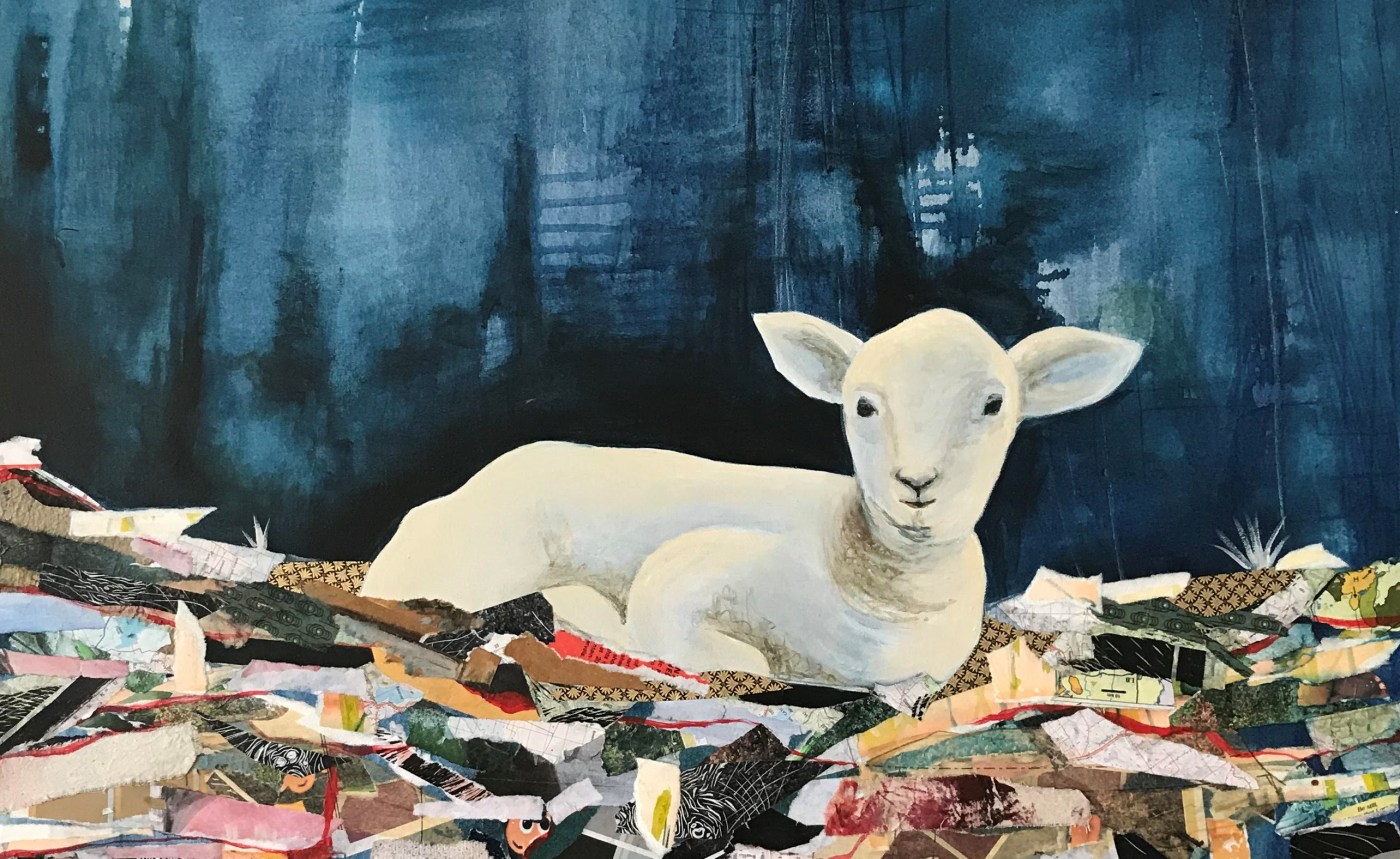
Revelation can be read to judge and exclude … but what if it’s not like that at all? Listen here. A reflection on Revelation 6:1-8:1 given to the Vietnamese Evangelical Church of Australia (English language service) on 28 July 2024.
A couple years ago, I met a young woman on a train. I was quietly reading my Bible, trying to be discreet, but she noticed and began asking questions. Gradually our conversation unfolded, and what I learned was this: She was South Sudanese. Her family had fled that long and terrible war, and eventually found asylum in Australia.
We began talking about the Covid lockdowns in Melbourne and how distressing they were. ‘Yes,’ she said, ‘the army came in their jeeps. They parked on our street, and knocked on every door in our suburb, and made sure we all stayed home. We’re all refugees there. We know what soldiers do. We were absolutely terrified.’
My heart sank. There had been no jeeps in my father’s suburb, no door-knocking. The matrons of Camberwell hadn’t had soldiers in khaki ordering them to stay home.
But another friend had been at the public housing towers in Flemington when the police had shut them down. The residents had been given no warning that it was going to happen; many people living there had little to no food in their flat. After an outcry, groceries were eventually brought in, but it was charity food: low quality, culturally inappropriate, out-of-date, not even halal.
And I reflected that families in Brighton hadn’t had the police stationed in the street while food diverted from the waste stream was delivered to their door. Instead they had isolated in their spacious homes with their secure salaries and tennis courts and streaming services and ‘all the oil and wine they wanted’, to paraphrase Revelation 6:4. Meanwhile inflation went up and casual workers scrambled, locked down in public housing towers and unable to work, or doing risky jobs and struggling in a tanking economy just to buy wheat in the form of bread.
Why am I telling you all this? Because they are examples of how empire works, and critique of empire is at the heart of John’s Revelation.
Last time I was here, I introduced you to Malachi. I explained that behind the prophecy is one of the big themes in the biblical story: and this is the theme of empire. I also explained that the Bible is full of stories about Israel being invaded by empire, being sent into exile by empire, being enslaved by empire, and being shaped by empire; and that it’s full of preachers and prophets urging the people to resist the empire’s culture, economics and lies.
Malachi was one such prophet, working when Persia dominated the landscape: and he was urging the people to engage in right worship and place their deepest trust in God. Now we’re reading Revelation, which was written by John of Patmos when Rome was in power. But funnily enough, like Malachi John is also urging the people to engage in right worship and to place their deepest trust in God. Only John approaches it a bit differently. Where Malachi came at it head on, telling us directly that our worship was rubbish and that God was most displeased, John uses the old ‘bait-and-switch’ to reveal a God who is so much better than the emperor: a God who is truly worthy of worship.
Maybe you’re wondering, what on earth is bait-and switch? But you know the method. You see an advertisement for a new smartphone, and you notice it’s incredibly cheap. You think, ‘Wow! And my phone’s so old, it keeps freezing and crashing, the camera’s rubbish and I’ve cracked the screen … I think it’s time for an upgrade.’ So you count your dollars then you go to get the phone. But when you get there, you’re told that actually the last one of that model has just been sold, but there’s another model available and it’s only this much. Or maybe the one you want is available, but it turns out that it comes with a mandatory phone plan. One way or another, you do the maths and you realise what they’re offering is not really a bargain at all. But you’ve already decided to upgrade your phone so you think, ‘That’s incredibly annoying but, oh well, whatever,’ and then you get the different model.
So the bait was the advertisement for one model, then they switched it out for something lower in quality or more expensive. And because you were already hooked on the idea of a new phone, you went ahead. You thought you were getting one thing, but actually you ended up with something else.
Bait-and-switch is how John structures Revelation. Again and again, he gives us an image and we think it’s about God. ‘Yes,’ we think, ‘God’s just like this. Oh help!’ Then we turn the page and discover that God is different. But unlike the feelings of frustration and disappointment we experience with the switched out smartphone, we should be feeling relief, even joy. Because John’s doing the opposite of every advertiser ever. Rather than raising our expectations then disappointing us, he reveals to us how awful our expectations really are, then shows us a God who is so much better than we think. It’s like expecting a Nokia dumb phone, but instead receiving an iPhone 15 plus a Macbook Pro thrown in, with free lifetime calls, text and internet.
What do I mean by this? Well, last week you looked at chapter 5. ‘Who can break open the scroll?’ asks an angel. John then baits us with a line from an Elder: ‘The lion,’ he says, because we expect the Lion of Judah will be able to do everything. The lion is a fierce, powerful, carnivorous beast, a metaphor for a violent warlord of a king, and exactly the type of person we assume will be given power and authority.
But what happens? John turns: and in place of the powerful Lion we expect he switches a little Lamb. Even more shocking, it’s been murdered, and it’s not even on the throne. So we learn that it is not a violent king but the nonviolent Lamb, the one who gives his life for the sake of love, who is worthy to open the scroll. Then all creation begins to sing because, unlike the Lion, the Lamb is truly worthy of worship—and God is so much better than we think!
Now, in chapters 6 and 7, we watch this Lamb who is worthy ripping open the scroll, seal by seal by seal. And again and again, John baits us. Seal by seal, he gives us images of empire which we associate with God. We think military, money and medicine will save us. Then, when it all fails, we expect judgement, punishment, suffering, even death, and we attribute this all to God. But if we pay attention, John might have a switch or two up his sleeve. So let’s watch him at his game.
The first seal is ripped open—rrrrip!—and we see a white horse with a rider carrying a bow; he gallops away to conquer. ‘Ah,’ we think, ‘God is conquering the earth through violence!’ because that’s how empire works and that’s what we’re trained to think. But if we pause a moment, we might remember that the God we encounter in scripture turns away from violence. In the story of Noah and the ark, the grand finale occurs when God sets a giant bow over the earth. And it’s pointed away from the earth as a sign and a promise that God will never use violence again.
John was writing at the time of Rome, whose army dominated a vast region of the earth for centuries. But they didn’t use mounted archers. Instead, they moved in huge mass troop formations. It was the Parthians who used mounted archers, and they are the only tribe who managed to deflect Rome from invading their territory.
They didn’t invade Rome; however, they did manage to block Rome from invading them. But rather than copying Rome’s tactics only to be crushed by its greater army, they used archers who rode white-ish horses. These riders made small surgical strikes by galloping in and picking off army outposts and other outliers. They were tactical warriors, and they did this often enough and annoyingly enough that eventually Rome retreated. Just like, say, guerrilla warfare in a jungle might be so effective that eventually a vastly bigger, wealthier and more powerful army might be forced to withdraw.
So this first rider is not an image of God’s soldiers coming to get us. Instead, it’s a critique of Roman military power. It’s telling us that even the most powerful armies are vulnerable: so don’t place your faith in them.
It’s a lot for only one image: and now—rrrrip!—the Lamb opens the second seal. Another horse appears, this one red. Its rider is given a great sword, and gallops off to take peace from the earth so that the people would slaughter one another.
It’s a curious phrase. We usually assume the rider is killing everyone, thanks to the sword. Yet way back in Revelation 1, another sword was mentioned. It wasn’t in a hand, but came from the mouth of the One who is first and last, who died and is now alive. In other words, the sword is the Word of God, and the Word, we know, speaks truth and peace. If we remember this, then we might wonder if this rider’s sword is also God’s Word, and then we might notice that it’s not the rider doing the killing. The people are slaughtering one another. So what’s going on?
Like the Persian Empire we encountered through Malachi, the Roman Empire established ‘peace’ through violence. It invaded, it slaughtered, it dominated. Once absolute control was achieved, local leaders were lined up and forced to bow down to the Emperor or his representatives. Then, as long as the conquered territory remained completely submissive, ‘peace’ was maintained.
Pax Romana, it was called: and it was a false peace. It was the sort of peace where the bodies of crucified people lined the highways as a warning to others to keep your head down, say nothing, submit to every indignity and every form of violence. It was the sort of peace achieved when people are disappeared, as happened in Argentina’s Dirty War; or dismembered, as happens to those who resist drug lords in Colombia now. At a less extreme level, it’s also the obedience to Covid lockdowns achieved when the army patrols the streets, or the police barricade the building. The people isolate not through neighbourly concern, self-control or choice, but in response to terror and the threat of force.
The second rider removes this false peace. Through the Word of God, he takes away the power of the forces which ensure our terrified submission. And because we refuse to learn how to build true peace, when the false peace is removed all hell breaks loose. It’s terrifying, but it’s not telling us about the nature of God. Instead, it’s a revelation about the inability of violence to create true peace, and our unwillingness to practice God’s peace.
Rrrrip! The Lamb tears through the third seal, and out comes another rider. This one is on a black horse, and its rider carries scales. ‘A quart of wheat for a day’s wages, or three quarts of barley, but all the oil and wine you want,’ we hear, and with these strange words we’re back to the lockdowns. The scales and words are telling us that the rich can always get their luxuries, even when the poor are scrambling for the basics. And I blush, because it confronts me with my own wealth. In iso, I enjoyed oil and wine, while people in the Flemington towers were scrambling to get rice and bread.
Taking this back to John’s time, Rome’s wealth was unprecedented. Luxuries like oil, wine, even fish, were carted all over the empire on the beautiful straight roads built by slave labour. But this wealth wasn’t equally distributed. For example, fishermen couldn’t afford to eat fish. Why? All fish was considered the property of the empire. It was so heavily taxed, only the rich could afford it. In fact, a fish breakfast on the banks of Lake Galilee was a declaration of freedom from empire: an act of nonviolent resistance which broke the law.
So the image of a rider with scales is a reminder that economic prosperity has winners and losers. The empire makes some people rich while everyone else struggles, and just one little disruption, one little virus let’s say, can cause the whole economic system to crack.
Rrrrip!—the Lamb opens the fourth seal. This time it’s a sickly horse, and its rider is Thanatos, or Death. It has the power to kill a quarter of everyone, which sounds unbelievably awful until you remember that smallpox kills a third of its victims, and H5N1 bird flu kills half. In this age of antibiotics, we mostly struggle to imagine these sorts of death rates, although Indigenous Australians can tell you a thing or two about mass death by imported viruses.
But the point is not the death rate. Instead the image reminds us that, one way or another, whether through war, famine, disease, or even wild beasts, we all die: and there is nothing that anyone can do about it. We can own all the possessions, we can become famous celebrities, we can pour resources into wellness, special diets and bio-hacking. It doesn’t matter. Eventually every single one of us will die, and not even the emperor can escape.
But nothing in the text says that death is a punishment from God. Instead, like the previous three horseman, this image critiques our false reliances. We trust military, money, and medicine to protect us, but the only thing that can truly save us is God.
So these riders and horsemen are all bait. We think they’re telling us what God is like. Fierce. Violent. Punishing. But no. Instead, they’re revealing our false reliances, and they’re showing that we have internalised a vicious image of God. We’ve confused God and the emperor, and so we expect suffering and death at God’s hands. But while we’re thinking about this, and wondering about the nature of God and salvation—rrrrip!—the Lamb opens the fifth seal. And this time, we see martyrs, those who were killed because of their witness to the Word of God.
And maybe John is baiting us again: because the martyrs are crying out for vengeance. They died in witness to the Word of God, yet they are baying for blood. If we believe that God is the Lion, a violent warlord of a king, we know what will happen next. We’ll be adding our prayers to the prayers of the martyrs and cheering as vengeance is hurled upon the earth … and maybe next week you’ll discover the awful consequences when those prayers are answered, and you’ll see how ultimately ineffective those consequences are.
But instead, in this moment, we pause. For now, there is no vengeance. For now, every martyr is simply given a white robe to wear and is told to wait. And in the waiting space—rrrrip!—the Lamb tears off the sixth seal and creation is unmade.
The earth shakes, the sky turns black, the moon blood-red and stars fall from the sky. And whether John is referring to actual planetary bodies, or to symbols of the emperor and his powers, either way it’s absolutely terrifying. Everyone everywhere, commoner and king, runs to hide. ‘The day of wrath has come—who can stand it?’ they ask, attributing the wrath to God and the Lamb.
The four horsemen have showed us what we really trust in and expect, and it’s awful. Now this final image shows us attributing the catastrophic unmaking of creation to the one on the throne and the Lamb. Our illusions are laid bare. Our military, our money and our medicine won’t save us. Those who witness to the Word receive no special protections, but can be murdered for their efforts. And now we suspect that God and the Lamb are out to destroy us and the earth and everything we love? It’s absolutely devastating, beyond hope.
Again and again, people want a Lion. A ruler like Netanyahu, perhaps, or Putin or Trump: men who claim to protect people from what they’re afraid of; men who avenge every injury, whether real or imagined, in God’s name. But the horsemen reveal that when we place our trust in the Lion, our lives are controlled, our freedoms disappear, our safety becomes an illusion, our bellies are empty, and our loved ones die anyway. All our hopes crumble into dust, and now we fear God’s wrath. Who can stand it, indeed? But just when we can no longer bear these images, John finally moves towards the switch. We thought things were beyond redemption, but now an angel ascends from the sunrise, carrying another seal.
What seal is this? It’s the seal of the Living God. And this suggests something interesting. Perhaps the previous seals were not God’s. Perhaps nothing is as it seems. Because in the midst of all this death and destruction, a voice like thunder tells them to stop. ‘Don’t touch the earth! Don’t touch the ocean! Don’t even touch a tree until I’ve sealed the servants of God on their foreheads!’
It’s a hint, a whisper, a little breeze of relief. Maybe the earth will survive. Maybe some people will be saved, after all. And I’m right back on the train with my friend. Remember her? The South Sudanese woman who told me about her experience of lockdown. Our conversation on the train continued. She told me that she had become a Seventh Day Adventist, and she had been taught that 144,000 people would be saved from the destruction of the earth and from God’s wrath. It’s the number we find here in Revelation chapter 7.
‘144,000,’ she said. ‘It’s not very many, is it?’ Suddenly anxious, she said, ‘I probably won’t even get in.’ And for her, that meant endless torment. After all she had suffered already, what with warfare and refugee camps and waiting and longing for safety, what with visas and resettlement and poverty and intergenerational trauma and the Australian army banging on the door, her faith gave her just a teeny-tiny shred of hope. 144,000. Maybe she’d get in. Maybe not. Maybe her suffering would continue after death into eternity.
And if God is small, mean, and exclusive, maybe this is all she or any of us can ever hope for. If God is as grabby as the emperor, and as stingy in his favours, then our hope is teeny-tiny indeed. But if God is not like the emperor, and if the methods and economics of Rome cannot save us, if this is indeed what the four horsemen have been telling us, then maybe even this teeny-tiny whisper of relief is a little wriggly worm, just bait.
Pausing, we hear John’s voice: ‘And I looked again,’ says John … could this be a switch? ‘I looked again,’ says John, ‘and I saw a huge crowd, too huge to count.
‘Everyone was there—all nations and tribes, all races and languages. And they were standing, dressed in white robes and waving palm branches … singing Salvation! Hosanna!’
144,000? It’s just bait. It shows us the smallness of our hopes, the meanness of our hearts, a worldview conditioned by the emperor. But if we turn with John we will see a huge crowd, too many to count, God’s grace too generous to be measured. And we will realise that God is infinitely good, even in the face of our failings, even when we worship the wrong things, even when we don’t understand, even when we foolishly cry out for vengeance in the name of a nonviolent God.
Because salvation belongs to the Lamb who was murdered. Salvation belongs to the one who refuses retaliation and whose only experience of violence is in the suffering of it. Salvation belongs to the one who gives his life for the sake of others, and for the sake of a world of love. And because of this endless abundant overflowing love, this goodness, this grace, this generosity, the apocalypse is cancelled. God is too big, too gracious, too loving, too involved, to destroy the good earth and the people whom God so adores.
If you listen with your heart, you’ll hear angel choirs singing, and Sudanese women ululating, and Vietnamese men setting off firecrackers in celebration. You’ll hear Argentinian grandmothers at family reunions weeping for joy, and Colombians shouting ‘Peace! Hallelujah!’ You’ll hear a great roar like a finals crowd, but there are no losers here: everybody is welcomed into the party. Because we are all part of this scene, we are all swept up into God’s salvation, and not one person is left out. The whole universe rejoices in song and celebration, praising the goodness and greatness of God. And in the big reveal of the only God worth worshipping, I say: 144,000? That’s small potatoes. If you think that’s as good as it gets, your God is waaaay too small.
So to the woman from South Sudan who has intimately known hunger and thirst and desert heat and violence and the loss of far too many loved ones, to the one who has known soldiers charging into her hometown and soldiers hammering on her door here in Melbourne, to the one who is terrified that she won’t make God’s cut, I say: Hear the good news according to John: There will be plenty of room for you and all your loved ones, both living and dead, and me and my people and everyone on this train and everyone in the church and everyone on the face of the earth. We shall all know the salvation of the Lamb, who is too good and too loving to leave anyone out.
And in the dwelling of the Lamb, described in Revelation 7, there will be no more hunger, no more thirst, no more scorching heat. The Lamb will shepherd us and lead us to springs of the water of Life, and God will wipe every last tear from our eyes. With the Lamb at our side we will have food, water, shelter, comfort: the overflowing evidence of love.
Rrrrip!—the Lamb removes the seventh seal. No arguments. Not even a word. What’s left is only awe in the face of such generosity and gentleness, such goodness, such grace. With heaven, then, let us fall into reverent silence.
.
.
.
.
.
To the one who is and was and moves among us now, the nonviolent Lamb and the only God worth worshipping: ‘Blessing and glory and wisdom and thanksgiving and honour and power and strength be to our God forever and ever, Amen.’ Ω
Reflect: What is your relationship with Revelation? Do you usually think of it as good news? Why or why not? How does the witness of Jesus inform (or not) your reading of the text?
A reflection on Revelation 6:1-8:1 given to the Vietnamese Evangelical Church of Australia (English language service) on 28 July 2024 © Alison Sampson 2024. Painting by Rachel Peters (detail). This reflection was prepared on the lands of the Wurundjeri Woi Wurrung people of the Kulin Nation.
 Alison and the whale