A friend encouraged me to re-preach an oldie, but you can never quite do the same thing twice. So here’s the oldie, changed to reflect recent news events and some fresh weirdness in my life. Listen here. Given to Coburg Uniting Church on 8 September 2024.
‘If you don’t raise your voice, it is unlikely that anyone will hear you,’ wrote Malala, the Afghani girl who was shot by the Taliban simply for going to school. Yet last month, the women of Afghanistan had their voices completely silenced. ‘They must not sing or read aloud in public, nor let their voices carry beyond the walls of their homes,’ reports The Guardian. Why? Because every woman’s voice is now deemed to be ‘a potential instrument of vice.’
Of course, since many Afghanis live in ramshackle houses all crammed together in the street, this means very many women will no longer be able to speak above a whisper. Ever. The consequences of being heard are both undescribed and terrible: to be detained and punished in a manner deemed appropriate by Taliban officials.
As a person who has found her life’s work and deep joy in preaching, writing and speaking in public, and who to her children’s chagrin absentmindedly sings in the street, I find this news difficult even to report. I cannot imagine how to live without speech, how to guard myself so I don’t accidentally break out with a do-re-mi, or how to take the risks some ferociously brave Afghani women are taking, recording themselves on TikTok singing freedom songs.
What I do know is that I recently interviewed for a job where, it turned out, there would be no opportunity for me to speak. The role was for pastoral care and worship but, I soon discovered, there was a catch or maybe three. One, no preaching. Other people would do that. Two, no actual curating or leading worship. Instead I was to encourage others to ‘express their unique selves’ in worship, rather than give voice to the church as a whole. And three, the church was preparing a statement on one significant issue, that is, institutional responses to child sexual abuse. This was great, except that they had then taken a decision to NOT engage with any other issue, specifically queerness, colonialism or climate, for the next two years. The conditions made me feel suffocated, gagged; I wondered if I could operate with any integrity under such constraints.
While I was wondering, the Holy Spirit got to work. I say this because, quite unprompted and in a dozen different ways, over the next week a bunch of friends and strangers got in touch; each one of them gave thanks for and encouraged my speech. One of those people was your own minister, Ronnie. He’s a man I’ve never met yet he texted me out of the blue to ask if I would preach this Sunday. When I opened my Bible to see what the readings were, I burst out laughing: because they were all about speech. A Syro-Phoenician woman teaching. A silenced man finding his voice. A desert singing, a directive to encourage the faltering of heart, a promise of God’s healing through speech.
Of course, as an opinionated woman who speaks in public I am not always affirmed. My voice may not be deemed ‘an instrument of vice,’ but it is certainly not always welcome. Many churches, even entire denominations, do not permit people such as myself to preach, even though the New Testament describes us as ministers, leaders and co-workers in the gospel.
Indeed, a preaching woman enrages many. Years ago, I turned off the comments on my blog because people weren’t engaging with the themes; they were just calling me names. Sometimes, I’m a heretic. Sometimes, I’m a wolf in sheep’s clothing. Sometimes, I’m a bitch. These comments, especially the bitch ones, are designed to slap, silence and shame me. They tell me the speaker doesn’t see me as fully human; they want me to shut up and stay home, no doubt barefoot, pregnant and in the kitchen.
I’d dismiss it all as patriarchal tediousness, just insecure people’s attempts to shame and control, except that this desire to silence women is on a continuum. It doesn’t matter whether it’s name-calling on social media or the blanket rejection of women’s ministry or the arrest, rape, torture and death of any woman heard in public: it’s all the same urge. Indeed, a shockingly high proportion of men, including nearly a third of men in Australia, believe it’s okay to silence a woman using violence.
I also take note of what people call me because of today’s story, in which Jesus calls a woman a dog. Sure, he was tired; he needed a break; he didn’t want to be disturbed. So when she burst into the house demanding healing for her daughter, he snapped. He said to her, ‘Let the children be fed first, for it isn’t fair to take the children’s food and throw it to the dogs.’
Say what you will, there is no nice way to interpret this. Dogs in the first century, and in many cultures now, are not domesticated pets. They’re not house trained; they aren’t carried around in handbags; they aren’t washed or groomed or clipped. Instead, they’re wild scavengers living on the streets, snarling over the scraps. They’re rabid, flea bitten; their butts are full of worms; when they feel cornered, they snarl and snap. If you see a dog, you cross the road to avoid it; if there are kids playing on the street, you hurry them inside.
And ‘dog’ is what Jesus calls this woman.
Many commentators say this is not really a bad thing, or maybe it’s a bit of fun said with a twinkle to test the disciples or tease the woman. To which I say, Eff that for a joke. The only person who could believe it’s okay to call a woman a bitch is someone who is never at risk of being called one themselves, and who has no interest in those of us who are. Take it from me, a woman who has been called ‘bitch’ a number of times and who apparently has a resting bitch face: it’s an insult.
This is not gentle Jesus meek and mild. It’s juvenile Jesus, the product of a religion whose men pray every morning, ‘Blessed are you, Lord, our God, ruler of the universe, who has not created me a woman.’ And it’s an entitled young man who thinks his gifts should be limited to his own people. It’s a man who has been trained to hold those beyond his people in contempt, who has not yet fully learned respect, and who verbally bitch-slaps a woman who is making demands.
Which is pretty hypocritical of him, because immediately before he encounters this woman, Jesus has a stoush with religious leaders. They were objecting to the way his disciples ate without ritually washing their hands. And what did Jesus say? That ‘what goes into a person from outside cannot defile, since it doesn’t enter the heart. Instead, it’s eaten, digested, then flushed away … It’s what comes out of a person which defiles.’ End quote. In other words, it’s the horrible things people say and do to others which makes them gross.
Like, say, announcing all women’s voices are instruments of vice. Because if any woman’s voice makes you think and act dirty, where does the filth really lie? In her voice, or in your heart? Or, if you call someone a bitch, who is being ugly? Her, or you? Whose face is contorting with hatred?
So I wonder if what Jesus said and did to the Syro-Phoenician woman gave him pause. According to his own teaching, it’s not the object of contempt but the one who conveys it who is defiled: for they are revealing a dark, unloving heart. And here he is, dismissing a woman’s deep need, humiliating her and calling her names.
‘The eyes of the blind shall be opened,’ sings Isaiah, ‘and the ears of the deaf unstopped …’ (Isaiah 35:5), and usually, we relate these words to how Jesus works among people. But not here. Here, it’s Jesus’ eyes which must be opened; it’s Jesus’ ears which must be unstopped; it’s Jesus’ dark and troubled heart which needs healing: and it’s the Syro-Phoenician woman who does it for him.
For she takes his insult and slaps him back, saying, ‘Sir, even the dogs under the table eat the children’s crumbs.’ With these words, Jesus is confronted with his prejudice, his rudeness, his bias and his sense of entitlement; he is confronted by his own lack of mercy. He is confronted by a woman who is engaging in his own culture’s practice of theological argument and who, like the prophets, knows to demand good things from God based on God’s own characteristics. Worst of all, he is confronted by a woman who clearly understands the expansiveness of God’s love better than he does.
What is amazing about this story is that he takes it. Jesus lets this woman, a Gentile beyond his ethnic and religious boundaries, teach him about his own faith. His eyes are opened, his ears are unstopped, and his heart is blown wide open as he realises: His work is not limited to Israel, but extends to all people.
Just in case we’ve missed the implications, Jesus immediately encounters another Gentile: and this time he doesn’t say no. This man is not and never will be Jewish. He’s also deaf-mute. So his friends bring him to Jesus so that his ears can be unblocked and his tongue freed for speech. Jesus heals him, and they are all so delighted and astonished that they tell everyone they meet about him. ‘He has done everything well,’ they say. ‘He makes even the deaf to hear and the mute to speak.’ He even allowed his own ears to be unblocked, and it changed him and led him to grow in wisdom and kindness.
This story is the pivot point of Mark’s account. It’s the moment when Jesus’ focus broadens. And it happens not when the Syro-Phoenician woman begs but at the moment she stands up to him. Like Malala, she knows that if she doesn’t raise her voice, nobody, not even Jesus, will hear her. So she refuses to be silenced by his insult; she refuses to grovel. Instead, she pushes back, hard, and her logos, her word, her teaching, is what opens Jesus’ heart. For he says to her, ‘For your teaching’ – not for your begging or for your need, but for your teaching – ‘the demon has left your daughter’: and with that, his ministry to the Gentiles begins, which is how we are all here today.
What, then, might these stories tell us?
First, I suggest, we should push back against Jesus or any of his representatives who try to limit the good news to some people and not others. If we have been told that we don’t belong, that God’s gifts of grace and healing are not for us, if we have been told that God hates us or our way of life, if we have been silenced in the name of church order or household codes, then this story should give us backbone. It tells us that anyone can talk back and demand their place at God’s table. Even people of different religions. Even queer folk. Even women. For as Jesus himself came to understand, there are no barriers to God’s healing, to God’s wholeness, or to God’s blessing: they are given unconditionally to everyone.
Second, if we ourselves have been touched by Jesus, that we mustn’t be afraid to use our own voice. Yet many of us, I suspect, find it difficult to share our faith. Maybe we have experienced forms of witness which are manipulative or overbearing. Maybe we are embarrassed to speak our life’s deepest truth. Maybe we are afraid of alienating people, or of not knowing what to say. Yet the Syro-Phoenician woman, the healed deaf-mute man and all who witnessed the healings weren’t professionals. They weren’t trained communicators, they weren’t theologians, they weren’t even Jewish! But they trusted that the God of the Jews is gracious and merciful, they insisted that this God’s love extends to them, and when they directly experienced it, they recognised it as good. And then they went out and told everyone about it.
Their proclamation should encourage us to talk about our faith. By this I don’t mean the sinners prayer or church doctrine or seven steps to salvation. What I mean is that we should feel emboldened to tell the sacred stories of our lives. Weird stories like mine, of getting crazy affirmation while remaining unemployed. Encouraging stories, like the healing power of giving voice to our deepest truth. Loving stories, like experiencing tenderness from unexpected quarters. Hopeful stories, like songs of resistance in public places and gentleness in the face of hate.
We may not be Afghani women singing on TikTok, but in a world where there is too little good news and life can be overwhelming, even our stories can open other people’s eyes to God’s presence and God’s action. Even our stories can bring life to others; even our stories can encourage others to ‘be strong and not be afraid!’; even our stories can help build God’s peace (Isaiah 35). So let’s tell them.
But even as we speak, let’s also make sure to listen. Today’s scripture contains a particular challenge for those of us in the church, which is this: If we want to follow Jesus then, like him, we must listen to people who are not ‘good Christian folk,’ so to speak, and we must allow them to teach us about our own faith. Followers of Jesus live with a strange tension. On the one hand, we can speak with confidence about our faith. On the other, that same faith tells us that we do not yet know the full reach of the gospel: because in this story Jesus doesn’t. In this story, he expands his faith and ministry in response to the teaching of a person who lay outside his gender, ethnicity and religion, someone, in fact, whom he first rejected and insulted. And so we too must be willing to listen, learn, grow and change, becoming more humble, more gracious, more generous, more hospitable in response to challenges from people beyond our religious boundaries.
Most of the time, we live in a bubble; we are surrounded by people and opinions we largely agree with. So we need to work to put ourselves in positions where we can be taught by people who are different. People of different faiths, perhaps, or people of no faith, or people for whom faith is a question. For straight cisgender Christians, it means seeking out people of diverse genders and sexualities, hearing from them how dominant theologies destroy lives, and opening ourselves to queer readings. For white Christians, it means learning from Indigenous people and people of colour. For some Christians, it means listening to a bitch like me; for me, it means listening to centrists and conservatives. For all of us, it means learning from those people we might be tempted to reject, insult or diminish; and it means learning from God’s other revelation: that is, the land.
For Mark structures his story to show that Jesus’ conversion is to a ministry extending beyond Israel not only to Gentiles but to the whole of creation. The encounter with the Syro-Phoenician woman lies between two feeding stories, two occasions when Jesus teaches and feeds thousands. The first of these takes place in Jewish territory, and there are twelve baskets of crumbs left over. Numbers are important to the gospel writers: and so, being intelligent Bible readers, we are reminded of the twelve tribes of Israel. We realise that Jesus’ ministry extends beyond his own little tribe to the whole of Israel.
But, as the Syro-Phoenician woman notices, there are so many crumbs! There are so many leftovers that even Gentile dogs and instruments of vice can be fed. Which is why, after her teaching, Mark tells another feeding story, only this time it’s in Gentile territory. And this time, the disciples gather up seven baskets of leftovers. We recall the seven days of creation, and we realise that Jesus’ ministry, and ours, extends to all people and all creation! And this brings us back to Isaiah.
Here is your God, calls Isaiah: the one who makes the desert rejoice, and the wilderness blossom with flowers. Here is your God, calls Isaiah: the one who brings people and land into an intimate communion shimmering with gladness. Here is your God, calls Isaiah: the one who strengthens the weak, emboldens the fearful, opens eyes, unblocks ears, and inspires the silenced to sing (Isaiah 35).
We began with Jesus insulting a woman, but we end with a beautiful promise: the reconciliation of all creation: male and female, Jew and Gentile, people and land. We began with humiliation and rejection; but we end with permission to speak out and demand healing; we end with a mandate to listen to those denied a place at the table; we end by finding our own voice. We end with an urgent vision for Australia and Afghanistan: to build a world where women can be strong and teach, and men can listen and change. We end with streams flowing, crocuses blossoming, land rejoicing and people singing; we end with the full and flourishing communion of all things.
So let us praise God, so fully joyfully creatively human: the one who checks his privilege in order to listen; the one who is responsive to the needs of the most vulnerable; the one who is open to change. And let us praise God: so fully joyfully creatively divine, who sends streams of living water through dry deserts and dusty hearts, and who invites us to a wonderful flourishing. Let us be refreshed by this beautiful vision; and let us be formed into this God’s image: ever learning, ever listening, ever witnessing, ever growing, as we draw deep from the boundless wells of God’s abundance and mercy and love. Amen. Ω
Reflect: Where have you noticed God’s presence giving someone voice, strength or healing? What sacred story of your life would you tell to someone today?
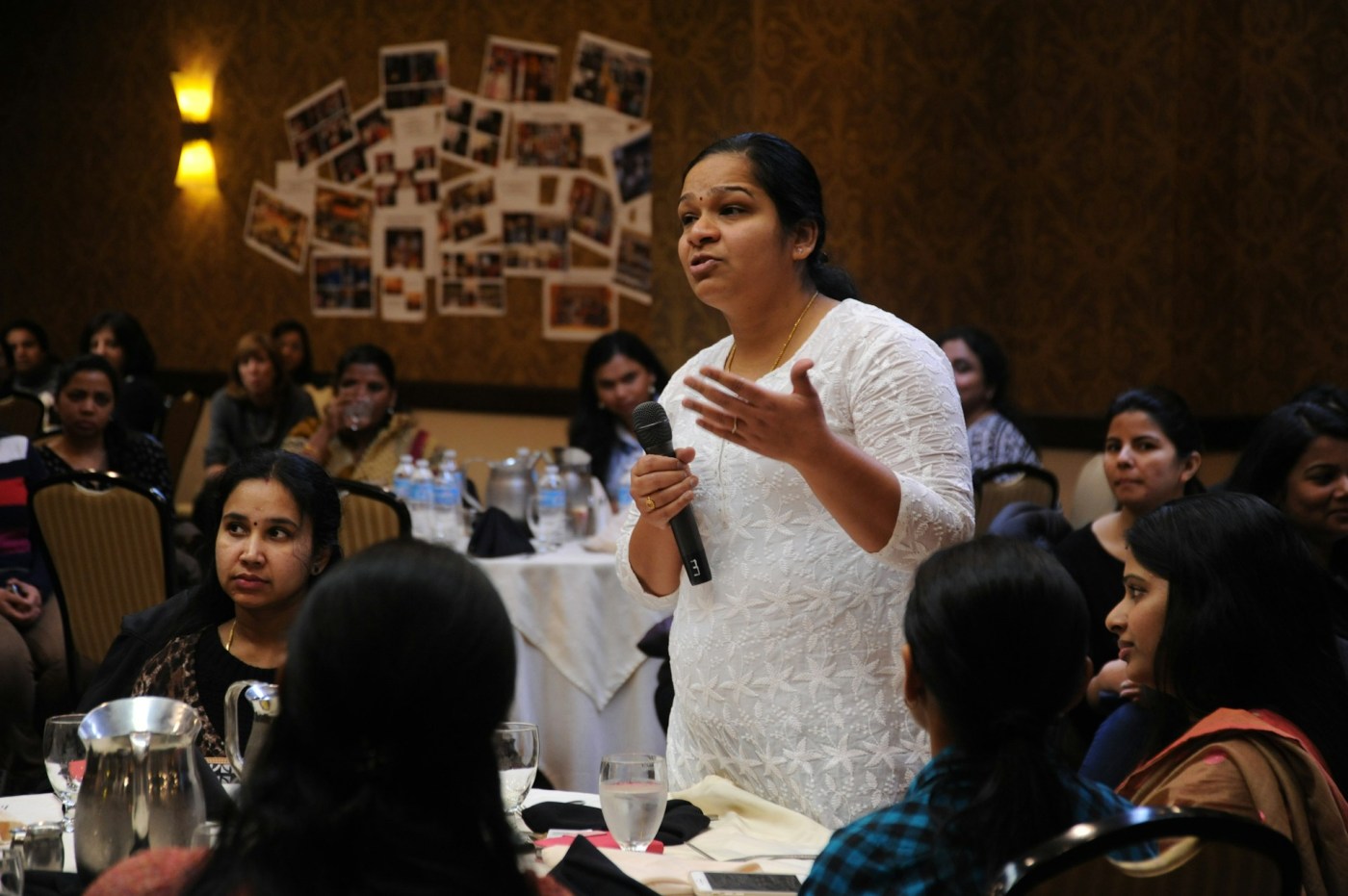
A reflection on Isaiah 35:4-7a and Mark 7:24-37 given to Coburg Uniting Church on 8 September 2024 (Year B Proper 18) © Alison Sampson 2024. Photo by Wonderlane on Unsplash. The women in the picture are tech consultants on specialist occupation visas to the US, speaking about their concerns regarding conditions for women and girls in the developing world. This reflection was prepared on the lands of the Wurundjeri Woi Wurrung people of the Kulin Nation in Poorneet Tadpole Season. This week, coupled dragonflies careen over every watercourse, and the wind is soft and warm.
 Alison and the whale