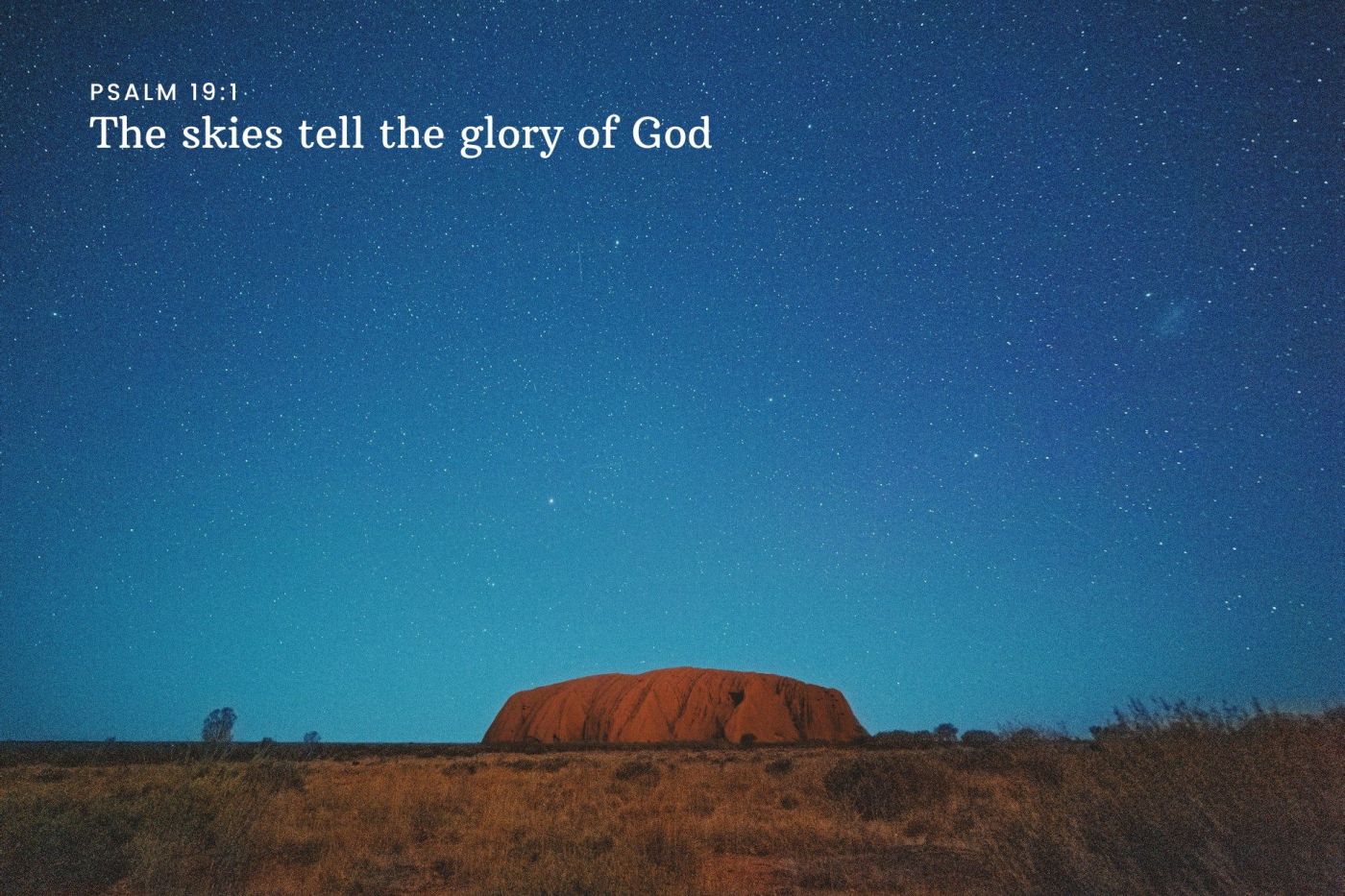
A reflection inspired by Psalm 19, shared with Flemington Ark People’s Pantry on 15 September 2024. Listen here. Links to further resources below.
There’s an ancient story, the oldest in the world, which many people know. It’s often associated with the people of the desert: the Martu, the Anangu, the Pitjantjatjara, the Yankunytjatjara and Ngaanyatjarra peoples, but others know it, too. It’s a long story, with dozens of different versions and a thousand twists and turns. The characters go by different names in different places, as does the story itself: but sometimes it’s called Kungkarangkalpa: the Seven Sisters. And, very, very, very, very briefly, one version goes like this:
Long, long time ago, seven ancestral beings – the Seven Sisters – came down to earth. You might know of the Nephilim, the gods in Genesis who came down and had babies with earth women? Well, these sky women came to earth and filled men with desire. One of those men was Wati Nyiru, who is also known as Yurla.
Wati Nyiru was a clever man with an evil spirit who became obsessed by the Sisters. He desired the oldest Sister, or maybe them all, but they were of a skin group forbidden to him. Any such marriage was against the law. Yet still he wanted them, and watched them, drawing closer and closer …
So the Seven Sisters ran. Wati Nyiru chased them across country, using shapeshifting and clever tricks and bad magic to try to catch them. At the Pangkal waterhole, exhausted by the pursuit, the Seven Sisters turned themselves into boulders and rested. At Atila (Mount Connor), they danced in a claypan, leaping up and exposing themselves to tease Wati Nyiru. At an escarpment, Wati Nyiru sent his desire ahead of him as a carpet snake. It found its way to where the Sisters were hiding, but the sisters threw the snake away and Wati Nyiru went chasing after it. Once, he managed to weaken the eldest through sickness, but her sisters protected and rescued her. Over and over again, the women escaped Wati Nyiru.
Eventually, the Sisters leapt from a big hill into the sky – but Wati Nyiru pursued them even there! And if you are outside at night, in a dark place, you will see Wati Nyiru, in what Europeans call the Orion constellation, still chasing the Seven Sisters, or what Europeans call the Pleiades, even today.
‘The skies tell the glory of God, tell the genius of God’s work!’ sings the Psalmist. And perhaps a beautiful sunset, a glorious dawn, leads us to awe and wonder and the praise of God’s name.
But we can go deeper. For the story of the Seven Sisters describes a path from Roeburn in Western Australian all the way to the east coast of the continent. It sets out the land formations, water holes, and sources of nourishment so that a wise traveller can walk the story safely across many different lands. Along the way, it teaches of kinship, skin groups, initiation, ceremony and law. It describes the male gaze, the power of desire, the protections of sisterhood, the importance of flexibility and resilience, and so much more. To those who know the story and look up, the skies indeed tell of a beautifully interconnected continent, crossed by songlines, abundant in food and water, and balanced through right relations between skin groups, land, animals and plants.
The Psalms were composed on a different continent, under different skies. Our English words for the constellations are from yet another continent, with yet another view of the skies. And we live in a big city, where the skyways are almost completely invisible to us.
Even so, the Psalm points to the importance of learning local stories and Indigenous knowledges. It points to the creative force that unites all things in beautiful harmony, and that teaches a way of living which leads to the flourishing of all. ‘The law of God is perfect, and renews life,’ sings the Psalmist, just as the lore of Country is intelligent, sophisticated, tested and wise: for it has sustained life in balance for many tens of thousands of years.
The skies indeed tell the glory of God through the story of the Seven Sisters; we might call that glory shalom. So keep your eyes on the stars, share their stories, and with the skies bear witness to God’s glory: and may your words and thoughts always be acceptable to God, our rock and redeemer. Amen. Ω
An Anangu-Pitjantjatjara-Yankunytjatjara story collides with a Hebrew Psalm flowing through a Cornishwoman who was born in the colony and learned about the APY story at art galleries built on Wurundjeri land. Paintings, stories, animations and interviews from a major exhibition here; I love the animation narrated by Shellie Morris; we showed it as part of the service. Senior Law Women and AṈANGU Dancers from the APY Lands unfold another version with great good humour here. Wirangu women Susie Betts and cultural knowledge keeper Veda Betts tell yet a third version here, linking it to stories told around the world. Explore, learn, be fed, enjoy … and share the story!
Inspired by Psalm 19 , and shared with the Flemington Ark / Essendon Baptist on 15 September 2024 (Year B Proper 19) © Alison Sampson, 2024. Photo by Henrique Felix on Unsplash (edited).
 Alison and the whale