An invitation to connect with the earth. (Listen here).
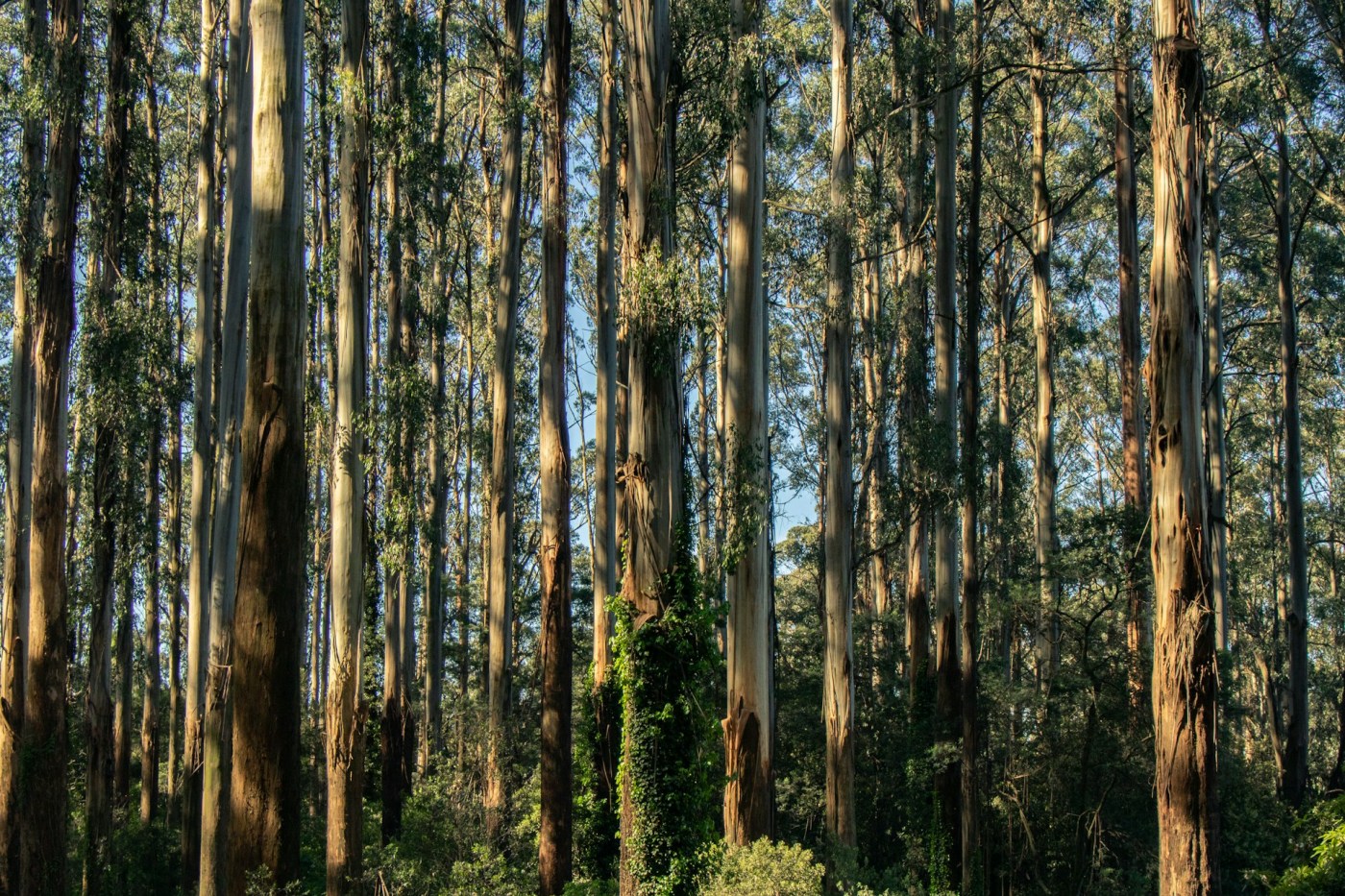
Down by the river, on a gentle bend, there is a quiet spot. You can rest there awhile and listen to the water rippling. If you turn your gaze to the sky, you will see branches. They corkscrew around, twisting and turning, bending and bowing in response to each other so that every leaf on every branch has its own space. No tree is crowding another, for they are crown-shy.
Watch carefully, and you will begin to notice insects. Bees zoom in on straight paths; wasps zigzag in arcs towards their nest. Columns of midges rise and fall with the sun. Dragonflies zip across the water, whipping through the dappled shadows of the tree. Beetles dig through the leaf litter at your feet; ant trails are everywhere. Grubs burrow into the trunk, generating the sweet white substance we call manna.
With a shake and a rustle, a wattlebird flies in, and hangs upside down sipping nectar. Spotted pardalotes mine the leaf stalks for their gum. A pair of tawny frogmouths sit quietly on a branch, looking for all the world like knobs of bark. Halfway up there’s a hollow where a branch came down over a century ago; it is now home for possums, or parrots. You might see a koala high up in a fork, meditatively chewing. Perhaps you notice slanted incisions in the trunk where, at night, gliders drift in to eat the sap that oozes from the cuts. Later, a powerful owl will launch silently from the topmost branch.
You look around and see more. There’s a fallen branch hosting bright orange bracket moulds, countless mosses, a forest of miniscule mushrooms. Maybe you know something about mycorrhizal networks: how the roots of the tree are threaded with fungi; how those fungi are sending minerals, hormones, water, warnings, and other information to its neighbours; and how a grove of trees synchronises its growth through these networks so that the whole community thrives. Maybe you sense this communication happening in the soil right now, the gifts that flow between the trees.
The gifts extend to you. In the shade you feel cool, refreshed. The tree hosts djeri caterpillars, good tucker for black cockatoos and people. Its flowers feed bees which make beautiful honey. The manna can be gathered and taken as a mild laxative. The leaves create a scented smoke which chases out fever, and the oils contain an antiviral and are useful against flu. The bark and burls make shields, and containers for carrying water. This single tree provides shelter, food, medicine, habitat, and materials for making; for many, it is essential for ceremony.
Sitting under a manna gum, you see a whole world and more. You see neighbourliness in the way it is crown-shy. You see hospitality in the many species which find a home there. You see diversity, and beauty, and intricacy, and life. You experience hospitality yourself in the food it provides, in the anchor of its roots, in the shelter on a hot day. It is cool in the shade. A fly buzzes.
Old Abraham knew a thing or two about trees. In Genesis 12:6, we are told that he stops at the Alon Moreh. Most English translations call this the oak of Moreh, but moreh means, quite simply, ‘teacher.’ In other words, he’s at the teacher tree. In her book Braiding Sweetgrass, Potawatomi woman Robin Wall Kimmerer explains that Indigenous elders usually instruct youngsters indirectly. ‘Go to the river stones,’ they might say. ‘They’ll tell you what you need to know.’ Or, ‘Go watch the beetles; there’s something you need to learn.’ And away they go to spend hours, days, even weeks, learning the lessons offered by these teachers.
We see something of this in our own faith tradition. Look to the hills, advises the Psalmist. Consider the ravens, counsels Jesus. Consider the wildflowers: because they all have something to teach us. For centuries, Christians have studied the twin revelations of creation and the Bible; though for the last hundred years, creation has been largely overlooked. But there at the teacher oak, source of information and revelation, Abraham has a vision: God promises that his children will belong to the land.
It’s a big promise for a childless stranger journeying in a strange place. So the stranger builds an altar there, then keeps on travelling. Eventually he ends up at the oaks of Mamre, where he sets up camp and builds another altar. We meet him today at the entrance of his tent, resting beneath the trees in the heat of the day.
Like the manna gum, oaks are a keystone species. They host up to 300 different animal species, 1,100 plants, 370 fungi, 700 lichens and 5,000 insect and invertebrate species. Over 500 different species of caterpillar can be found on the oak. Not individuals, but species. Oaks shelter and feed everything near them: other trees, field grasses, and of course people. Their respiration cools the earth and air. Their roots dig deep and bring up nutrients so other plants can thrive. They hold the soil together and build it up through leaf fall. The health of the forest and fields, and the people who live among them, depend on the gift of the oak.
And it is while resting there in their shade and shelter, observing, thinking, learning, praying, that Abraham sees Yahweh again. Then he turns and sees three strangers approaching, and offers them extravagant hospitality. A fatted calf. Three days’ worth of bread. Some yogurt sauce. Perhaps pickles, and hummus, and olives, and tabbouli: whatever Sarah can whip up. They eat under the shade of the trees, and in the ensuing conversation Abraham and Sarah encounter God.
We usually interpret this to mean that Abraham sees God in the stranger, and that is absolutely part of this story. But the opening verse of this passage offers a further possibility. It tells us that Abraham first saw Yahweh while resting under the trees; it is only later that he turned his head, saw the strangers and recognised God again. And I wonder, just as Jesus often went to the wilderness to encounter God and encouraged his followers to do likewise, perhaps Abraham in the shade of the oaks glimpsed God in the branches above.
Perhaps he watched the breeze, which in both Hebrew and Greek is the same word as spirit, riffling through the leaves. Perhaps he reflected on how God’s spirit hovers over chaos and sings the world into being, and how God’s breath pours life into every person.
Perhaps he observed the oaks sharing space with other trees, and sharing the soil and sky: and in this way learned more about neighbourliness. Perhaps he noticed also the thousands of species being welcomed in and the oaks’ generosity of shelter and nourishment: and in this way learned not to fear the stranger.
Perhaps he sensed how he was connected to the web of life in the oaks, and to the breath-breeze which animated their leaves: and in this way understood his connection with all living creatures, and the necessity of interdependence.
And in all these things and more, perhaps Abraham glimpsed Godself, and God’s wisdom, and power, and grace. Then when he turned, he saw three hot tired hungry strangers. He, too, had been a stranger in the land. He knew what it was to be hot, tired and hungry; he felt his connection with them. Their discomfort was his discomfort: yet it was something he could remedy. So in the spirit of the living God revealed in the teacher trees, Abraham embraced them and welcomed them to his table.
And this story of hospitality became so profoundly defining for the children of Abraham that it is enacted by Jesus, quoted in Hebrews, discussed and expanded in the Jewish Talmud, and in the Quran is told three times.
*
Let us acknowledge that we are gathered on Wurundjeri country: the place of the manna gum caterpillar people. ‘Wurun’ is what English speakers call manna gum; ‘djeri’ is the grub which lives on it: and thus we have Wurundjeri. I pay my respects to ancestors and elders, who learned from the trees, the grubs, and everything else how to live in this place with wisdom, hospitality, and balance.
They will tell you that, three hundreds years ago, we’d have been in the shelter of a beautiful mixed forest following Birrarung, the River of Mists. Wurun would have lined the waterways, then bundy, or longleaf box, and swamp gum. Heading up the slopes, we’d have seen red and yellow box; while in gullies candlebark, peppermint gum and messmate were more common. Clearings were burned into the forest creating a mosaic pattern of mature trees, soft soil for crops, and grassy runs for attracting game: because why chase something if you can bring it straight to you?
But manna gums are great for timber, and you can’t run sheep in a forest, and anyway we have a housing crisis and the city keep growing and growing. Once there were millions upon millions of trees, and vast plantations of murrnong daisy yam, and great swathes of protein-rich grain-heavy kangaroo grass growing, feeding, sustaining, and nourishing an interdependent web of life. Now we have endless houses, ever-expanding roads and supermarkets full of plastic-wrapped monocultures.
And yet sometime, somewhere, an English speaker caught a glimpse of wurun and recognised grace. For they named it after manna: the sweet, white edible stuff found in the wilderness that was a direct gift from heaven. And perhaps they also glimpsed the overlapping economics of Indigenous and Exodus life: collect no more than you need; don’t store up stuff to rot and be wasted; and in this way there will be food tomorrow and plenty enough for all. All this, in a white flaky substance and a tree.
But this way of living seems long gone, and the effects of overconsumption are everywhere. An unseasonably warm winter. Wildfires in Siberia. The greening of the Arctic. Unprecedented heat and rain and hurricanes. Food prices going up. Big cities struggling to breathe, and a blazing hot summer coming our way.
Where does this leave us? Well, I don’t think we are heading back to a well-managed land anytime soon, or that there is a quick fix to these problems. This church will not be curbing a vast and rapidly growing city, or reversing climate change and the extreme weather events we are learning to expect.
But as people of faith, we can bear witness. We can learn our history and what the land was like, and acknowledge that colonisation has drastically harmed Country and her people. We can live more gently and thoughtfully ourselves, and between us we could list a hundred ways to do this: tackling food waste, rethinking our gardens, getting political, and so much more.
But before any action lies something much more important: and that is the call to connect. Connection with God. Connection with each other. Connection with neighbour. Connection with the land.
For the history of colonisation is a history of disruption. Whether blackfeller, whitefeller, or any other feller, every one of us has been dislocated from the place and traditions of our ancestors, and from lives lived in harmony with the land. Every one of us bears these scars. But the God of shalom brings wholeness and healing; for shalom means right relationship between God, people and the land.
So like Abraham, like Jesus, and like most Christians for most of history, we can pay daily attention to Country. We can seek out our own teacher trees, teacher stones, teacher winds, teacher butterflies. Taking guidance from traditional custodians, ecologists, gardeners and poets as well as our own wisdom tradition, we can watch, listen, learn and pray through creation, and deepen our connection with the land.
At the start of this reflection, I took you on a journey to a tree by the river. I invite you now to think of a special place of your own. Perhaps it’s a particular tree or flower. Perhaps it is a bend in the river, or a stretch of coastline, or the silhouette of hills at dawn. Perhaps it is a corner of your own garden, or a branch you can see from a window. Whatever, wherever, big or small, I invite you to close your eyes now. Take a deep breath, in, out, and ask God to open your heart as you imagine this special place.
Where are you?
*
What colours, shapes, movements do you see?
*
What can you smell?
*
What can you hear? What sensations do you feel?
*
What angle is the light, and how do the shadows fall?
*
What makes you curious? What else do you notice? Is there a teaching, or something you need to learn?
*
What will you tell Jesus about this place? Can you invite him into this place with you?
*
I invite you to ponder these questions over time, perhaps sharing with others if anything comes up. But for now, I will return to Genesis.
Many years after today’s episode, Sarah died. Abraham grieved, for he loved her well. Then he spoke to the people of the land about a suitable burial site. After conversation and negotiation, he purchased a burying ground ‘east of Mamre, the field with the cave that was in it and all the trees that were in the field’ (Genesis 23). Abraham laid his wife’s body there and later, when he died, his body joined hers once more, beside the trees of the field.
I think now of your own dear brother, who died so suddenly last week while travelling overseas. I think of how important it is to his wife and to all of you that his body is returned home, back to the place he loved so well.
And I think of burials. Perhaps it is a function of having our mothers die young, but my husband and I have already chosen our burial site. It’s in a heavily deforested landscape near what Europeans call Mount Elephant; its true name, Djerrinallum, means sea swallows’ nest, or more probably hill of fire.
Djerrinallum is a volcanic cone rising abruptly out of plains and wetlands. The cemetery near it provides a natural burial, a quick rot, amongst the trees and grasses. There are no headstones. Instead, loved ones are given a GPS location where they can go sit awhile at the site, and listen to the wind in the trees. For each body buried, more trees are being planted on nearby Djerrinallum, gradually reforesting the cone.
We have chosen this site because we don’t want our bodies locked away in hermetically sealed coffins. Instead, we want our bodies to unite fully with the earth as she feeds, sustains, and guides generations to come.
And I wonder. Perhaps in being buried near Mamre Abraham wanted a final glimpse of God, dancing in the branches of the oaks. Perhaps he wanted to return his body to the patch of earth he had come to know and love so well. And perhaps he wanted to become one with the trees who had welcomed him, sheltered him, and taught him how to live in the land, where once he had been a stranger. Ω
Reflect: If you would like to take this further, why not consider the insects (here); the birds (here); the sky (here); a particular place (here); and a garden (here). You might even like to do one reflection each week for a while.
A reflection on Genesis 18:1-15 given to Rosanna Baptist Church on 6 October 2024 (off lection; this text is usually preached in Year A Proper 6) © Alison Sampson 2024. This reflection was prepared on the lands of the Wurundjeri Woi Wurrung people of the Kulin Nation in Poorneet Tadpole Season. This week, blackwoods are in flower and the air is filled with their sweet fragrance.
 Alison and the whale