Military violence never ends, whereas Jesus’ way of nonretaliation leads to a true and lasting peace. (Listen here.)
To get to Armageddon, known in Hebrew as ‘Megiddo’, we drive past an airfield. Our Israeli guide tells us about the Syrian fighter pilot who defected there in 1989. He was flying a Soviet-made MIG-23. The plane provided Israel with valuable intelligence, adding to what was already one of the most sophisticated military forces on earth.
Our guide is understandably proud of this story, his nation. He was once an officer in the army, and he has spent his life contributing in very practical ways to the construction of modern Israel. He was born there, after his parents escaped Poland; all but one other member of his extended family were killed by the Nazis. Another day, at the Holocaust Museum, he will tell us what they learned: “The Jewish people will never trust anyone else for their safety,” he will say. “They can only trust themselves.”
But this day, he keeps talking about fighter jets, and we keep driving. I feel utterly depressed. For in the Hebrew Bible, Megiddo is the site of many clashes where victory is attributed to God; and in the book of Revelation, it’s the site where the kings of the world are assembled for a final battle. Megiddo, or Armageddon, has long been associated with the violence we expect from both human and divine kings; it feels to me like nothing ever changes.
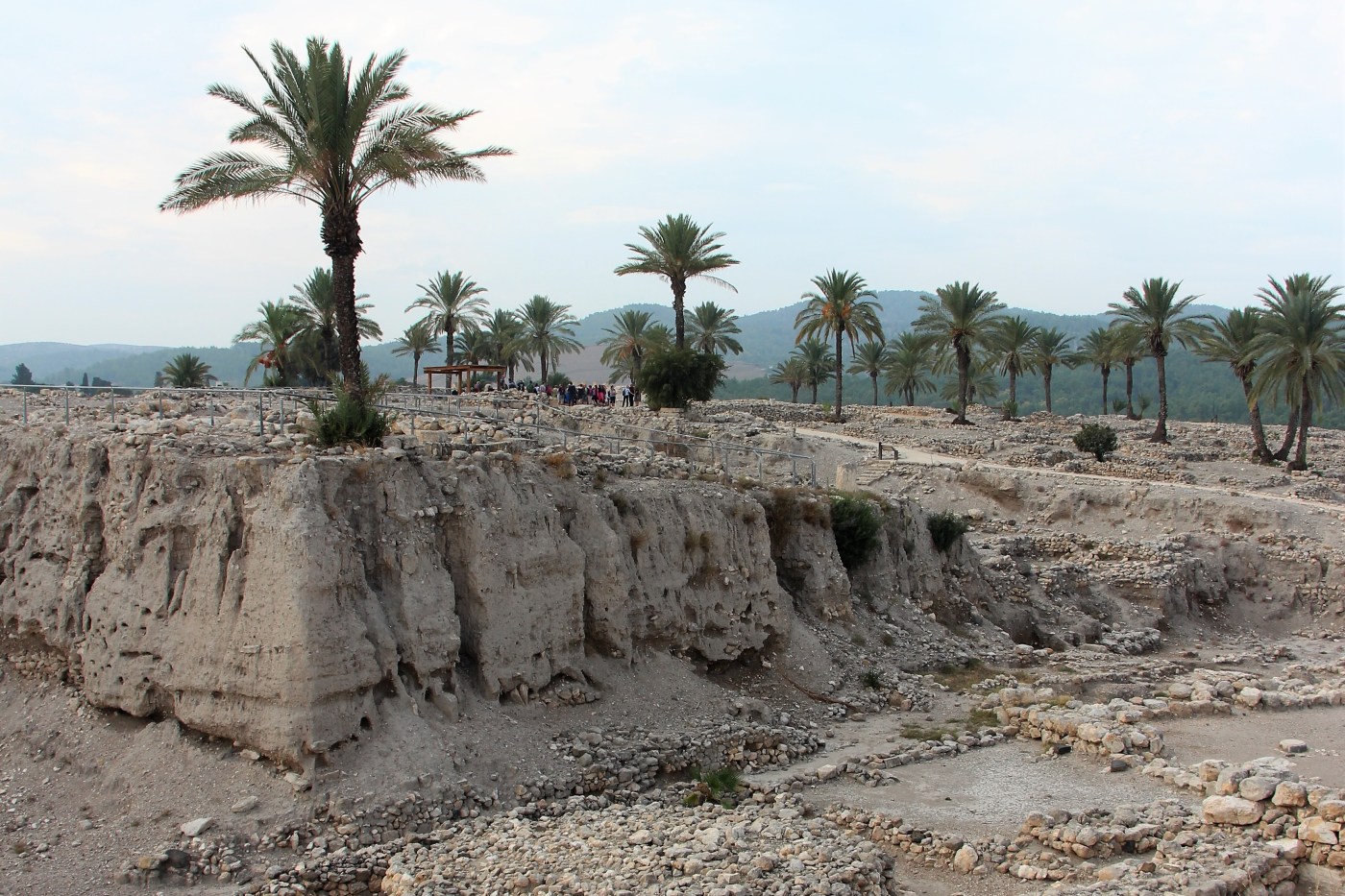
At Megiddo, we park and begin to climb. Megiddo is a tell: a settlement built on the ruins of another. And this tell is high: it has twenty-nine layers. Twenty-nine times, a settlement was built there; twenty-nine times, it was invaded, the people slaughtered or enslaved, the buildings demolished. Twenty-eight times, it was rebuilt; but after the last destruction, it was abandoned.
We walk up the tell. It happens to be November 11: Remembrance (Armistice) Day. Our New Testament lecturer reminds us that, in the book of Revelation, the Word of God comes with a sword: but the sword is not in his hand. Instead, it’s in his mouth. It’s not for killing, but for proclaiming the truth of Jesus, prince of peace. I remember the image of blood on white garments: and how it’s not the blood of enemies slain, but his own blood, poured out for the violence of the world. I remember the image of a throne on which sits neither lion nor warrior. Instead, a murdered lamb stands beside it. Undefended, with no military power, it was easily slaughtered.
At eleven o’clock, we pause for a minute’s silence. We pray for all those who have suffered or died in war; we pray for an end to all wars. In the silence, two Israeli fighter jets fly overhead. Their engines roar, and the echoes ricochet loudly for long seconds afterwards.
The minute comes to an end. Our guide, who lost most of his family in the Holocaust, points to the echoes in the sky. “Those are the sons of light,” he says. “Those F-16I’s protect us from the forces of darkness which seek to destroy Israel.”
Today is the Feast of Christ the King. This is a relatively new event in the church calendar. It was instituted in 1925 by Pope Pius XI, who was negotiating with Mussolini for political independence and the absolute dominance of the Roman Catholic Church. In return for these favours, Pius worked to suppress the only democratic party in Italy at the time. He agreed to neutrality in international negotiations, and he instituted this Feast: Christ the King.
This is all very interesting, not least because Jesus himself never claimed to be king. Instead, kingship is something others thrust upon him. “You say I am a king,” he says to Pilate, and it wasn’t him but the Roman army which nailed a sign to the cross declaring his kingship. Even when the crowds tried to anoint him king, he slipped away. Even so, under the guidance of popes Christians have long been celebrating a Christ made in the image of a European king.
In case you’re thinking this authority has been benign, even godly, know this: With the consent of the Catholic Church, the Fascists in Italy expelled all Jewish children from state and private schools. They fired all Jews who were working in universities, banks, the civil service and the military. They limited and regulated Jews in other industries, and they stripped Jews of their property and bank accounts. The Pope told Mussolini that the Church had long seen the need to ‘rein in the children of Israel’ and to take ‘protective measures against their evil-doing.’ He did not criticise the anti-Semitic measures taken by Mussolini, and in any case Mussolini reassured the Pope that he would do nothing to Italy’s Jews that had not already been done under papal rule.
We here on the other side of the globe have also seen religious power exercised in all its horror. We know how church and state colluded in the forcible removal of Indigenous children from their families, in the shaming and control of unmarried mothers, and in the ongoing shaming and ostracism of queer folk. We know, too, that the state long turned a blind eye to the sexual abuse of children by religious leaders. And we also know that, only last week, the Catholic Church successfully argued in the High Court that it has no legal responsibility for the actions of its priests, because technically they are not employees. It does not deny the abuse, which in the case before the court involved a five-year-old. It merely insists that this is not the Church’s problem, and that the Church is not required to make amends.
For me, at least, it is difficult to conclude anything other than this: that the image of Christ as authoritarian king is the result of a dark marriage between religious and state power. It leads to horrific outcomes for vulnerable people, and it has no foundation in the gospel.
For the gospel challenges easy assumptions about Christ’s kingdom and rule. We don’t see Jesus enthroned in glory in any gospel account. Instead, we see a shackled Jewish political prisoner being interrogated. And because any suggestion of kingship has political implications in this world now, Pilate is trying to understand him. Is Jesus like the man our Israeli guide calls “that crazy meshuggeneh”, King Herod, who submits to Rome? Or will he be different? Will those who pledge allegiance to Jesus’ kingdom, the kingdom of heaven, place Jesus’ authority above Rome, and Jesus’ agenda above all other agendas? What sort of threat is he?
These are good questions for those of us who pray, ‘Your kingdom come.’ Will God’s kingdom be like another human kingdom, only bigger, more powerful, and more decisively violent? Will it come as many Christians imagine it, fuelled by the wrath of an angry God, with vengeance and slaughter and desolation and blood running through the streets? Is Jesus another Caesar or Kaiser: authoritarian, abusive, contemptuous of the vulnerable and interested only in power? Will people and places continue to be destroyed in Christ’s name? Are F-16I’s truly a tool of the righteous?
With questions like these buzzing through his mind, Pilate asks Jesus, “What have you done?” But Jesus is elusive, saying, “My kingdom is not from this world. If it was, my followers would be fighting.”
Do you hear that? Those who follow Jesus don’t fight. They don’t take up arms, they don’t bear weapons, not even to protect their king. And Jesus didn’t come to shore up his power base, or dominate the news cycle, or compel obedience, or embody vengeance, or blur the line between truth and lies. Instead, he came to testify to the truth. And in his life, ministry, death and resurrection, we see the nature of this truth.
This is the truth known in free and self-giving love. It’s a truth which does not protect itself, but which empties itself of power and gives its privilege and its life away.
This is a truth which is obedient even unto death, knowing that only this will bring about reconciliation and God’s life for all people. It’s a truth which does not discriminate between Jew or Gentile, but instead invites all peoples into a loving, forgiving, healing, liberating, life-giving embrace. It’s a truth in which retaliation is not an option, and enemies are transformed by love.
This is a truth which is so radical, and which runs so counter to our usual experiences of kings and borders and sovereignty and safety and security, that Pope Pius XI couldn’t imagine it. My Israeli guide can’t imagine it. Many Christians won’t imagine it. And in the nightmare of the Holocaust, Hezbollah, Hamas, and Israeli military might, and with the rise of a vicious Christian nationalism in Russia and Hungary and America and so many other places, I don’t really know how to imagine it either.
But after seeing Megiddo, imagine it I must. For twenty-nine invasions and twenty-nine flattenings and twenty-nine rivers of blood in the streets tell me one thing: military violence never ends. It may limit retaliation for a little while, but it changes nothing; it heals no relationship. It does not bring peace, only fear, anxiety, submission and suffering, and the looming threat of retribution. Enemies remain enemies, locked in a dance to the death.
There must be another way, and this is the way of Jesus Christ, that extraordinary man who turns kingship on its head. For unlike any earthly ruler, he teaches us to love and bless and pray for our enemies, seeking only their good. He insists on the power of vulnerability; he embodies nonviolence; he prioritises care for the last and the least. In his living and loving, he asks us not to be warriors, but to offer our own lives as a gift. So let us listen to his truth and allow it to change us; and may it bring about reconciliation, healing, and a true and lasting peace. His peaceful kingdom come; his will alone be done, on earth as it is in heaven. Amen. Ω
A reflection on John 18:33-37 and Revelation given to Coburg Uniting Church on 24 November 2024 (Year B Proper 29, Christ the King Sunday) © Alison Sampson 2024. Photo by Nathan Steer (edited). This reflection was prepared on the lands of the Wurundjeri Woi Wurrung people of the Kulin Nation in Poorneet Tadpole Season. This week, warm air and cool are in constant dramatic dialogue.
 Alison and the whale