A fascinating pairing of texts from Isaiah and Philippians, and an invitation to speak on love in a troubled world, from West Preston Baptist Church. (Listen here.)
“Today Christians stand at the head of this country … I pledge that I will never tie myself to those who want to destroy Christianity … We want to fill our culture again with the Christian spirit—we want to burn out all the recent immoral development in literature, theatre, the arts and in the press—in short, we want to burn out the poison of immorality which has entered into our whole life and culture as a result of liberal excess …”
These words were spoken to a country heavily burdened by debt. It was a country which was failing to mend an ever-widening gap between rich and poor. The haves were displaying their wealth publicly and flamboyantly, while the have-nots struggled to put bread on the table.
This was a country which had seen significant change. The nature of work had undergone seismic shifts, due to a financial crisis and the ruthless demands of new corporations. As emerging technologies disrupted the old order, unemployment and inflation were taking their toll. Even so, there had been a surge in immigration, as people from other places seeking a safe haven and a better life flocked to this country.
Women were participating in the workforce in unprecedented numbers. Arts and culture were also undergoing major shifts. Music was experimenting with shocking new forms, as were literature, dance and the visual arts. Once taboo relationships were coming out of the closet. Everything was changing, and rapidly.
To those of us living in Australia now, this might all sound a bit familiar. Perhaps we can therefore understand the people’s response to this and similar speeches. In the face of all the struggle and change, they longed for stability, and secure work, and adequate housing. They longed for solutions to the cost of living crisis. They longed for certainty and security and an assurance that God was with them: and so they voted in Adolf Hitler. Because in the speech quoted above and at many other times, Hitler promised to make them a Christian nation, to root out the evil from among them and to give them the peace and prosperity that they yearned for.
We know what happened next. The nation became profoundly shaped by outrage and fear, unfreedom and violence. Women were blocked from education and employment, limited to Kinder, Küche, Kirche: that is, children, kitchen, church attendance. Every German boy became a little soldier, sent to kill or be killed on the battlefields. Millions of Jewish, Romany, gay and disabled people were murdered on the altar of nationalism. Neighbour betrayed neighbour, in the attempt to protect themselves. There were night raids, book burnings, public hangings, horror in the streets. A war stretched over years and continents, drawing in nation after nation and destroying countless lives.
That was Germany then, but I suggest there are resonances with the USA now. For it, too, is a country with a vast national debt, a gaping chasm between rich and poor, and a cost of living crisis. It, too, is struggling to negotiate the culture-shattering demands of new industries and large corporations, and the disappearance of properly paid work. Like many in Germany in the 1920’s, many in the US feel threatened by radical shifts in employment, the arts and human relationships. And, like Germany in the 1920’s, the US is a country which has integrated Christian rhetoric into its culture and politics, while making the military foundational to its economy.
Perhaps that’s why the statements made by Hitler sound a lot like the statements made by some American politicians today. Spreading lies about immigrants eating people’s pets, and proclaiming the need for a great big wall, and declaring that immigrants are, and I quote, ‘poisoning the blood’ of America, all sound a lot like the demonisation of Jewish and Romany people in Nazi Germany. The explosion in book-banning, the attacks on the free press and the rejection of trans identities have clear echoes of the weeding out of ‘immorality’ promised by Hitler. Plans to limit access to birth control and the elevation of tradwives look a lot like Kinder, Küche, Kirche, and every boy a little soldier is simply the typical trajectory for any kid growing up in rural America.
This year, the Louisiana legislature required that the Ten Commandments be posted on the wall of every public school classroom. And this year, we have seen the political targeting of group after group after group: Muslims and Mexicans, trans people and gay folk, even teachers, booksellers, librarians and childless cat ladies. ‘One nation under God’ declares the Pledge of Allegiance: so is this what it looks like to be a Christian nation? And is this what people hope for in the coming of our king?
These are great questions for Advent, for Advent is a time of anticipating more than ever the coming of God’s kingdom. It’s a time of hopeful expectation of a world in which God’s will is done, and the kingdom, the power and the glory are God’s, in this time and for all time. And so Advent is traditionally a season to reflect on what sort of God we are expecting. “Daddy’s home!” chanted Trump supporters at a recent rally, promised his return to the White House and the enforcement of a violent patriarchal discipline. Do we imagine God to be like this: a Caesar, Kaiser, or violent and vengeful King pouring out judgement on the earth? “I will protect the women of America,” promises Trump, “whether they want it or not.” Do we long for a strongman who will claim a godly mandate to bring about God’s kingdom come?
Of course, we here in Australia are not America. Even so, these questions are for us, too. Because we too are experiencing an ever-growing gap between rich and poor. We too, are seeing seismic disruptions to the nature and stability of work. We are experiencing a chronic shortage of housing, a food supply controlled by a duopoly, an expansion in what many consider to be acceptable forms of marriage, and many other changes to our economy and culture. Like America, we too are experiencing economic and social stress; we too are seeing our politics swing sharply to the right. In fact, a recent Guardian Essential poll showed that nearly a third of Australian voters, given the opportunity, would vote for Trump.
We all want peace and prosperity. We all want our nation to thrive. We all want God to be in charge: but how will this come about? Is Christian nationalism the way?
Long ago, the people of God were asking similar questions. Their political and religious leadership had failed. The kings had worked in their own interests, exploiting women, labour and the poor while building up vast stores of personal wealth: and so the monarchy had come to an end. Meanwhile, the priests had prioritised scriptures which elevated their own power while marginalising vulnerable people. Their focus on religious purity and ceremony had come at the expense of justice, and God was not well pleased. According to the prophets, Israel could sacrifice bulls until a week next Tuesday and fast until it was blue in the face: but God would no longer listen. In the absence of justice, compassion and kindness, God had turned away.
This, of course, had devastating consequences. Various prophets describe the results: invasion and colonisation by other empires; an obscene gap between rich and poor; a culture shaped by fear and violence; land degradation, soil erosion, drought and species loss; locust plagues and famine; exile to another land. Betrayed by their leaders, shattered by collective trauma, and cut off from all they had previously known, God’s people wondered if God had forgotten them.
It is into such a context of alienation, suffering and pain that the prophet Isaiah proclaims his message. What message does he bring? It turns out he makes no promise of a return to the monarchy, nor of a pure nation engaged in pure worship. Instead, he offers a vision where new people are grafted into Israel. Enemies, gentiles, eunuchs and other scorned people will become agents of healing and will praise God’s name. More, to a nation so bruised by priests and kings, Isaiah announces that God has chosen a servant to call forth gentleness, justice and love.
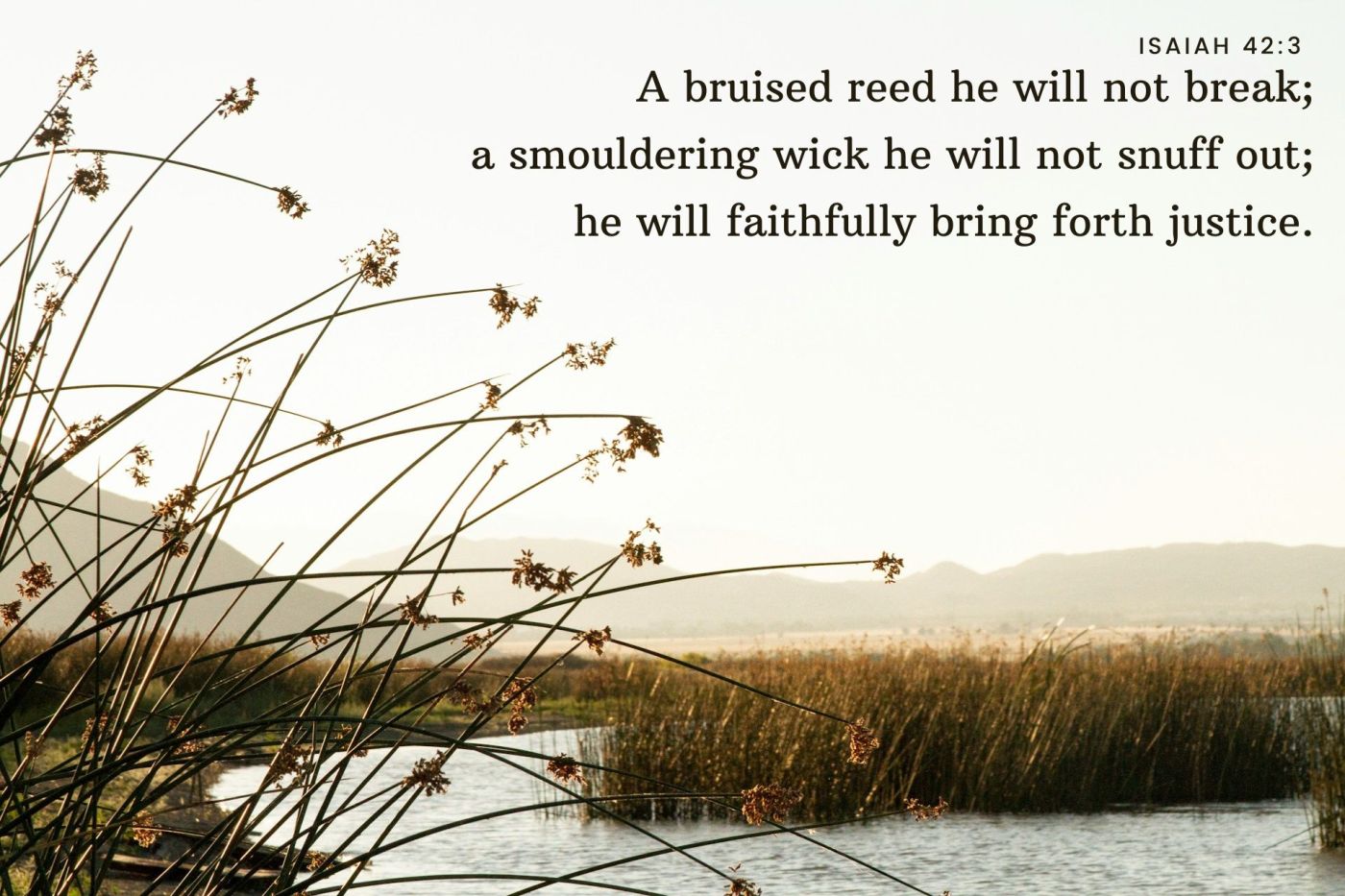
“Here is my servant, whom I uphold,” sings Isaiah, “my chosen, in whom my soul delights. I have put my spirit upon him; he will bring forth justice to the nations. He will not cry or lift up his voice, or make it heard in the street; a bruised reed he will not break, and a smouldering wick he will not snuff out; he will faithfully bring forth justice.” (Isaiah 42:1-4).
So this servant doesn’t raise his voice or make it heard in the streets. He’s not ranting into a microphone at a political rally or drawing attention to himself on social media. Instead, he is quietly going about his business, which is to bring forth justice.
And this justice is not just for Israel, but for the nations. So God’s servant rejects supremacy. To put it in more contemporary terms, God’s servant has no truck with white supremacy or Aryanism or Zionism or religious nationalism or any other ideology which preferences some peoples above others. Instead, in Isaiah’s vision, all peoples will be treated fairly, and well.
In our context, this justice might look like equal policing, and equal access to society’s benefits and law. It might mean ensuring fair work and fair trade. And it might mean learning the triggers for migration. Rather than demonising those compelled to leave their homes, God’s servant might seek to alleviate poverty and stabilise good government in far off places, while welcoming those who arrive anyway. Rather than setting aside special economic zones and building border walls, God’s servant might work towards equal opportunities, sustainable economies and a predictable climate so that everyone, everywhere, can thrive.
What else? “A bruised reed he will not break, and a smouldering wick he will not snuff out,” proclaims Isaiah. God’s servant will tread gently, treating wounded people and the faint of heart not by bullying and humiliating them, but with the greatest tenderness and care.
“Thus says God who created the world and fills people with life-breath,” says Isaiah, “I have given you … as a light to the nations, to open unseeing eyes, to bring prisoners out of dark dungeons … new things I now declare; before they spring forth, I tell you of them.” (vv 5-9).
A light to the nations, God’s servant isn’t protectionist. This isn’t Make America Great Again but God’s kingdom come, where abundant love and blessing pour far beyond national borders.
Sent to open unseeing eyes, to bring prisoners out of dark places, God’s servant speaks truth. He reveals the false promises and death-dealing practices of empire, then opens people’s eyes to God’s hope, God’s peace, God’s joy, and God’s love.
These are not the same as the empire’s. For where the empire is all about domination and supremacy, Isaiah imagines integration and beauty. Israel has known a horrific ground invasion, the violent death of many, the exile of the few. Even so, Isaiah portrays a world and a cosmos where all life flourishes, and everything is tinged with delight. You know the images: the lion will lie down with the lamb, young people and old will thrive, people will build houses and plant gardens, they’ll enjoy the fruits of their own crops and their own labour. Instead of blackberries manna gums will grow, instead of thistles, sheoaks. There will be peace like a river, the trees will clap their hands, even the mountains will sing! And although we can’t quite imagine it, Isaiah assures us: this glorious newness is on its way. Business as usual is not how things will always be. Every empire will fall.
Who, then, is this chosen servant? We here in a Christian church are tempted to call out ‘Jesus!’ and be done with it. But I think the answer is bigger and more interesting than that.
First and foremost, let’s remember that Isaiah is a Jewish prophecy. And the Jewish expectation is that the Messiah (in Hebrew), or the Anointed (in English), or the Christ (in Greek), will be sent to restore the nation. But what this Messiah will actually be like is the subject of countless arguments and speculations. Is he a suffering servant? Is he a warrior king? Will he come riding in from heaven on the clouds? Could he be a society, even, or a city, or a nation?
Israel wonders, and so the referents keep shifting even within individual prophets. For example, in Isaiah chapter 11, first an individual then all peoples are described as messianic as they embody nonviolence, protection of the poor, and full knowledge of God. Elsewhere the Messiah is an individual born from the line of David, or Jerusalem itself. Again and again, there’s this ambiguity: Is the Messiah an individual, or is it a whole city? Is it one person or a nation through whom God will bless the world?
In Isaiah 41, from which today’s passage flows, the prophet identifies the servant as Israel. “You, Israel, my servant … I have chosen you,” says God (vv 8,9). Here, it’s not a priest, king, warrior or thunder god but God’s people who are chosen. They have been selected as a nation to bring about God’s liberation from the forces of empire and death.
In the world’s terms, this is clearly hopeless. God’s servant is charged with a ministry to the blind, the captive, the wounded and the faint of heart, yet Israel itself is under Babylon’s thumb. It’s blind to other ways of being and doing; it’s in literal, political, economic, cultural and imaginative captivity; it’s terribly wounded and faint of heart. Israel is in need of precisely the healing it is called to bring into the world. It’s clearly in no position to kick Babylon to kingdom come and bring about God’s way by force. But the promise of Isaiah is this: that in humbleness, gentleness, justice and even suffering, newness is possible and everything will be transformed.
This understanding brings me to Jesus, and to us. Because hundreds of years later, having witnessed Jesus’ life, ministry, death and resurrection, people were trying to make sense of him. They noticed how he embodied some Hebrew scriptures, and so they reinterpreted prophecies such as Isaiah’s in this new light. And in doing so, just as the prophets moved between an individual and a corporate understanding of the Messiah, so too did those trying to understand Jesus.
So Jesus himself is identified as the Messiah, of course, that is, as the Christ; but then the church is described as the body of Christ and commissioned to bless the world. In others words, the messianic language keeps sliding between Jesus and his people: because his disciples realised that members of Christ’s body are called to continue his work. Jesus is the Messiah, yes, but those of us who dwell in him and are led by his spirit engage in the messianic project with him.
We know what this looks like. As Paul describes so vividly in the Philippians hymn, Christ emptied himself of power and took on the form of a slave. So Christ is the antithesis of your typical empire or king. He’s nothing like them. Therefore, we are not to be fooled by those who cry “Lord, Lord” while using their power to dominate, exploit, silence or control, and we reject the calls for a Christian nation to be established by force.
On the other side of the coin, we who dwell in him and are members of his body are not to use our own power in harmful ways. We are not in the business of scapegoating or exploitation. We are not here to betray a neighbour, build a wall, or demonise any group. Nor are we here to spread or endorse outrage and fear, unfreedom and violence, not even on social media. There will be continuing economic, cultural and environmental crises; there will be further dramatic failures of leadership. This is the world we live in. Even so, no matter how hard pressed, we are not to pour out our frustration in the form of anger or blame, nor submit to hopelessness and despair.
Instead, with Christ at our head and with Christ’s reconciliation at our heart, we are called to the work of love. That is, we are to meet evil with true words, revealing the lies and violence of empire; and we are to join with others in humble communities shaped by nonviolence, justice and peace. As we, like Christ, empty ourselves of power, we make room for God’s overflowing love and mercy, and this invariably leads us to Christ’s transformative work of bridge-building, justice-seeking, peace-making, truth-telling, and relational healing. Filled with Christ’s spirit, we show a special concern for those who are bruised or burned; and we find ways to pour love and blessing not just upon our friends, but upon strangers and even enemies.
It should be clear by now that the messianic calling doesn’t mean power or trumpets or glory. It doesn’t mean domination and it very rarely means short-term success. Instead, at its heart, the messianic calling is simply to embody love in all its forms, and to entrust our lives to God’s future.
As such, our calling makes us vulnerable, insignificant, even foolish in other people’s eyes. Yet we speak volumes: because we reveal how God works in the world. And that is this: in the face of empire, in the face of compromised and corrupt leadership, in the face of human failures and human violence, in the face of disaster, despair and even death, God will always call forth something new, and this newness emerges from spaces of vulnerability, suffering, and self-giving love.
This is the hope that was born in a manger in Bethlehem. This is the hope that was born again from the garden tomb. This is the hope for which we pray and for which we offer ourselves once more. So with the same mind in us as Christ, let us be slaves of love, agents of healing, ambassadors of generosity and justice. Let us bear embodied witness to the power of resurrection life. And let us pray that, through the tender humility of God’s servant, every knee might freely bow and every tongue joyfully confess that Jesus Christ, with his good and gentle self-giving way, is Lord. God’s peaceable kingdom come, God’s infinitely loving will be done, on this good earth as it is in heaven. Amen. Ω
A reflection on reflection on Isaiah 42:1-9 and Philippians 2:5-11 shared with West Preston Baptist Church on 15 December 2024 (off lectionary) © Alison Sampson 2024.
 Alison and the whale