A message for, from and about those who ask me to use my platform to speak on their behalf. I acknowledge the privilege that enables me to speak in churches in this way. (Listen here.)
One of my dear friends grew up in a good Christian family, as we say. Her father was an elder, a pillar of the local church; he still is. And when she was fifteen and he realised she was an incorrigible lesbian, he threw her out of home.
I think back to when I was fifteen; I was totally clueless. I have no real idea how my friend survived. What I do know, however, is that she gave me the cross she had received at her confirmation to give to someone else. ‘With my history, I can’t do faith,’ she said. ‘I don’t want the cross. But it might be important for someone you know.’ Instead I keep her cross beside me as I work, as a reminder of what happens when people prioritise anything other than love.
I could spend a week telling stories of beautiful beloveds cast off, cast aside, cast out. I could list countless stats and figures setting out the astronomically high rate of queer kids living out of home, even on the streets, many from ‘good Christian homes.’ I could talk about the ways politicians and religious types stir up fear and hatred against queer folk as a way of creating the illusion of unity. And I could become outraged at all these travesties of love: for sacrificing children or, indeed, anyone is nothing short of a travesty. ‘I desire mercy, not sacrifice,’ says Jesus quoting the prophet Hosea, but it seems some people continue to be sacrificed under the guise of his precious name.
Of course, different churches have different positions on queer folk, ranging from outright discrimination to acceptance. Some even position themselves as allies of the queer community, which is great: for God knows the queers need all the allies they can get. But the reason they need allies is because we live in a society which harshly penalises people for being queer. As a demographic, LGBTQ+ folk generally earn less and have a higher disease burden and know less personal safety and live shorter lives because of social, economic and religious discrimination.
In other words, queer folk need allies because of socially constructed vulnerability. It’s a decision, made by the majority, that such people will not have equal access to the power, safety and benefits of our society. The dynamics are clear when we reverse the idea of allyship: for can we imagine the local Beers & Queers group graciously proclaiming itself an ally of the church or a political party, and having a statement to that effect on its website?
So we have a situation in which some people are significantly discriminated against by the majority, sometimes explicitly, more often in subtle or subconscious ways. But however it happens, this situation is profoundly unjust. In this context, then, how do we position ourselves? What is the right use of power by a Christian? What does justice look like? A few things come to mind, but at heart they’re all about kenosis.
Kenosis is a Greek word which has slid across into theological language; it simply means ‘self-emptying.’ It describes how Jesus emptied himself of power and gave his life for the sake of others. He was the son of God. He could have come in order to dominate. He could have aligned himself with the rich and powerful, or the so-called silent majority. He could have assumed a position of privilege or at least safety in this world. But he didn’t. Instead he instead took on the form of a slave and humbled himself, even unto death.
Those of us who follow Jesus, who allow his spirit to dwell in us and who seek to follow his life path, are called, then, to kenosis. Like him, we are never to lord it over others. We do not rest in the social, economic and personal privilege of the straight cisgender majority. We don’t tie up heavy burdens and place them on people: ‘Don’t be like that.’ ‘Be straight.’ We might not always understand how other people live but, like Jesus, we can trust their own testimony. For we are not here to judge or condemn. Instead, through the grace of the Holy Spirit we act as advocate, leaving any judgement to the perfect judge whose wisdom is not our own.
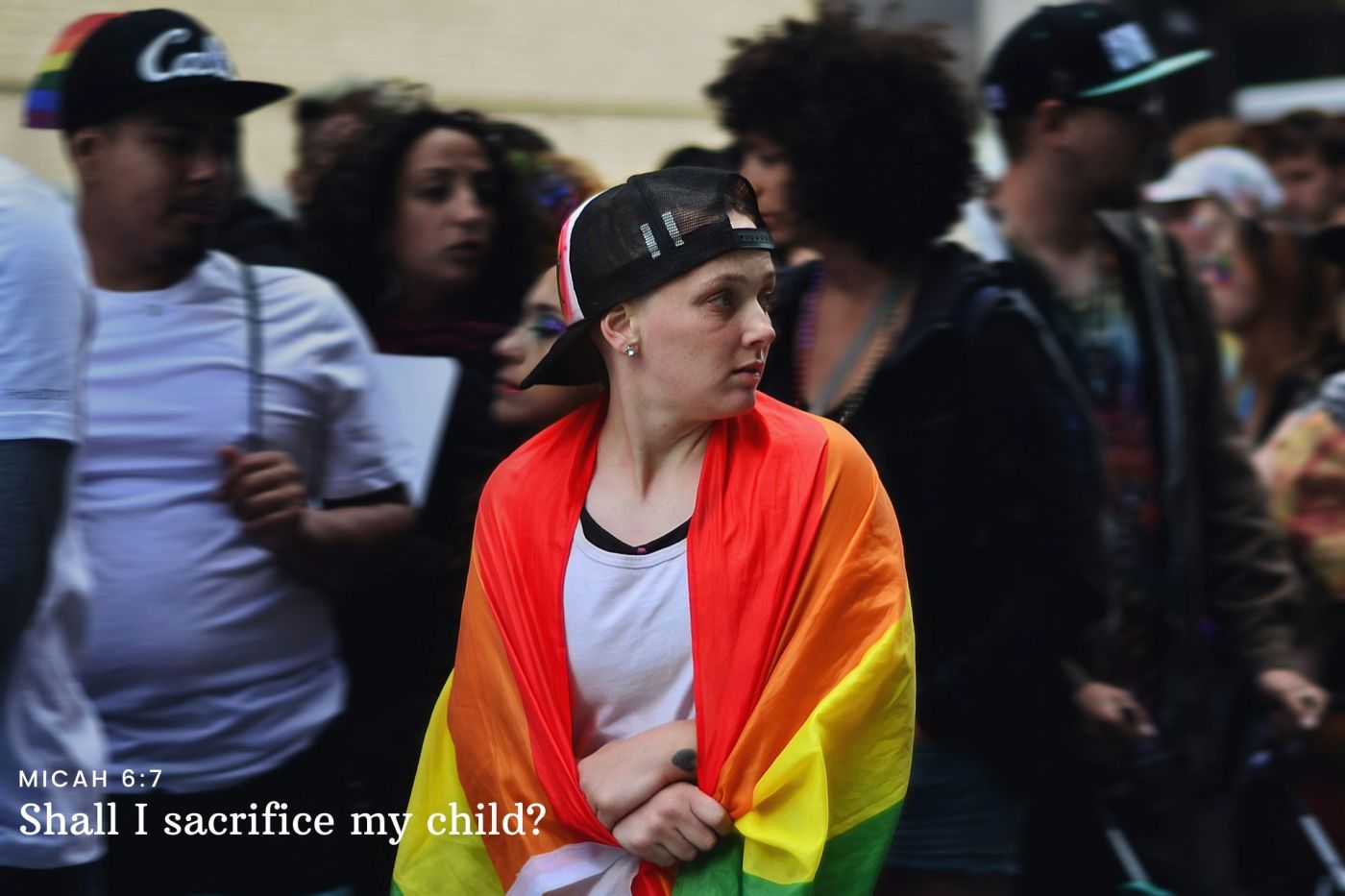
‘With what shall I come before the Lord?’ asks the prophet Micah. ‘Shall I offer my firstborn, the fruit of my body?’ In other words, shall I sacrifice my child to my faith, just as my dear friend was sacrificed to her father’s convictions? The answer is clearly no, for he goes on to ask again, ‘And what does the Lord require of you?’ The answer, very famously, is this: ‘To seek justice, love kindness, and walk humbly with your God.’ So we actively seek not discrimination, but equality and safety for all. We engage not in condemnation and judgement, but in kindness and mercy for all. Our stance must never be one of arrogance, but a grounded humility in our dealings with all, no matter their gender or sexuality. And for this stance to be more than theoretical, this means much more than benign silence. It means acknowledging and repairing the harms that have been done in Christ’s name. It means treading gently with our faith and our opinions, alert to other people’s stories. And for those of us who can, it means going beyond the boundaries of the church to the places where people are hurting, and embodying lovingkindness among the people we encounter there.
The Jesuit priest Daniel Berrigan once cheekily proclaimed, ‘Your faith is where your ass is at!’ He went on to explain that faith is not about your words, or your stated theology, or your vague feelings of benevolence. Instead, your faith is about where you place your body in real space and time: for where your body is reveals where your deepest commitments truly lie.
Ten years ago, feeling deeply foolish but with too many sad stories in my heart to ignore, I took my body to a local council IDAHOBIT event. IDAHOBIT is the International Day Against Homophobia, Biphobia and Transphobia; as many of you will know, it’s marked on May 17th each year. At the time, I was a pastor in a regional area which showed fairly widespread hostility to LGBTQ+ folk. There was the casual violence, the name calling, the accosting in the street; the homophobia from the pulpits; the footy club slurs. This was all bad enough, but during the plebiscite on gay marriage, Christians carrying anti-gay placards marched on local government schools at pick up time. In this context, I wondered if it might be helpful, even healing, for someone if I as a pastor were to place my body in that space. I wasn’t sure. I knew nobody, I’m terrible around strangers and very awkward in a crowd, and I worried that simply being a Christian there could be triggering for somebody.
Despite my fears, however, I kept feeling prompted to go. So I turned up in my fairly awkward self. Someone very graciously welcomed me and asked me who I was. When I told them I was a minister, they nearly fell over. They told me it was the first time a pastor or public Christian had ever showed up in that space. I was asked to join people for gake – gay rainbow cake – so that more people could meet me, and that is where I met the friend who was thrown out of home at fifteen. It was much later that she entrusted me with her story, and even later with her cross. But it was only when I was moving away that her girlfriend said to me, ‘If all you had ever done was turn up that first day, just once, it would have been enough.’ After a lifetime of condemnation, persecution and hatred from people who call themselves Christian, she said it was profoundly healing to have a Christian turn up to a public event who said, ‘I’m here, I’m sorry, pleased to meet you.’
Friends, I’m no saint. I’m constantly learning more about divesting myself of deeply rooted Christian privilege, and that particular friendship has been largely to my benefit. Over the years, I have learned so much from various queer friends about the way of Christ, that is, what it means to be rejected and persecuted by your religious leaders, your townsfolk, and those who are supposed to love you; what it means to be steadfast; how not to capitulate to hate. I am so grateful. And I look to the day when queer folk no longer bear the brunt of our society’s fear and hatred, and are no longer the scapegoats of the church. I look to the day when nobody has to hide in the shadows for fear for their personal safety. Indeed, I look to the day when all people know fullness and flourishing through the life of the Holy Spirit.
In the letter to the Hebrews, we are urged: ‘Let us go outside the camp, bearing the disgrace that Jesus bore: for here we do not have an enduring city but we are looking to the city to come.’ I imagine a big city, a gracious city, overflowing with life and diversity; I imagine a generous city, a just city, where absolutely everyone can thrive.
But until that day comes, among a demographic which experiences so much discrimination and harm so often in Jesus’ name, let us acknowledge and bear his disgrace. Let us empty ourselves of privilege and power and move out of our comfort zone. Let us align our bodies and lives with deeply vulnerable people in our personal relationships, our workplaces, our neighbourhoods, and the wider world. Let us follow the Spirit’s beckoning to unexpected, even deeply uncomfortable, spaces, that we might bear witness not to hostility and condemnation, but to God’s overflowing graciousness and love. Ω
Reflection for a belated IDAHOBIT shared with The Village Church, Mount Eliza, on 25 May 2025 (off lectionary) © Alison Sampson, 2025. Photo by Palash Jain on Unsplash (edited).
 Alison and the whale