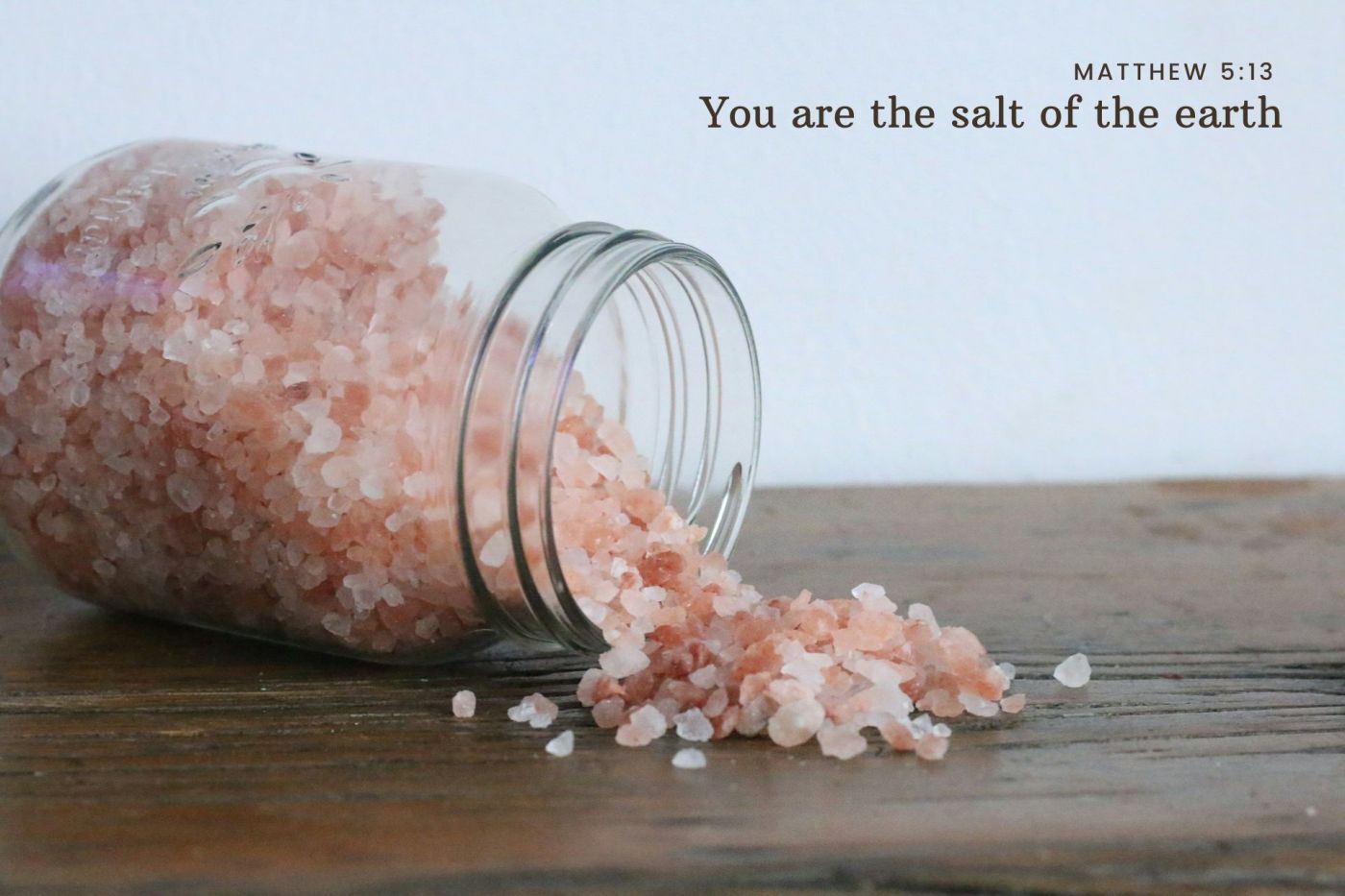
On law, exile, love and salt. (Listen here.)
Salt, light: no doubt most of you have heard a sermon or three about these before. And no doubt at least one of these sermons has talked about doing good in this world. I’m all for this interpretation: I’m a Protestant! So I’m a huge fan of running around for Jesus and doing stuff, for ‘faith without works is dead.’ (James 2:17). But I’m also aware of the risks of this approach. Too easily, saltiness becomes something we strive for rather than a description of who we already are. Too readily, we get caught up in being seen to be good people who are doing good works, and we forget the fundamentals of relationship.
So I’d like to introduce another way of reading the passage which I find helpful. It gets us to the same place in the end, but it’s based not on our activity but on God’s formation. This way of reading starts in a story.
Once upon a time, long, long ago, there was a mighty empire called Assyria. In those days, it was the biggest empire in the world. It had the most powerful army. It was incredibly rich. And in 722 B.C.E., the Assyrians invaded ancient Israel. They colonised the land, they stole the wealth, and they sent tens of thousands of captives into exile.
Now, the Assyrians weren’t kind, but they were smart. They knew that if their captives stayed together, they would stay strong. The Assyrians didn’t want that; they wanted obedient slaves. So, like more recent empires and colonisers have done, the Assyrians deliberately sprinkled the Israelite captives across their whole empire. This way, the captured Israelites lost their links to language, history and mob. These folk never made it back to Israel. Instead, they were gradually assimilated, building new families and communities with people from other countries, other cultures, other religious groups. Gradually they lost their Jewish identity, not only in the eyes of others, but they forgot it about themselves.
Yet the rabbis maintained that, without even knowing it, these hidden Jews embodied the basic moral practices of Torah, that is, the Jewish Law as described in the five books of Moses. They might not have followed all the rules, they might not even have known them, but their lives were Torah-shaped. For the Law had taught their ancestors to love God and love neighbour, and this orientation and practice continued through the generations.
As such, the hidden Jews were a force for good in the world. The rabbis described them as salt of the earth. Like salt, they brought out the best in what was around them. Like salt, they preserved life. Like salt, they healed wounds. Like salt, they were bold and distinctive. And like salt, they had been sprinkled around.
When the rabbi Jesus tells his Jewish disciples that they are salt of the earth, he is drawing on this ancient story, and he’s doing it as part of his renewed interpretation of the Law. For the gospel according to Matthew describes Jesus in ways which parallel the Jewish law-giver Moses. Like Moses, Jesus comes out of Egypt. Like Moses, Jesus crosses the waters. And like Moses, Jesus goes up the mountain and teaches his followers how to live.
We call this teaching the Sermon on the Mount, and in it we find the Beatitudes. We also find a call to faithful relationships, a command to love our enemies, an encouragement to be generous and trusting in all that we do, and this little passage on salt and light. And right after this salt/light thing, Jesus tells his listeners that he didn’t come to abolish the Law and the Prophets but to fulfil them, and that not one letter of Torah will ever pass away.
The funny thing is, Jesus and his disciples frequently broke the rules. They gleaned wheat on the Sabbath, they healed on the Sabbath, and they didn’t wash their hands in the ritual way. They ate with sinners and foreigners and shared their food, and they were regularly criticised by religious authorities for doing these things. So how could Jesus fulfil the Law if he didn’t follow all its rules?
In Matthew 22, a no doubt anxious religious authority asked Jesus to describe the greatest commandment. Jesus replied, ‘Love the Lord your God with all your heart and with all your soul and with all your mind. This is the greatest and first commandment. And a second is like it: Love your neighbour as yourself. On these two commandments hang all the Law and the Prophets.’ (vv 37-40). So, love of God, love of neighbour: this is the fulfilment of faith, because the Law and the Prophets rely on these things.
When Jesus tells his Jewish disciples they are ‘salt of the earth’, he’s telling them who they already are. They’re the people who embody the goodness of the Law in the world. As we have just heard, this goodness is expressed through loving God and being a great neighbour. So it’s about being engaged and attentive and generous and kind. It’s about being open to difference. It’s about justice and fairness and service. The Law is provided to shape people in these ways and guide them in these things. But by alluding to an ancient story of exile, Jesus is implying that even people who don’t know or have forgotten the Law can live with love, love and more love, poured out as kindness and justice and hospitality and humility and service.
Not one letter of the Law will be erased: because the call to love God and neighbour continues. Not one person will be erased: because absolutely anyone might be the great-great-great-great-great-great grandchild of an exile. And not one neighbour will be erased: because in this reading, whether friend or stranger or even enemy, whether coloniser or colonised, whatever their nationality or culture, whatever their abilities or migration status or loves, every person is precious to God and is worthy of our love and care.
‘You are the salt of the earth,’ says Jesus to his disciples. We don’t need to make it happen. So let us pay attention to his teachings: the Beatitudes, the fulfilment of the Law and the absolute priority of love. For through love, we will bring out the best in what is around us. Out of love, we will preserve life. Because of love, we will heal wounds. By our love, we will be bold and distinctive. And for the sake of God’s endlessly overflowing love for the world, we will be sprinkled around.
Let us pray: Loving God, even when we forget ourselves, you work through us. Continue to fill us with your love, grant us your savour, and sprinkle us wherever you need, because salt is both who we are, and what we long to be. Amen. Ω
Where & when: It’s Waring Wombat Season, deep winter, and Old Man Saltbush is blooming. Dense panicles of delicate pink flowers grace every bush, set off against the salty, silvery leaves.
Reflection on Matthew 5:13-20 shared with Westgate Baptist Community Church, 27 July 2025 (off lectionary, reading usually assigned to Epiphany 5 Year A) © Alison Sampson, 2025. Draws on insights by Richard Swanson found at provokingthegospel (here). Photo by Melissa Di Rocco on Unsplash.
 Alison and the whale