On flea bombs, sick kids, old wardrobes, the Grim Reaper – and resurrection life! (Listen here.)
Hi, I’m Alison, and I’m the daughter of a dynamo! My mother, Ruth Sampson, was a pastor of this church in the 1970’s and 80’s. She was energetic, dynamic, well remembered by many, yet she is long gone. In her absence, I’ve been asked to talk about her contributions, both at Box Hill Baptist and elsewhere in that era, and to draw out some points for your future.
To begin: In the early seventies, Ruth and her husband John moved from Perth to Melbourne. Through Perth connections, they rented the manse – which they discovered on their first night to be absolutely flea-ridden! So they invested in flea bombs, then joined the church. Ruth began volunteering here, then gradually moved into more formal ministry roles, first alongside Graeme Garrett, then Bruce Rumbold and Dave Mutton. Her work included preaching and teaching, encouraging and companioning, mentoring, guiding and talking endlessly about faith. She also engaged in administrative and practical care. ‘Good administration is good pastoral care,’ she used to say as she organised rosters, ran events, and helped recently arrived Cambodian refugees make a home in Melbourne. At home, she cooked for and fed the multitudes, and frequently hosted interstate and international visitors.
Ruth was a great networker. She juggled ministry at Box Hill with working for the Baptist Social Justice Group and studying at Whitley College. Near the end of her time at Box Hill, she also began travelling overseas annually to serve with the Baptist World Alliance. There she held various roles: Chair of the Human Rights Commission, Chair of the Resolutions Commission and, at one stage, both roles simultaneously. (She had very little need of sleep!) These broad brushstrokes give just a hint of her networks and those of Box Hill Baptist in that era. For she participated in local Baptist networks of those who cared about justice; wider Baptist networks who cared about women in ministry and liberative theologies; and global Baptist networks of those who cared about the world. Then there were the Perth networks, the missionary networks, the local primary school networks, her university networks and all the rest.
Juggling multiple responsibilities and networks took time. Like many trailblazing women of that era, Ruth was like the Energizer Bunny; she never seemed to stop. More biblically, you could say she was a Proverbs 31 sort of woman, rising early to prepare a sermon then going to bed in the small hours after writing up the minutes of a deacon’s meeting which ran late. To quote Proverbs, she was generous and wise, and did not eat the bread of idleness. She made pastoral phone calls with the phone propped on her shoulder as she chopped, cooked and stirred dinner. She folded the Baptist Social Justice Group newsletter on the dining room table, tucked between the washing and the ironing. She wrote sermons at her desk overlooking the backyard where she could keep half an eye on my sister and me as we played. (At least once, Robyn escaped on her tricycle and pedalled down Station Street looking for a friend’s house; my mother only realised when a stranger came knocking furiously on the door, my sister tucked under one arm, the tricycle under the other.)
My mother’s activities were greatly enabled not just by my father’s commitment to her work, but by the congregation’s care. When we were young, Robyn and I were often minded by members of the church. Joyce Milne then Barbara Poxon cared for me a day each week, while my sister spent those days at the Brights, then the Horsboroughs. On Saturday mornings we went to Bruce and Jean’s for dress ups, cubbies and other creative play. In a horrible year of constant sickness – Robyn and I both got the measles, then my sister, my father and I got the mumps – Robyn and I were at one stage nursed by a church roster. I remember emerging from delirium to find one person then another standing in the bedroom, keeping an eye on me while the fever raged and soothing me back to sleep. As we grew older and less prone to illness, Ruth was frequently out. Proverbs 31 begins with the question, ‘Such a woman, who can find?’ As a grumpy teenager arriving home to an empty house yet again, my answer became, ‘Not me, because she’s never home.’
Notwithstanding her grumpy teenager, Ruth was a dynamo who galvanised others and brought people and networks together. In the New Testament, a minister or diakonos is someone who connects need with resource, whether that be food, clothing, friendship, prayer or the gospel. This is exactly what my mother did, and her death in 2000 left a great big hole in the world.
I could go on and on about my mother. However, I suggest there is a danger when a church looks to individuals to form its identity, and there is a thinness to any history which places too much focus on the pastors, the big names, the powerful personalities. For this diverts attention from all the other actors in God’s story, and takes away from the fundamentally corporate nature of the church.
I have briefly named my mother’s contributions because that is what I was asked to do, but I want you to hear this: What I remember so powerfully from those years, and what has been so formational in my own journey of faith, is not my mother the dynamo. That relationship is too complicated, too fraught. Instead, what I remember and will treasure my whole life is the dynamic loving presence of the church.
It was the coming together of the congregation as a whole to love one another, to study scripture, pray, and imagine God’s kingdom come, and to then put those imaginings into practice: those are the things which have profoundly shaped my own faith and ministry, and the faith and ministry of Box Hill Baptist Church.
The first stirrings were back in the seventies. Graeme and Ruth worked as a team, trying to galvanise a somewhat comfortable congregation into a living, active expression of God’s kingdom-culture. Together they developed the series called RevFaith, short for Revolutionary Faith. For a full year, Graeme preached on faith in action, while Ruth prepared complementary Bible studies. They sought to form a strong corporate identity as the people of God, called to join forces in order to better love and serve the world. Adapting the structure of the Church of the Saviour in Washington, D.C., committed members at Box Hill began to form intergenerational ‘households’. Young children, teens, and adults old and young met regularly to eat together, to pray and to share their lives. Each household was also encouraged to follow the Spirit’s lead in embodying the gospel in their local context.
‘Never doubt that a small group of thoughtful, committed citizens can change the world,’ wrote the anthropologist Margaret Mead. ‘Indeed,’ she continued, ‘it is the only thing that ever has.’ This could have been the church’s rallying cry.
Some members became galvanized around the high rates of youth unemployment. Led by Joyce Milne and Wal Kirby, they developed the Barn as a youth drop in centre. Over time, this morphed into a Community Youth Support Scheme, where young people were trained in life skills, cooking and hospitality. Some members opened their own homes to troubled kids and teens; perhaps half a dozen families fostered or adopted children. Other church members were concerned by the lack of affordable housing. It led to Jubilee Place, a housing agency spearheaded by Hal Bisset which continues in a different form even today. Yet others were interested in community. Together they leveraged the assets of the church in creative ways to enable households to live closer together.
There were multiple housing projects; Barcelona Street is the most well-known. There, the church purchased an odd-shaped block and organised the construction of five units built by Keith Milne. Four were purchased by church households, and the fifth made available for supported accommodation. This fifth unit saw a range of occupants over the years, who tapped in and out of support as they needed. Single mums, people struggling with mental health issues, refugees: many found a home and a regular community meal at Barcelona Street.
Other members were passionate about the arts. They formed a group which wrote and organised musicals; they put together a song book which included songs they had written to reflect the church’s emerging theology; they made banners and introduced them to worship; they enriched our lives in so many ways.
Still others were concerned about the plight of Cambodian refugees who had arrived in this country with nothing. People sourced and donated goods, filling the back hall ready to furnish homes and dress people. While Ruth helped people negotiate with Centrelink, access healthcare, find language classes, arrange marriages and learn to sew (the church ran five classes a week on industrial sewing machines!), it took the multitudes to move people from Springvale Refugee Hostel into public housing.
I have a letter my mother wrote to her parents in December 1983. After describing how she was planning a sermon and organising a lunch for 250 people, and how that same week I had come down with the mumps at a church barn dance, she went on, ‘We have eight families to move in two and a half weeks. As well, we have sold the two-storey red brick house opposite our church and tomorrow is settlement day. It’s to be demolished on Wednesday … which means that all our furniture stored there for these eight families must be moved out and stored by tomorrow … We are organising a team of babysitters for Alison, along with a team of removalists. Just as well the term ‘church family’ is more than a cliché, and reflects some kind of reality.’ End quote.
In other words, volunteers cared for me in my illness, while others moved the contents of eight households twice in two and a half weeks. Perhaps the latter helps explain why so many members of the church owned vans or trailers in that era, and why so many of them looked so fit. As my father tries not to remember, most of those house moves involved enormously heavy Victorian wardrobes – and stairs!
This work was of course linked with the emergence of the Cambodian Christian Community. Then there was the Village Well counselling service and a thousand other outworkings of the gospel.
This kaleidoscope of activities involved the whole congregation. Ministers helped galvanise people, yes, and encouraged and facilitated them. But without the open hearts, without the time set aside for bible study, prayer, discernment and action, without the willingness of so many people to get on board, get creative and get active, it never would have happened. Those were glory days because a small group of people joined forces to embody God’s economics and culture in a variety of ways, together.
We all love the idea of glory days, and those years are certainly golden in my memory. But there’s something about those days that perhaps you don’t remember or know, and that is this: these things came to life during a time of great sadness. In the decade after my parents showed up, nearly sixty people passed away. Many were older and went to meet their Maker, so to speak, but others were much younger. There were coronaries and cancer, car accidents, septicaemia, all the horrors which kill people in their thirties, forties and fifties, and a cluster of sudden deaths among lay leaders. I remember my mother saying she began to wake and wonder, ‘Which beloved person will die today?’ It was awful. Some of my own caregivers died suddenly – a Sunday School teacher from cardiac arrest, my weekly carer from septicaemia – and the church as a whole was rocked to the core.
More, it faced some very difficult questions. For what sort of future does a church have when so many members have died or are living with life-limiting illness? How could so many younger adults be struck down, so many parents of young children, so many leaders? What does it mean to be blessed by God when all is dust and ashes? Comfortable assumptions about faith and God’s favour had nothing to offer in this moment.
It was amidst this wreckage and wrestling that RevFaith really took off. For in turning to the Beatitudes and in contemplating the way of the cross, people gained clarity. They saw that their suffering wasn’t some bizarre divine punishment, and they realised there are no guarantees. The biblical witness is clear: the life of faith includes pain, grief, and persecution. More, it dares to claim that those who suffer are blessed, and it insists that on the other side of death, there is resurrection. And so it was, for out of this time of great sadness and suffering new life, new relationships, and a church on fire for the gospel emerged.
The Cambodian Christian Community was one example. Box Hill was a very Anglo church until the Sunday an older Cambodian woman turned up. She spoke no English, but sat through the service in silence then ducked out the door. The next week she returned, bringing forty or so Cambodian friends and relatives. Recent boat arrivals from a Thai border camp, they were living at the refugee hostel and looking for a church. They came, they stayed, and forty years later Cambodians continue to be part of the congregation, both in the morning service and through the Cambodian Christian Community which for decades met here in the afternoon.
A few months after their arrival, someone asked a member of the group what had prompted them to come. The answer was simple: the woman who first visited had gone back to the hostel and said, ‘I’ve found a church that understands grief.’ Without a word, without a shared language, she had read the faces and the pain in that place and recognised it for what it was. Given the brutal regime from which she and the others had fled, she was looking for a place which might understand. And so a dying church was reinvigorated; an Anglo church became bicultural; new relationships were formed; and we all glimpsed resurrection.
There are many other stories from that time, but it now seems so long ago. For many here today, perhaps it is but a dim memory, or a rumour of things unseen. Even the most vibrant era will always be just a moment in time; it cannot continue forever. RevFaith grew, and flowered, and bore fruit, and died, but the seeds of that time continue to germinate. My own work in Warrnambool was one such fruit; so, too, my sister’s work in policy and advocacy for vulnerable people, and so many others. For there must be a hundred, perhaps a thousand, people and projects that in one way or another have their roots in those days.
Even so, the ongoing influence is largely invisible and, like most churches these days, Box Hill Baptist feels a bit diminished. A once packed church is now half empty. Key members are incapacitated, or have left or died, and others will soon follow. There aren’t many kids, and perhaps you’re wondering what future, if any, the church has.
I don’t know the answer to that question. We are living in a very different era from the days of RevFaith. Our economy has changed radically. Housing is far more costly; travel is much more common; everything’s open on a Sunday. Women have entered the paid workforce en masse, families are super busy and church attendance is no longer the norm. What happened fifty years ago was rooted in a particular economic and cultural moment; things will not happen in the same way again. We are in a new context, and the life of the community of faith must take a different form. Yet what form this will be, I can’t yet imagine.
Even so, I know this: that a small group of thoughtful, committed citizens of the kingdom of heaven who gather regularly to love one another, to read scripture attentively, to pray wholeheartedly and to wait for the Spirit’s lead can expect their hearts to be set on fire. And out of this will come something good, something life-giving, something entirely new and unexpected, which we cannot yet predict or know.
Long ago, RevFaith erupted from ashes. RevFaith itself is now ashes, as are many key players along with my dynamo of a mother. So, too, have we endured the slow death of many people’s hopes and dreams for the church. What we once knew is no more; what we now face is a mystery. In this context, I wonder, what needs to be let go of? What still needs to die? And how are you gathering together? Because seeds lie dormant, waiting to emerge. Let us nurture them with love and prayer, and let us be ready for the harvest. Ω
Where & when: Wurundjeri country. We’re now in Poorneet, Tadpole Season, a time of blustery gales, warm winds and sudden showers. Dragonflies fill the air with their dance, Waa is building his nest, and tadpoles are just about to hatch!
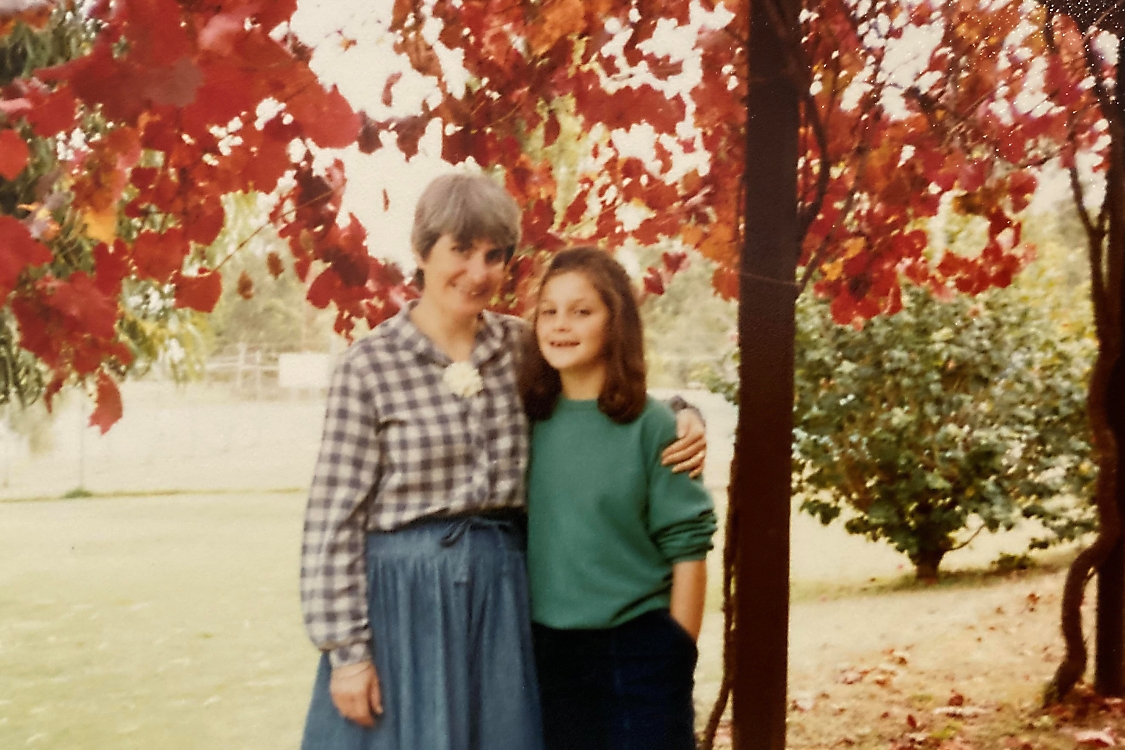
Reflection shared with Box Hill Baptist Church, 21 September 2025 © Alison Sampson, 2025. Image shows two Reverends: my mother Ruth Sampson (ordained 1990) and me, Alison (ordained in 2018).
 Alison and the whale