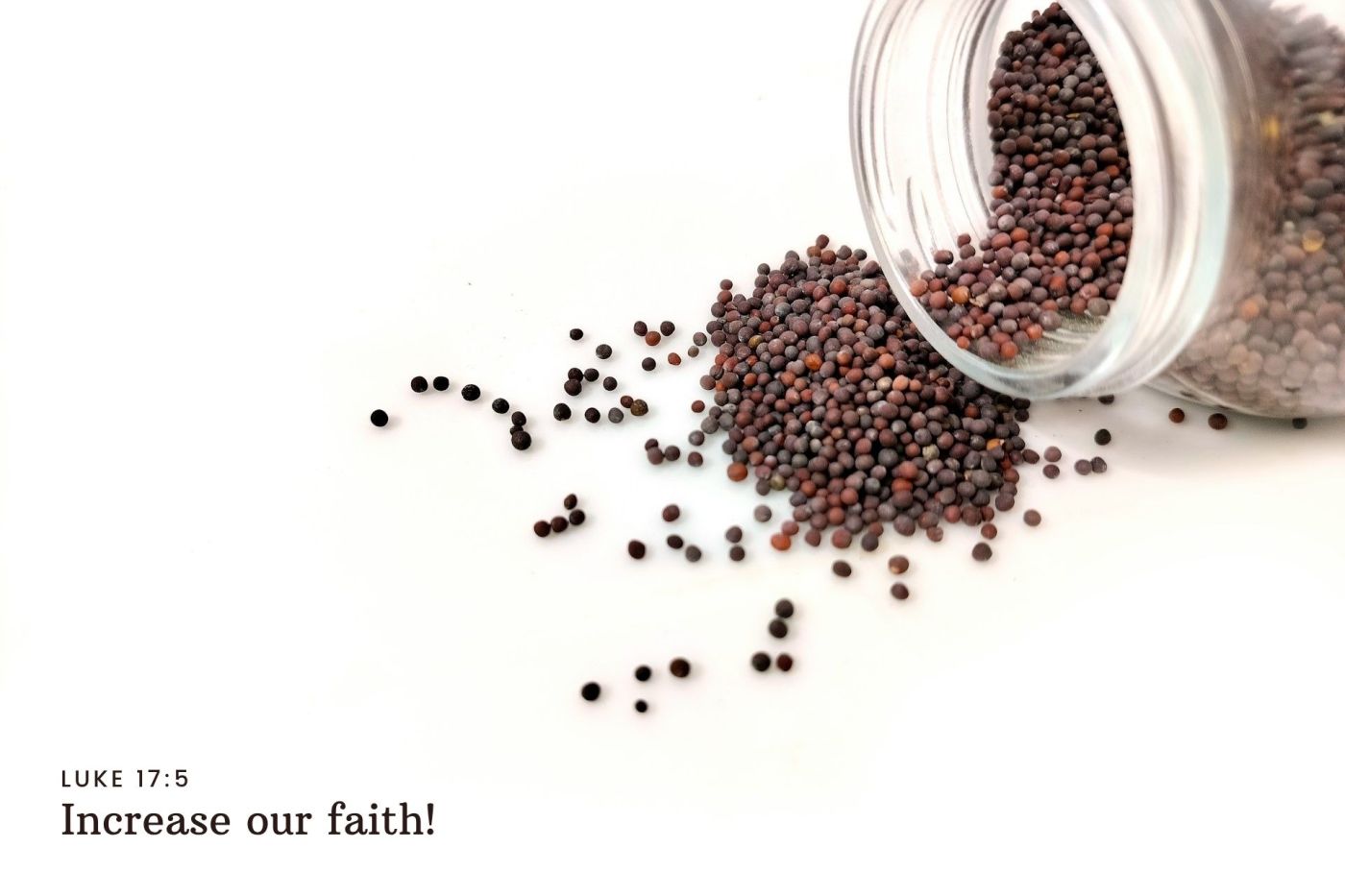
How much faith is enough? (Listen here.)
Once upon a time, John D. Rockefeller was the richest man in the world. At the peak of his wealth, he was asked by a reporter, ‘How much money is enough?’ To this he famously replied, ‘Just a little bit more!’ If only I had a bit more money, says the rich man, then I’d relax. I’d be able to slow down and take a break. I’d spend more time with my family, explore my creativity, follow my deeper calling, be more generous, give more away. Whatever. But first, I just need that little bit more. You want something from me? I’ll get back to you in a year or three. I’ll be ready then.
I remembered Rockefeller’s words as I was preparing this reflection. It can be nerve-wracking to look at a blank page and know that I’m expected to come up with something meaningful. This week, I read the texts and thought, Lord, what on earth am I going to say? What riveting image, what extraordinary story, what great insight will I share? God, they’re a smart bunch, they’ve been at church forever, they’ve heard everything, I’ve got nothing! I need more wisdom, Lord. More education. More creativity, more time, more solitude, more anything. Then Rockefeller’s words came to me.
They reminded me that Luke’s account is full of people wanting just that little bit more. Jesus, tell my brother to share the inheritance with me! Teacher, what must I do to get eternal life? Father, give me my share of the estate. Sir, I have just bought a field, more oxen; I can’t come to the banquet. Lord, increase our faith! And when we’ve got the more – more land, more money, more life, more oxen, more faith – then, perhaps, we will be truly faithful.
But to all this, Jesus says: No. To all this, he says, The kingdom is among you, here and now. To all this, he says, wealth is fleeting, and you can’t serve both God and Money. To all this, he says, Don’t wait! Seize the day, and follow me. And to his disciples he says, ‘If you had faith the size of a mustard seed, you could tell that mulberry tree, “Be uprooted and planted in the sea.’’’ (Luke 17:6).
Over and over again, in many different ways, Jesus tells people they have what they need to be faithful. When faced with 5,000 hungry men, not to mention uncounted women and children, the disciples want to send them away so they can purchase food. But Jesus tells his disciples, ‘You give them something to eat.’ (Luke 9:13). You do it. You have the resources. You have the power. Now.
Faced with a hungry person? Give them a sandwich. Need to prepare a sermon? Sit down and write. Worried about someone? Get on your knees and pray. Over and over again, he expects his disciples to bring goodness, growth and fruitfulness into harsh and unpromising circumstances. Proclaim the gospel! Heal people! Forgive someone seven times in a day! Refuse to retaliate, choose peace, plant a mulberry tree in the sea!
Of course, we can’t quite do these things. We don’t have the power, we can’t make things new, we rarely bring healing, our efforts at proclamation are deeply compromised and forgiveness is frequently beyond our grasp. No wonder the disciples beg, ‘Increase our faith!’ Because if faithful activity relies on our own faith, our own skills, our own efforts, it’s truly impossible.
But faith is not something we have. It’s not something we can grab at. It’s not a rare gift given only to special people. It’s not something we need to wait for, and it cannot be increased. The people Jesus praises for faith aren’t the religious experts or the mega-rich or those who have their act together. Instead, Jesus commends those who simply turn to him in trust. The haemorrhaging woman. The Samaritan leper. The Roman centurion, the blind beggar. They’re people outside the religious fold; they got nothing. But these are the people Jesus commends. For, in their trust, they make room for his power to flow through them, and then anything can happen. Healing, perhaps, or acceptance. Worship. Community. Transformation. Resurrection life.
For those of us who pride ourselves on our faithful activity, Jesus’ approach can be deflating. It would be nice to be more appreciated by him, to be patted on the head and given a biscuit from time to time. Instead he admonishes disciples to consider themselves as worthless slaves, only doing their duty. When these words are wielded like a weapon, or heaped on those whose work is all too often undervalued or dismissed i.e. women, then these words can be dangerous. But in the context of faith, and owned for ourselves, they make sense. Because if we think faith is something we have, we earn, we deserve, we strive for, then we are prone to congratulate ourselves for any expression of faith. Healing and all the rest become evidence of our own gifts and talents, rather than the power of God flowing through us. On the flip side, we will always want just that little bit more. We can’t do this, we don’t have the resource, my faith isn’t strong enough yet. Give me more time, more money, more wisdom, more strength, more power in the Spirit, Lord: then I will be faithful!
But faith is not about us. Instead, faith is what happens when we stop focusing on ourselves and instead turn towards God; and its fruit is seen when we are empty enough for the Holy Spirit to flow through us.
‘Increase our faith!’ say the disciples still learning.
But John the Baptiser says, ‘I must decrease.’
The apostle Paul says, ‘God has called us to a holy life, not because of anything we have done but because of God’s own purpose and grace.’
And to the apostle Paul, Christ says, ‘My grace is sufficient for you, for my power is made perfect in weakness.’
So with John, let us decrease. With Paul, let us empty ourselves of any ego. Let us let go of any pride in our own achievements or any anxiety about not doing or being enough. Let us reject any idea of the strength of our faith, and any shame at any sense of its weakness. Instead, let us turn to the One who loves without measure, and who seeks to fill us with overflowing life. For the steadfast love of the Lord never ceases, God’s mercies never come to an end. They are new every morning, for God’s faithfulness, and only God’s faithfulness, is great.
Let us pray: Christ Jesus, you taught that the hungry would be filled, then you emptied yourself of power and gave your life away. Empty us, Lord. Empty us. Put to death our reliance on wealth, our pride in our gifts, our shame at our faithlessness. Empty us, and make room for God’s fullness: that our lives might shine out with your faith. Amen. Ω
Where & when: Wurundjeri country. We’re now in Poorneet, Tadpole Season. Magpies are swooping, swallows are soaring and, high above Collins Street, three peregrine falcon chicks have hatched.
Reflection shared with Manningham Uniting Church, 5 October 2025 © Alison Sampson, 2025. Photo by Jaspreet Kalsi on Unsplash (edited).
 Alison and the whale