Corporate logos vs the cosmic λόγος. (Listen here.)
Whenever I hear Colossians or pretty much any of Paul’s letters, my brain has a tendency to shut down. ‘Yeah, yeah, yeah,’ I think or maybe, ‘Yeah, nah,’ as I impatiently wait for the gospel reading. Why? Because Paul’s letters are packed with political and cultural references that we all too often miss. So we tend to talk about them using formal theological terms and other religious mumbo-jumbo, spiritualising what are actually explosively political texts. In this way we answer questions no-one’s really asking, rendering the texts abstract, lifeless and marginal to our faith.
This is a crying shame, because Paul’s letters aren’t religious speak at all. But to understand why, we need to know a bit about the context. Paul was writing against the backdrop of Rome. In Roman proclamation, Caesar was equal to the beginning of all things. Caesar was described as the start of life. Caesar was the saviour, the peacemaker. Caesar was the head and father of empire. Caesar was the one who brings good news. In Colossians (and other texts), Paul appropriates this imagery, language and worldview and reinterprets it through the lens of Christ. He replaces Caesar with Christ and the body politic of empire with the vulnerable body of the church.
In so doing, Paul paints a picture of an alternate kingdom whose politics, economics, virtues and household codes are antithetical to the emperor and all that the empire stands for. Colossians, then, is an invitation into a potentially treasonous worldview. To affirm this worldview is to declare an allegiance which puts the reader at odds with the society around them, even as it challenges them to dismantle many of the values which they themselves have internalised.
To help us hear just how outrageous Paul’s claims are, rather than explain line by line I’d like to try something a little different. Drawing on a method called targum and inspired by the work of Brian Walsh and Sylvia Keesmaat, I’d like to re-tell the Christ hymn (Colossians 1:15-20) for this day and age. Targum is a process of weaving translation and commentary together, helping a community locate a text in their current moment. It’s a way of being faithful to scripture while recognising that dominant powers and images keep changing, and that significant reimagining is required to render the text meaningful here and now. So in the spirit of the Word made flesh who dwells among us, let’s turn to the words of the Christ hymn and see if we can hear them anew.
We live in a world of images. Apple, Microsoft, Meta, Google. Facebook, insta, X. Nike, adidas, lululemon. Logos abound. They adorn our clothing, litter our workspaces, top our buildings. On every bag and bus stop: logos. On every tax invoice and business letter: logos. On every fast food chain and every packet from the supermarket and even on the waistband of our underpants: logos. We recognise them instantly. Our individual lives are permeated by the logos, shaped by the logos, defined by the logos that we embrace. And with all these logos come world-building myths so ubiquitous and powerful, we rarely notice them.
What are some of these myths? Here are just a few. AI is inevitable; we must use it or be left behind. Billionaires are remarkable and have earned their wealth. Environmental destruction is the necessary cost of economic growth, and economic growth is always necessary. What we buy, wear and like is a powerful statement of individuality and identity. Regulation of business stifles creativity. Technology will save us. And on it goes.
We live in a constant deluge of this attention-seeking mind-numbing creativity-cramping messaging, refreshed every three seconds on our phone. The attention economy, corporate culture, surveillance capitalism and the myth of global affluence have colonised hearts, minds and even churches; most of the time we are too co-opted and too overwhelmed to even notice.
But into this desert of the imagination explodes not another logo but the λόγος, the Word, the Christ. Christ is the image of the invisible God: and this image is different. In a world which worships wealth, he says, ‘Blessed are the poor.’ In a world which elects patriarchal power, he washes the feet of his friends. In a world which insists shopping is a civic duty, he says, ‘Don’t worry about your life, what you’ll eat or wear.’ In a world which seeks wisdom from online gurus, he says, ‘Consider the ravens, consider wildflowers, break bread.’ In a world which loathes disability and tries to hide or fix it, he asks a blind man, ‘What do you want me to do for you?’ In a world of trademarked therapies, he says, ‘Your faith has made you well.’
This is an image of freedom, not control.
It’s an image of invitation, not coercion.
It’s an image of self-giving, not grabbing.
It’s an image of abundance, not scarcity.
This is the image of a God who refuses to dominate and who prioritises the weak and vulnerable. And this is the image we are called to embody, for we are made in the image of the One who has been made visible in Christ.
Christ, who is the firstborn of all creation. In Christ, all things on earth were created, things visible and invisible. Whether thrones or dominions or rulers or powers, whether tech lords or overlords or even time lords, whether media barons or mining magnates, whether Rome or Wall Street or Silicon Valley or the Pentagon, whether eggs or elephants or electrons, all things, all desires, all logos, all powers, all drives, whether life-giving or death-dealing: all things have been created through Christ and for Christ. Christ precedes all things, and all things hold together in Christ.
When we are fragmented into itty-bitty consumer units lit by the glowing of a screen: all things hold together in Christ. When we are torn apart by the politics of scapegoating and envy: all things hold together in Christ. When we are dislocated, disenchanted, dispossessed, depressed: all things hold together in Christ. In a culture of death, in a culture of denial, in a culture of rapacious consumption and ecocide and killing fields and revenge porn: all things hold together in Christ. For Christ is at the head of the resurrection parade, where all that is wounded, alienated and broken, all that is untethered, all that is fractured, all that is polluted and dying and death-dealing and even dead, all things are being drawn into newness of life and wholeness and health and healing.
And in this fragmented, disconnected, atomised world, Christ takes on flesh through the wounded weirdness we call church. In the common prayers, in the acknowledgement of sin and the grace of forgiveness, in bread, wine and water; in relinquishing power and in priority for the poor; in testimony, in vulnerability, in truth-telling, in lament; in an alternative economics and in care for creation; in an identity so much bigger than any logo we could ever brand ourselves with; in the coming together of all genders and all ages and all sexualities and all abilities and all classes, the church embodies the diverse community of God imaged as the body of Christ.
And Christ is the beginning of all things. Not the emperor, not the president, not the tech bros, not the large language models we pretend are intelligent, not DNA sequencing, not ancestry.com, not the coding which creeps into all our lives, but Christ. Christ is the firstborn of the dead, Christ holds the first place in everything. For in Christ, all the fullness of God was pleased to dwell. The life, the abundance, the grace, the goodness, the generosity, the mercy, the indescribable overflowingness of God: all, all of it dwells in Christ who is the DNA of the church.
And through Christ, God was pleased to reconcile to themselves all things, whether on earth or in heaven. All you can imagine and far more that you can’t, all the sin, the hurt, the failure, the fracture; all the beauty, the pain, the suffering and the glory; all people, all quarks, all asteroids, all armadillos: all things are reconciled through Christ.
And how? Not through force, not through violence, not through erasing difference or denying diversity. Not through exerting power, not through loudly shouting. Not through synthesizing all ideas and existence into a totalitarian whole. Instead, reconciliation happens through a brutal execution by the state.
Perhaps you heard? The prisoner was accused of subverting the nation. ‘He opposes payment of taxes to Caesar,’ they said. ‘He claims to be Christ, a king, and stirs up people by his teaching.’ (Luke 23:2, 5). He rejects the rule of Rome, of Silicon Valley, of Death Valley. He offers an alternative body politic, a liberating worldview. And although the governor said there was no basis for condemnation, he then decided to appease the masses by ordering the prisoner’s death.
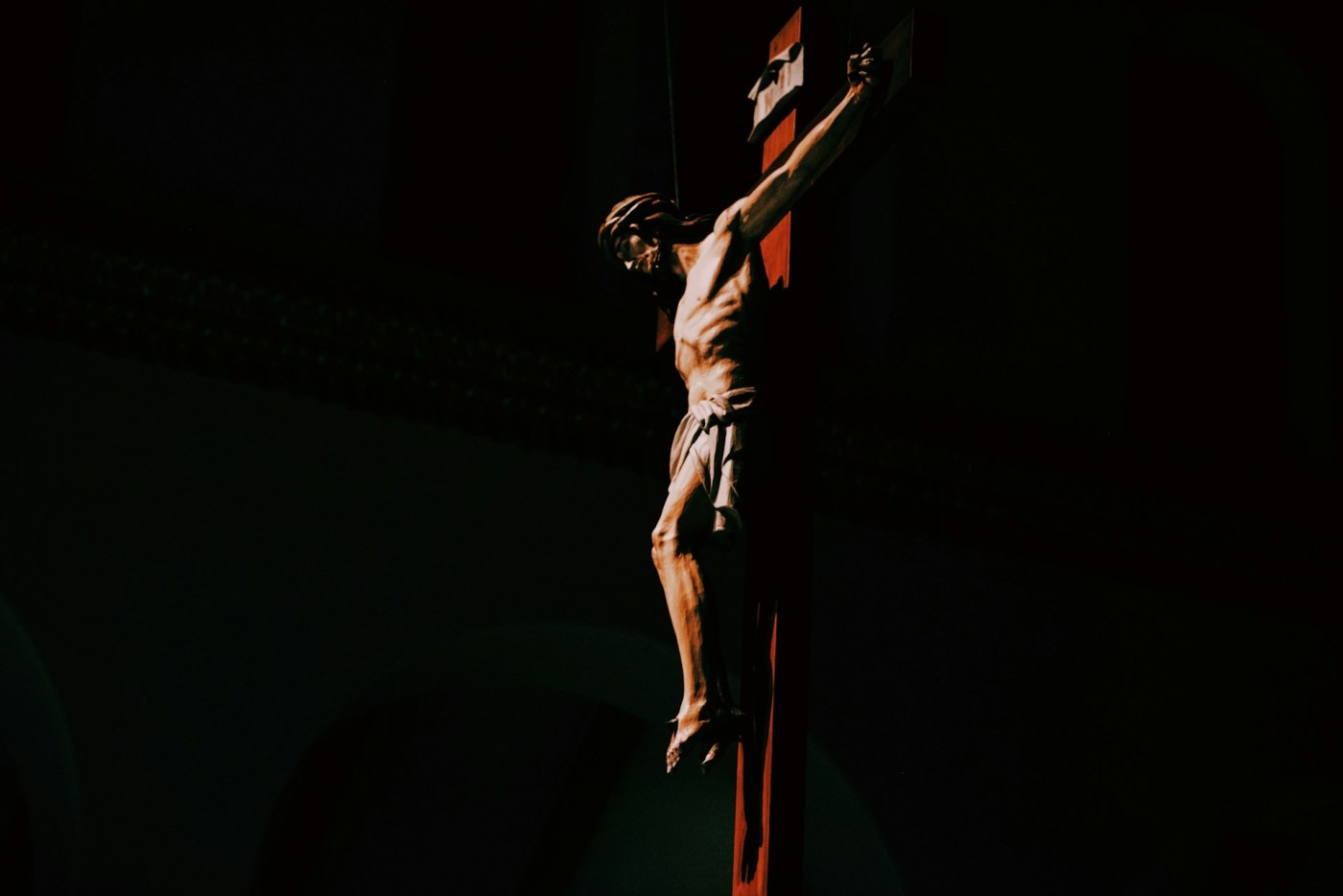
And reconciliation happened. It happened when the prisoner refused to call down angel armies and lay waste to human folly. It happened when he emptied himself of power and gave his life away. It happened as his arms stretched wide and the whole world was drawn into his embrace. It happened as his blood poured down and he breathed, ‘Father, forgive them.’ And it happened in the promise he made shortly before his death: ‘Today,’ he said, ‘today, you will be with me in paradise.’ As he takes on the suffering of the world and ends the tyranny of violence, he draws us into the garden of creation where everything began. This is the garden where God strolls in the cool of the evening. It’s the cemetery lit by the lemon light of dawn. It’s the city of fruit trees and rivers and the healing of all nations; it’s the site of mystery, commissioning, proclamation, joy.
In self-giving love, in the acceptance of suffering, in arms outstretched, in blood and water and bread and forgiveness, in the life-giving promise of communion in the garden on the other side of death: this is the image of the invisible God, the λόγος, the Word, the one true logo for our lives. And this is the image in which we are made: for we are the body of Christ. May our life together be permeated by the λόγος, shaped by the λόγος, defined by the λόγος that we embrace. In the name of Christ and only Christ: Amen. Ω
Where & when: Wurundjeri country, Buarth Gurru (Grass Flowering Season). The local grasses are heavy with lime green, burgundy, and brown flowering stems. Common brown butterflies are in the air, as are floating columns of midges. The air is warming, winds are gusting, storms are common.
Reflection shared with Manningham Uniting Church, 23 November 2025 © Alison Sampson, 2025 (Proper 29 Year C, Reign of Christ). Shaped by the work of Brian J Walsh & Sylvia C Keesmaat in Colossians Remixed. Subverting the Empire. (Downers Grove, IL: IVP Academic, 2004). Photo by Gianna B on Unsplash.
 Alison and the whale