Matthew | A bracing antidote to Christmas chaos

The prophet John provides a bracing antidote to Christmas consumer chaos. (Listen.)

It’s the second week of Advent, a time of preparation, and many of us are indeed preparing. We’re negotiating with families over who gets Christmas lunch, and who gets only Boxing Day. We’re arguing over whether to buy presents for everyone, or just the kids, or no one. We’re wondering if we can do handmade or recycled gifts, knowing we’ve left it too late, and that an avalanche of plastic is heading our way. We’re ordering hams and Christmas puddings; we’re decorating the house; we’re making lists and checking them twice. We’re juggling end-of-year events, and wading through Santa songs and pre-Christmas sales. Continue reading “Matthew | A bracing antidote to Christmas chaos”

Conflict in the church

It’s true: Christians fight. Sometimes (and this is embarrassing) they squabble over money or furniture or music or the flowers; other times (and perhaps this is more understandable) they argue over who is welcome at the communion table, what age is appropriate for baptism, or whether to eat meat sacrificed to idols. Often, they have simple personality clashes. The truth is, conflict has been part of church life since the earliest days, and what marks a church is not the absence of conflict, but how it is handled. Continue reading “Conflict in the church”

Luke | Proclamation, parties and praise!

Our Year of Luke is winding down, and I’m more in love with Luke than ever. Maybe it’s because Luke’s account is written for people like us: educated, professional, cosmopolitan, the sort of people who buy coffees out and who can confidently navigate a big city. The joy of Luke – and there’s a LOT of joy – is found when we allow God to confound our expectations and turn the world on its head. Hospitality is a big deal, and Luke teaches that we experience God’s hospitality when we welcome the stranger. Guests become hosts, outsiders know grace, the poor are blessed, and resurrection life can be experienced in this life now. Continue reading “Luke | Proclamation, parties and praise!”

Isaiah | Peace and plenty for everyone

Isaiah’s vision of a new creation promises peace and plenty for everyone: Indigenous, colonial settler, migrant — and koalas. (Listen.)

This reflection was prepared for a local people in a local area. However, its themes are pertinent to every locality in Australia, particularly, this week, those regions on fire because of colonial land clearing and extractive industries which release carbon, heat up the atmosphere and trigger catastrophic fires; and those regions affected by police racism and violence, including Yuendemu, where people are mourning the death of Kumanjayi Walker and protesting continued injustice. Continue reading “Isaiah | Peace and plenty for everyone”

Luke | This resurrection life

The church is called to embody a culture where women are no longer silenced, invisible or subjugated, and all people are called into community. (Listen.)

Every now and then, I get a letter addressed to Mrs Paul Holdway; and I reel. Once I’ve stopped reeling, I wonder who on earth this woman is. She sounds like a shadow, a cipher. She’s probably maternal, almost certainly matronly. I’m sure she’s a great supporter of her husband and good at housework. She probably darns other people’s socks, and I’m sure she makes things for cake stalls and fetes. I have no idea what she herself is like, or what she herself is really interested in, but I do know this: There’s something extraordinarily silencing about having my name obliterated in a letter which is ostensibly addressed to me. Continue reading “Luke | This resurrection life”

Luke | Recognizing our limits

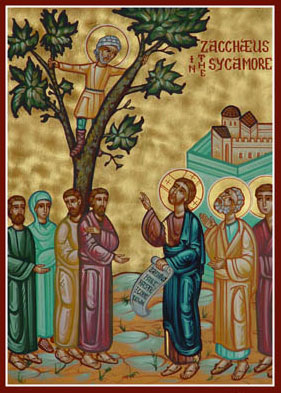
The gospel tells us that Zacchaeus is a man of short stature. He is also limited by Roman rule, by social expectations, and by other people’s judgements. Like Zacchaeus, we too are creatures with limits. We all experience social pressures and expectations; we all have finite time, energy, money, and capacity for relationship. Everything we do conforms to or upsets social expectations; everything we do uses time, energy, money, and capacity for relationship. Wisdom means recognising this, and weighing up our commitments accordingly. At this time of year, then, when many of us are deciding what we will commit to in the year to come, let us reflect on our context, our limits, our commitments, and our relationship with Jesus Christ. Continue reading “Luke | Recognizing our limits”

All Saints | Remembering the cloud of witnesses

The night Great-Aunty Pete died, she came to my mother on the other side of the country and said goodbye in a dream. After Lindsay died, he came to my kitchen while I was cooking dinner. In his life, he had intellectual and emotional disabilities; when he appeared in my kitchen, he was wise and mature and laughing. He told me not to worry about him anymore: everything was just fine. And I’m sure many of you have similar stories, where the dead have presented themselves to the living, and provided words of love and reassurance. Continue reading “All Saints | Remembering the cloud of witnesses”

Luke | Prayer, pride and prejudice

It takes deep humility to receive God’s grace. (Listen.)

As Jane Austen didn’t quite say, “It is a truth universally acknowledged, that a man in possession of a good fortune … needs absolutely nothing from God.” I regularly hear people tell me that their sickness and their sorrow is not worth praying about; let God first attend to other people’s need. While this all sounds very noble, as if God is a limited resource which must be carefully rationed, it strikes me that at least two things are wrong with this attitude. Continue reading “Luke | Prayer, pride and prejudice”

Luke | The persistent widows of Liberia

A story of persistent widows, and the challenge to a middle class congregation. (Listen.)

I want to tell you about some incredibly brave and inspiring women of faith … who threatened to take all their clothes off! The story goes like this. After many years of civil war, the women of Liberia had had enough. Their husbands were being killed or pressed into the army. Their sons were being abducted, turned into soldiers, drugged, and forced into killing members of their own families. Their daughters were being kidnapped and abused. Their own bodies were being used for violence and, through this, they were being infected with disease. Their crops were burned; their villages destroyed; their society torn apart. They had to walk miles to find food and clean water. They were sick, exhausted, grief-stricken, traumatised, and absolutely fed up. Continue reading “Luke | The persistent widows of Liberia”

Blog at WordPress.com.

Up ↑