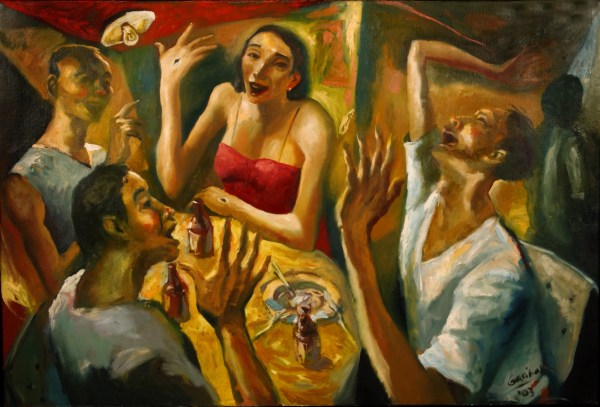
Esther is often portrayed as a love story. So let’s begin by making some observations. King Xerxes eliminated Queen Vashti when she refused to parade herself in front of an extended men-only drinking bout. Having got rid of her, Xerxes needed a new queen. His advisors suggested he seize all the beautiful young virgins, give each one a night to prove herself, and choose from among them. Continue reading “Esther | An embodied reading”
Further thoughts on gossip
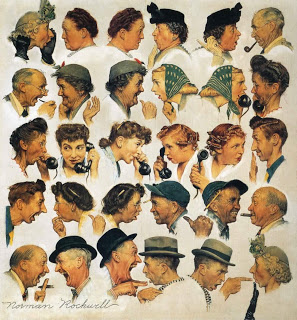
Gossip is so often named in the church as bad, bad, bad, that I am suspicious; so on Sunday I reflected on how healthy gossip can build community (here). After the reflection, someone commented that they had been told as a young person never to talk about anyone else; and that meant that they never even shared good news, not even with their spouse. The idea of healthy gossip was new, and suggested intriguing possibilities of positive communication. Yay! Continue reading “Further thoughts on gossip”
James | Holy gossip?!
Listen here.
Tonight’s passage from the Epistle of James scares the living daylights out of me. Apparently, my tongue is a deadly fire. It stains the whole body. It is a restless evil, full of poison. And as one who speaks to the gathered community, I will be judged with greater strictness for my speech. Even worse, this passage is often used to preach against gossip: that form of talking about people which is so often done by women. I should be quaking in my boots — and believe me, I am! For I am a woman who regularly chats with people about people. And yet, while there is no doubt in my mind that careless and malicious words can be incredibly destructive, I’d like to step back, and take a good look at gossip. Continue reading “James | Holy gossip?!”
Mark | Church without boundaries
Is he a racist, or is he the redeemer? Did Jesus come to reinforce ethnic and religious boundaries, or to transcend them? We have just heard a story from the gospel according to Mark, in which Jesus calls a Syro-Phoenician woman a dog. She pushes back; and he praises her faith and heals her daughter. Whether he was a racist who changed his outlook in response to her sharp wit, or whether he was feeding her a line to show up the racism of his disciples, we’ll never really know. But we do know this: The story lies between two other stories, two occasions when Jesus heals and feeds thousands of people. Continue reading “Mark | Church without boundaries”
Mark | You are not defiled
Listen here.
In tonight’s reading, religious leaders criticise Jesus’ disciples for failing to wash their hands in the correct ritual way before they eat. Jesus pushes back, hard, and goes on to say that we are not defiled by what we eat and drink. Instead, it’s the things we say and do which can defile us. But what if his disciples were criticised, not for failing to keep kosher, but for failing to maintain “Biblical family values”? For a region hard-hit by clergy abuse, here’s a new take on an old story. Continue reading “Mark | You are not defiled”
Faith | Strong in faith, free of doubt? Yeah, right!
Every week in common time, we end communion by singing “Halleluya! We sing your praises”, in which we claim that we are “strong in faith, free of doubt“. “And yet,” someone said to me recently, “I’m not free of doubt!” This came hard on the heels of a conversation I had with someone else, a deeply committed and faithful Christian who attends church most weeks, and who nevertheless has always struggled with any sense of a personal faith. Continue reading “Faith | Strong in faith, free of doubt? Yeah, right!”
John | Christo-cannibalism and the new community of love
For many years, our family shared Christmas lunch with friends and strangers. We’d put the word out, and eat with whoever wanted. One year, it was huge. Friends, and friends of friends, and friends of friends of friends, all turned up at our door. Some of them I knew and loved; others, I hadn’t met before. But gradually I came to realise: almost everyone there was gay. And almost everyone came from a religious family, which had rejected them because of their sexuality. Continue reading “John | Christo-cannibalism and the new community of love”
Prayer | The Examen: A daily practice
The Prayer of Examen, also known as the Daily, or Ignatian, Examen, is a classic tool for self-examination. It was formalised by St Ignatius of Loyola (1491-1556). The word ‘Examen’ has its roots in a Latin word meaning ‘to weigh accurately’; and so the Examen is about reviewing each day, and weighing it up through prayerful eyes. You can do it at any time, but in the evening is usual. It usually takes ten to fifteen minutes. Many people find it helpful to journal their experience of the Examen, so they can trace patterns and movement over long periods of time. Many also find it helpful to allocate a quiet corner to the practice, perhaps with a comfortable chair, a candle, the Bible, and their journal at the ready. Continue reading “Prayer | The Examen: A daily practice”
Forgiving yourself
When someone finds out I’m a Christian, they almost always say, “I’m not — but I’m a good person!” Good for you, I think, because I know I’m not. My innate tendency is to react to everything with anger, and if people are burned in the conflagration, to blame them. (Those of you familiar with the Enneagram are by now nodding your heads and saying, I knew she was a One!) It has been and continues to be my life’s work to notice each surge of rage, identify the trigger, then breathe out slowly and deeply and let it go in peace. Continue reading “Forgiving yourself”
Mark | Healed to serve
The disciples have returned from preaching and healing around the villages. In the face of people’s need, they have barely had time to eat, so Jesus invites them to come away to a deserted place and rest awhile. Yet the crowd guesses where they’re going, and meets them there. When Jesus sees the mob, his guts wrench with compassion, and he begins to teach and heal once again … Continue reading “Mark | Healed to serve”