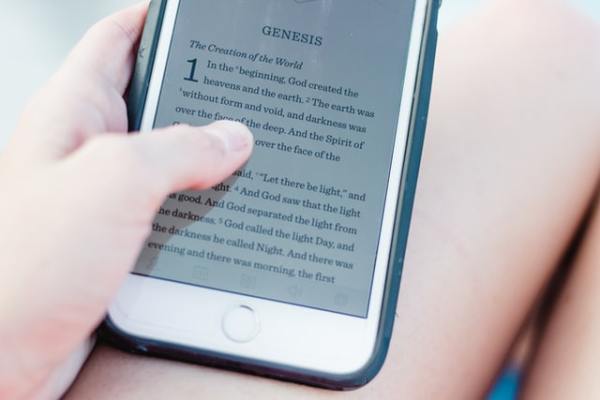
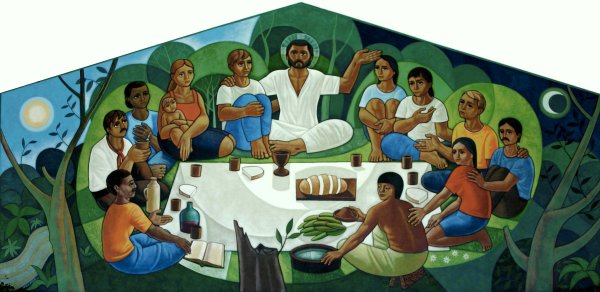
This coming Sunday, we will focus on the first creation story (here). During the service, I plan to reflect on how God acts in the face of chaos; here, I want to comment on translation. What’s interesting is the name of God and the related issue of pronouns, that is, he/him; she/her; they/them. Most English translations just write ‘God’ and assign a male pronoun; not coincidentally, most English translations have been authored by men. (If in doubt, read through the list of contributors in the front of your Bible. It’s an entirely depressing exercise.) Continue reading “Genesis | ‘Male and female they created them’: Pronouns and the community of God”
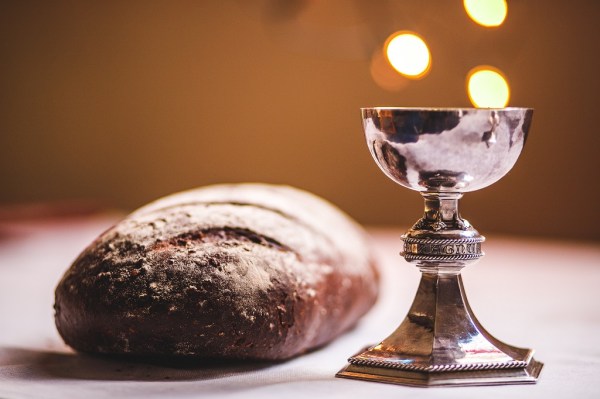
Why we won’t be sharing communion via Zoom
I was delighted with our first Zoom service. So many of you participated in the liturgy, and there was such good conversation both before and afterwards. And your feedback has been strong: that many kids stuck around; that the prayers for the world showed a high level of engagement; and that the tech made some of you actually feel closer and more connected than ever. So that’s wonderful! Continue reading “Why we won’t be sharing communion via Zoom”
Healing and community
Last week, we looked at how healing is about wholeness, that is, including, accepting and connecting all parts of ourselves. However, healing is even bigger than this. It is also about wholeness in a wider sense, bringing people into healthy relationship with other people and with the wider creation. We’ll look at creation next week; this week, we’ll focus on communities. Continue reading “Healing and community”
Luke | This resurrection life
The church is called to embody a culture where women are no longer silenced, invisible or subjugated, and all people are called into community. (Listen.)
Every now and then, I get a letter addressed to Mrs Paul Holdway; and I reel. Once I’ve stopped reeling, I wonder who on earth this woman is. She sounds like a shadow, a cipher. She’s probably maternal, almost certainly matronly. I’m sure she’s a great supporter of her husband and good at housework. She probably darns other people’s socks, and I’m sure she makes things for cake stalls and fetes. I have no idea what she herself is like, or what she herself is really interested in, but I do know this: There’s something extraordinarily silencing about having my name obliterated in a letter which is ostensibly addressed to me. Continue reading “Luke | This resurrection life”
Luke | The loneliness of the Australian colonial capitalist
The deep loneliness of colonial capitalism: and some pointers to an alternative economy. (Listen.)
The fear of saying the wrong thing means too often we say nothing at all. The following is a stumbling attempt to articulate some consequences of the colonial capitalist economy, to note resonances between some Indigenous economies and God’s kingdom culture, and to tentatively imagine a renewed economics which fosters connection and community. Time, space, audience and ignorance mean I necessarily make generalisations and minimise the extraordinary diversity of expressions of Indigenous economic systems. Continue reading “Luke | The loneliness of the Australian colonial capitalist”
1 Kings | Spirituality for the chaos of life
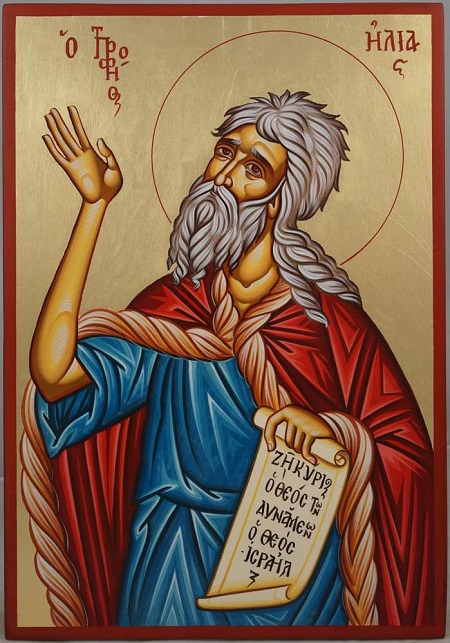
Most spiritual teachings assume solitude and silence, but the story of Elijah suggests that a healthy God-centred spirituality is grounded in the hustle and bustle of community. (Listen.)
Once upon a time, long long ago, when my kids were young, I felt for a while that my faith and spirituality had to go on hold. Life was so busy, and the kids were so demanding, and everywhere I went there were people. People needing a nappy change; people needing a story; people needing a cuddle; people needing a cuppa; people needing a neighbour; people needing a friend; people needing a volunteer; people needing a worker. Everything I had ever read about spirituality was about spending quiet time alone with God: yet quiet time alone was exactly what I never had. Continue reading “1 Kings | Spirituality for the chaos of life”
Luke | The path to Christian unity
When I first think of Christian unity, what comes to mind are those powerful commentators who are agitated by bedroom behaviours, who deal in moral absolutes, and who claim to speak on behalf of all Christians—and do so loudly, and often. Unfortunately, their attitudes and actions have led many in the wider community to perceive such people, and Christians in general, as puritanical, hypocritical, judgemental, reactionary, homophobic, sexist and fundamentally irrelevant. Yet when I look around at the people gathered here—faithful representatives of the combined churches of Warrnambool—I see something quite different. Continue reading “Luke | The path to Christian unity”
John | Love, be wounded, forgive, repeat
Loving like Jesus means loving together through betrayal and beyond. (Listen.)
“Love one another as I have loved you …”: Jesus says these familiar words at a critical moment. He has just washed the feet of each and every disciple. Now Judas has left the building. He’s heading to the authorities, to hand Jesus over to be tortured and killed. Continue reading “John | Love, be wounded, forgive, repeat”
Acts | Radiating resurrection
Peter raises Tabitha: for Christ lives on in his disciples. (Listen.)
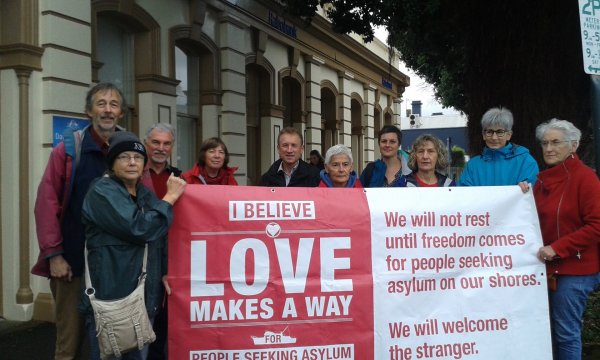
How long, O Lord, must we wait? How long until a saviour comes and sweeps through this nation, and puts everything right? How long until the corrupt are thrown out of power, the violent are contained, the poor are cared for, and the earth is restored? How long until political leaders show compassion? How long until religious leaders repent for the damage they have done? How long until asylum seekers are freed from detention? How long until children in foster care find stable healthy homes? How long until Australia’s First Peoples receive recognition and justice? How long, O Lord, must we wait? Continue reading “Acts | Radiating resurrection”
Discerning the spirits: Six approaches
Many of us have had the experience of feeling driven to do something, barging off and doing it, then experiencing that sick realisation that it was not the right thing at all. Many of us have also had someone tell us that ‘God has laid it on my heart and …’; yet their words have left us feeling confused, anxious, coerced or manipulated. Many of us seem to lack confidence in discerning the spirits or testing whether a prayerful experience or prompt is from God; and as a result, many of us seem to mistrust or deny any spiritual experiences at all. And yet, we have faith that God works through the Holy Spirit and prayer: and so, rather than denying all such experiences, we must find ways to discern the work of the spirits, good and bad. Continue reading “Discerning the spirits: Six approaches”