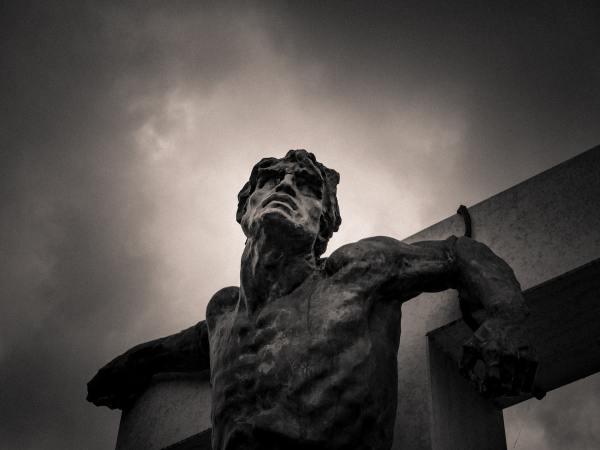
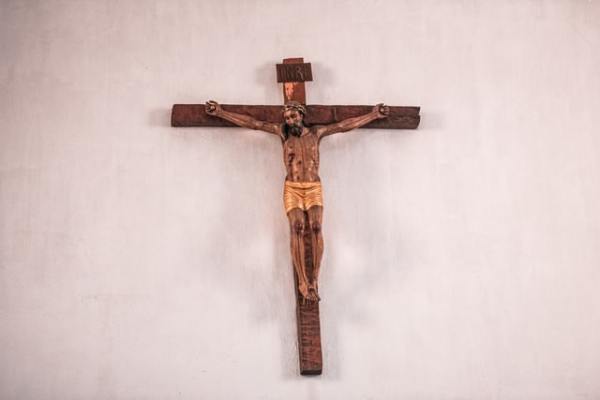
The pain is the terror which wakes you in the small hours. It’s the sweat rolling down your brow; it’s desperate prayer beyond words; it’s abandonment by friends who cannot bear to watch. It’s the gut-wrench of betrayal; the hollowness of a false kiss. It’s the scourge of the whip; the agony of thorns; the spear thrust in the side. It’s God-forsakenness, for God is nowhere to be found. This is the unbearable pain of crucifixion; in the suffering, something must die. Continue reading “First the pain, then the waiting, then the rising”
Mark | Menstruation, miscarriage, and the multitude robed in white
Bleeding bodies and suffering selves are all gathered up in Christ. (Listen.)
Like me, my mother was an ordained Baptist minister; but unlike me, she had endometriosis. Among other things, this meant that her menstrual periods were excruciatingly painful, and came upon her without warning, in great floods. And so my childhood is studded with high stress memories of her period suddenly starting while we were out. There’d be an intake of breath, then a quick hissed exchange between my parents, then a frantic search for a public toilet before disaster struck. Continue reading “Mark | Menstruation, miscarriage, and the multitude robed in white”
Isaiah | Slow reading | Your healing shall spring up quickly
Israel is engaging in spiritual practices, but God isn’t responding and Israel wants to know the reason why. We live in an age when spirituality has been privatised and turned into a marketable commodity; where fasting is about slimming and ‘wellness’; where subscription-based meditation apps are best-sellers; where spiritual practitioners push products on goop; where people spend thousands on spiritual retreats; yet anxiety, depression, addiction and autoimmune diseases run rampant. To those wondering, ‘Why isn’t God listening? Why aren’t we being healed?’, God’s answer through the prophet Isaiah is scorching–and there’s not a scented candle in sight. Continue reading “Isaiah | Slow reading | Your healing shall spring up quickly”
Mark | The strongest one
Jesus exorcises voices of family, church and society. A metaphorical mix up of demons, dwellings, and healing. Note: Beelzebul is the demon king, and also the demon of the dwelling place. (Listen.)
When I first introduced the man who was to become my husband to my extended family, not one but two different people said to me, “Wow! We never thought you’d meet anyone, let alone a Collins Street lawyer.” Never mind that my husband’s office was on Queen Street; the message was clear. All my life I’d been told by family, church and society that no man wanted an outspoken wife. I was insightful, articulate, prophetic, forceful: great qualities in a man or, perhaps, a celibate single professional woman. But if I wanted to ‘catch’ a good husband, I would need to dumb down and shut up, because the person God had made me to be was unattractive and unlovable, and would make a dreadful wife and mother. Continue reading “Mark | The strongest one”
1 Thessalonians | Slow reading | May God integrate y’all
In Acts 17:1-10, we learn that Paul and Silas went to Thessalonica and, in three days, convicted ‘some of the Jews’, as well as ‘a large number of God-fearing Gentiles and not a few prominent women’ to the way of Jesus Christ. However, others – both Jew and Gentile – saw the message as a threat, so they stirred up mobs, riots and legal accusations against them. Paul and Silas were hustled out of the city, leaving the brand new yet already persecuted church to fend for itself. The following is a word of encouragement written by Paul to the church—and to us now, especially those of us surprised by the new COVID restrictions. As you read, be aware that every occurrence of the word ‘you’ is plural here. In everything, Paul is addressing the Thessalonians not as individuals, but as a group. How does this affect your understanding of salvation-healing-wholeness? Continue reading “1 Thessalonians | Slow reading | May God integrate y’all”
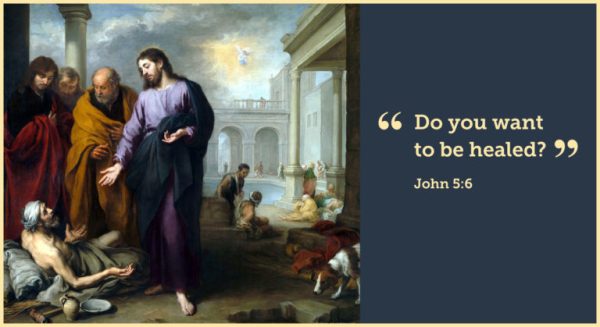
John | Slow reading | Do you want to be healed?
Of course everyone wants to be made well. It’s a no-brainer. Or … is it? Because healing means loss. It means letting go of dependency, taking up responsibility, and walking into a new future: a future often studded with conflict. As you listen to this story and dwell in the Word, you are invited to consider your own attitude to being made well. But first, imagine yourself in the beginning place: lying on a mat by a pool. You are comfortably dozing, and the sun is dancing across your eyelids … Continue reading “John | Slow reading | Do you want to be healed?”
Healing prayers: Integration and wholeness
Notes on healing prayers
What does Biblical healing look like?
The gospels are peppered with stories of Jesus healing people, and he commissions his disciples to do likewise. This healing is always much more than a physical cure. The Greek word for ‘demonic’ means ‘tearing apart’; and so something which is demonic tears apart bodies, minds and spirits; people and communities; people and the wider creation; and people and God. Physical or mental illness, toxic and abusive relationships, racism, sexism, war, shame, greed: these are just a few of the demons which tear people apart.
Continue reading “Healing prayers: Integration and wholeness”
Corinthians | Human violence, and the foolishness of the cross
To those reeling from another week in the patriarchy, the cross offers only foolishness: but in that foolishness we find healing and companionship. (Listen.)
Like so many people, I feel overwhelmed by the events of the last few weeks. Parliament House is revealed to be a hotbed of sexual violence; and our Prime Minister cannot imagine it matters until, we are told, his wife prompts him to think of his own daughters. Then the attorney general is named in allegations of historic rape. Meanwhile, the head of the defence force instructs young cadets that they should not make themselves ‘prey’ to predators, and that they can do this by, among other things, avoiding being ‘attractive.’ All this while our training grounds for power, that is, Sydney’s private schools, are publicly revealed as manifestly unsafe places for young women.
Continue reading “Corinthians | Human violence, and the foolishness of the cross”
2 Kings | The simple cure
We like to make things complicated, but the faith which heals is simple. A word for our graduates moving away to university. (Listen.)
Naaman was hoping for a miracle. ‘Easy peasy lemon squeezy,’ said the prophet’s errand boy. ‘Go wash in the Jordan seven times, and you’ll be made clean.’ Then he ran back inside, narrowly avoiding a boot in the behind.
Mark | Jesus-centred ministry: Spontaneous, informal, domestic
Just as the first recognized minister in Mark’s gospel is an unnamed woman in a private home, most ministry today continues to be spontaneous, informal, domestic. (Listen.)
I wonder what Simon’s mother-in-law prepared for Jesus and his disciples. Pita bread and hummus? Rice wrapped in vine leaves? Dried figs, almonds, and a soft mound of goats’ cheese? Because when Jesus visits Simon’s house, Simon’s mother-in-law is sick. But although it’s the Sabbath, and although she’s a woman, and although she’s sick, Jesus touches her. She is resurrected; she gets out of bed; and, most Bible translations say, she begins to serve them: and in the Middle East, that always means food.
Continue reading “Mark | Jesus-centred ministry: Spontaneous, informal, domestic”