When someone finds out I’m a Christian, they almost always say, “I’m not — but I’m a good person!” Good for you, I think, because I know I’m not. My innate tendency is to react to everything with anger, and if people are burned in the conflagration, to blame them. (Those of you familiar with the Enneagram are by now nodding your heads and saying, I knew she was a One!) It has been and continues to be my life’s work to notice each surge of rage, identify the trigger, then breathe out slowly and deeply and let it go in peace. Continue reading “Forgiving yourself”
Forgiveness as a household practice
Last week, I suggested some practical actions to help move towards forgiveness. This week, I’ll focus on forgiveness as a household practice, drawing heavily from a little book by Carol Luebering, The Forgiving Family (now sadly out of print). Luebering observes that it is in the family that most of us first learn to love, but that love must be cultivated and practised. One of the disciplines which cultivates love is, of course, forgiveness. What follows are four suggestions for forgiveness within a household; of course, most of them are helpful in other relationships, too. Continue reading “Forgiveness as a household practice”
Mark | One rule to ring them all
Listen here.
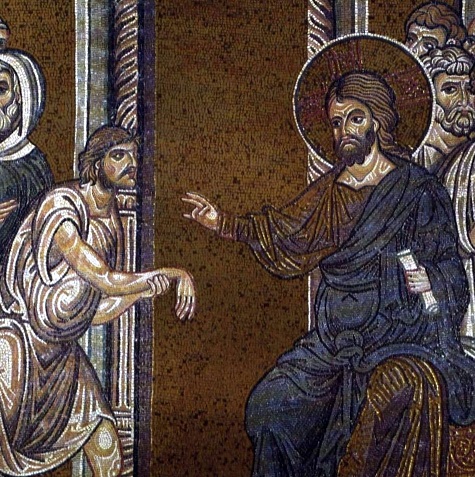
Tonight we reflect on a story in the gospel of Mark, when a man with a withered hand reaches out to Jesus and is healed. Yet it’s the Sabbath, and so the Pharisees go ballistic. But first … another story. A Catholic woman I know grew up in St Kilda, with a synagogue at the end of her street. One Friday night, when the Sabbath was already underway, there was a knock at the door. Continue reading “Mark | One rule to ring them all”
Birthed by the Spirit: Beloved by God
Introduction: Sometimes, we respond to the readings (John 3:5-8 and Romans 8:12-17) with a sermon. Sometimes, we have a conversation. Sometimes, like last week, people testify to God’s action in the world and their lives. And sometimes, we have a guided meditation which invites you to enter deeply into the readings. Tonight it’s a meditation. Listen to Womb, by Toni Childs, then work slowly through the meditation. Be aware that the meditation uses gendered language for God, language which the Biblical writers used. There are times when we analyse and even question this language: but tonight, I invite you to let it be. Instead, just rest in the imagery, and see what emerges in the silence. Continue reading “Birthed by the Spirit: Beloved by God”
IDAHOBIT, you da hobbit, what?!
What is IDAHOBIT, I hear you ask? It’s International Day Against Homophobia, Biphobia, Intersexism and Transphobia, and it’s on 17 May every year. On this day, people all over the world will stand in solidarity with their LGBTIQA+ friends, family, colleagues and neighbours to tell them that they are loved, and that they are not alone. Continue reading “IDAHOBIT, you da hobbit, what?!”
Luke | Open heart, open mind: Reading the Bible with Jesus
The Bible is full of contradictions, so we read with Jesus at our side. (Listen here.)
Like the wider Christian church, our congregation includes people who hold very different ideas about how to live. Some of us acknowledge the possibility of a just war; others believe that peacemaking is the only way. Some of us proclaim salvation through Christ alone; others, that there are many paths to God. Some of us freely affirm faithful homosexual relationships; others reject the idea that any such relationship could be godly. We are all reading the same Bible, yet our conclusions can clash. So what’s happening here? And what’s the way forward? Continue reading “Luke | Open heart, open mind: Reading the Bible with Jesus”
John | The sacrificial cult of work
Listen here.
What sacrificial system do we operate in? What system of meaning takes most of our time and energy, gives most of us a profound sense of identity, and for most of us is also an expression of faithfulness? And what same system of meaning can be hostile to women and children, and largely excludes people who are poor, sick, or disabled? For that is what the temple was for Israel: a social, financial, and spiritual hub, which gave people a powerful sense of identity. It was an expression of Israel’s faithfulness; but it was an expression which largely excluded women, children, and people who were disabled, sick, or poor. Continue reading “John | The sacrificial cult of work”
Jonah | Ministry without reservation
The book of Jonah is a powerful, difficult, and demanding book, more relevant than ever: for it shows a man walking into the epicentre of globalisation and military violence, unarmed, to preach the end of the age. Christians often think they should feel warm, fuzzy, loving thoughts towards the other; but, like Jesus, Jonah shows us that love means placing our very bodies among those we fear, hate, or simply don’t understand. Whether this means the extreme of walking into Mosul, the modern-day Ninevah, and preaching God’s word; or whether it means crossing the barriers of religion, age, class, or cultural, gender, or sexual identity in relationship, this radical enemy-love lies at the heart of the gospel – and it is terrifying. Continue reading “Jonah | Ministry without reservation”
Mark | Prepare the way: but how?
Listen here.
Once upon a time, long, long ago, I lived in Washington, DC. We went to a church which was once Harry Truman’s, then Jimmy Carter’s; and the Clintons came a couple times. Its members included diplomats, military men, and CIA staff; investors, bankers, and millionaires; presidential advisors, scientists, and journalists; and a governor of the Federal Reserve. So one of the hardest things about moving to Warrnambool is the teeny-tiny feeling that I have dropped off the face of the earth. Continue reading “Mark | Prepare the way: but how?”
Matthew | Beyond welfare
We are called not to client-customer relationships, but to love. (Listen here.)
This is the week when I am supposed to preach a hard-hitting sermon, telling you to get off your butts and roll up your sleeves. Start a soup kitchen! House the homeless! Run a drop-in centre! Start a free medical clinic! And if you don’t … judgement awaits. But I won’t go there. Because many of you have been down that road, and you have burned out. It’s not that those things aren’t important—they are!—but that I don’t think that this work is the point of tonight’s passage. For welfare and overseas development agencies can only do so much. They can fill a stomach, or tackle addiction, or provide accommodation; but if we truly want to see people made whole, then we need something more. Continue reading “Matthew | Beyond welfare”