Almost everything we do at church you can do at home, with one important exception
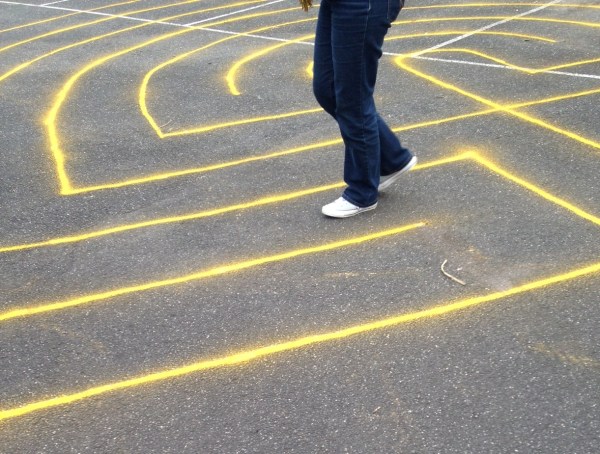
On Sunday we worshipped by walking. Several of us blessed the earth beneath our feet; others walked the prayer labyrinth; still others went on a reflective neighbourhood stroll. Afterwards, someone said, “You don’t need to be at church to do this: you could do these walks anywhere,” to which I replied, “Yes! Absolutely yes! And that’s true of most of what we do here.” Continue reading “Almost everything we do at church you can do at home, with one important exception”

Prayer | Walking the labyrinth

The labyrinth is an ancient spiritual tool. It is found all over the world, in diverse religious and spiritual contexts. It is not a maze or puzzle. Instead, the labyrinth has one path in and out, and following the path is a way of going deeply into what we might call the heart of life. In my experience, walking a prayer labyrinth is always absorbing, always surprising, and often very moving: things deep within me seem to shift, rearrange and reveal themselves as I walk and pray. Continue reading “Prayer | Walking the labyrinth”

Prayer | Climate march and other prayer walks

As we continue our journey through the season of creation, I’d like to introduce you to another method of prayer. Prayer is a way of deep listening. Yet when our minds are busy and distracted, we cannot listen well; and so we need methods to still our minds. One of these is to go for a walk! The repetitive rhythmic movement, and the regular intake and exhalation of breath, can help us find that still centre: the space where we notice the spirit bubbling up and gently prompting us. Continue reading “Prayer | Climate march and other prayer walks”

Luke | Ask, seek and knock for the presence of the Holy Spirit. And that’s it.

Many believe that prayer is a transaction between ‘good’ people and God; but is this what Jesus is really on about? (Listen.)

An old friend of ours, Monique Lisbon, once wrote a satirical song with a chorus that goes like this: God can’t keep track of the human race / when everyone’s praying for a parking space. The song is her response to those Christians who quite literally ask God for everything: personal prosperity, a perfect spouse, a big house in a nice suburb, and a parking space right outside the front. Jesus says, “Ask, and you shall receive,” and so they ask, and ask, and ask some more: for the verse has been widely interpreted to mean that God is a fairy godmother just waiting to reward our earnest prayers by granting our heart’s desire. Continue reading “Luke | Ask, seek and knock for the presence of the Holy Spirit. And that’s it.”

Blow through me, Breath of God

Did you know that, in both Greek and Hebrew, the word we translate as ‘spirit’ means ‘air-in-movement’? In Hebrew, it’s the feminine ruah, or breath, which hovers over the waters of chaos in Genesis. In Greek, it’s the gender neutral pneuma which descends from heaven and fills Jesus’ disciples. You get a sense of the Greek word from the English words ‘pneumatic’ (containing air), and my ten-year-old’s favourite word: ‘pneumonoultramicroscopicsilicovolcanoconiosis’, a condition seriously restricting air flow caused by the inhalation of silicate, possibly from a volcano. Phew! Continue reading “Blow through me, Breath of God”

Discerning the spirits: Six approaches

Many of us have had the experience of feeling driven to do something, barging off and doing it, then experiencing that sick realisation that it was not the right thing at all. Many of us have also had someone tell us that ‘God has laid it on my heart and …’; yet their words have left us feeling confused, anxious, coerced or manipulated. Many of us seem to lack confidence in discerning the spirits or testing whether a prayerful experience or prompt is from God; and as a result, many of us seem to mistrust or deny any spiritual experiences at all. And yet, we have faith that God works through the Holy Spirit and prayer: and so, rather than denying all such experiences, we must find ways to discern the work of the spirits, good and bad. Continue reading “Discerning the spirits: Six approaches”

Forgiving yourself

When someone finds out I’m a Christian, they almost always say, “I’m not — but I’m a good person!” Good for you, I think, because I know I’m not. My innate tendency is to react to everything with anger, and if people are burned in the conflagration, to blame them. (Those of you familiar with the Enneagram are by now nodding your heads and saying, I knew she was a One!) It has been and continues to be my life’s work to notice each surge of rage, identify the trigger, then breathe out slowly and deeply and let it go in peace. Continue reading “Forgiving yourself”

Forgiveness in situations of estrangement

As we continue our series on forgiveness, it is time to consider situations of estrangement. As always, I am drawing heavily from Carol Luebering’s little book, The Forgiving Family (now out of print). Of course, none of the approaches guarantee that a relationship will be restored. What they will do is help you bring a troubled relationship before God‘s loving presence. This may lead to reconciliation, or it may simply lead to your own healing and sense of freedom from a toxic situation. Continue reading “Forgiveness in situations of estrangement”

Forgiveness as a household practice

Last week, I suggested some practical actions to help move towards forgiveness. This week, I’ll focus on forgiveness as a household practice, drawing heavily from a little book by Carol Luebering, The Forgiving Family (now sadly out of print). Luebering observes that it is in the family that most of us first learn to love, but that love must be cultivated and practised. One of the disciplines which cultivates love is, of course, forgiveness. What follows are four suggestions for forgiveness within a household; of course, most of them are helpful in other relationships, too. Continue reading “Forgiveness as a household practice”

Blog at WordPress.com.

Up ↑