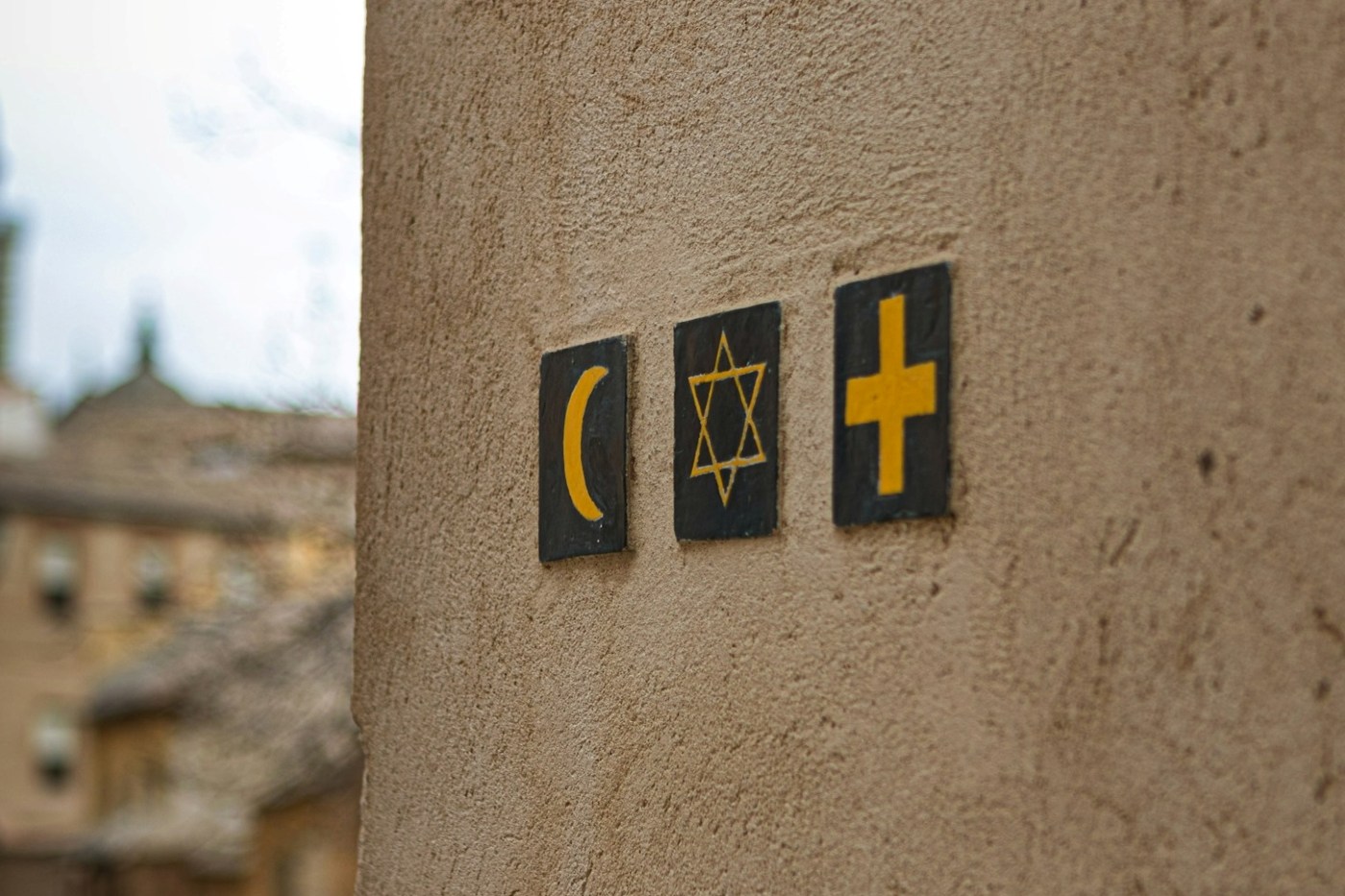
Can a common story offer hope? (Listen here.)
‘Leave your country, your people and your father’s household, and go to the land that I will show you… ’ says God to Abram. ‘I will bless those who bless you, and whoever curses you I will curse, and all peoples on earth will be blessed by you … To your descendants I will give this land.’ Then Abram entered the land with some process of negotiation and treaty. However, from the time of Joshua right up until last week in the White House, these same words have been used to justify driving people out.
Joshua ordered Israel to take Canaan by the extreme obliterating violence we now call genocide. Three thousand years later, Netanyahu is still at it, with the biblical-flavoured backing of America. For these words from Genesis are being quoted in the Knesset, the White House, and the Pentagon, and by evangelical preachers who have found a listening ear.
In what should be no surprise to anyone, the people of the land have fought back. The brutal October 7 attack was only one in a long history of desperate responses to an invasion reaching back into the Late Bronze Age.
‘All peoples on earth will be blessed by you,’ says God, but we are living under a curse. After thirty centuries of violence, we have Israel seeking to establish a Jewish state to the exclusion of all Muslims. As the Easter shutdown of churches in Jerusalem suggests, perhaps the ultimate goal is the exclusion of Christians, too. Then we have Hamas, which longs for an exclusively Muslim state from the river to the sea.
Complicating things further, we have these powerful evangelical Christians with all sorts of strange ideas. Some believe that the expansion of Israel from the river to the sea and the building of a new temple will trigger Jesus’ return. Others believe that lighting a fire in Iran will catalyse Armageddon and a cheerful end times bloodbath led by Jesus brandishing a sword. As Franklin Graham only last week spelled out after quoting this passage from Genesis, Jesus will come not as a Lamb but as a Lion, killing all who oppose him so there will be no more mourning or suffering or death (which sounds incoherent and contradictory to me).
These violently militaristic theologies are so clearly counter to Christ’s teachings that they would be laughable. Except, these people are in the White House and the Pentagon or informing them, and they’re providing weapons to Israel and ordering the destruction of Iran.
For followers of Jesus, the obvious response is to appeal to his call to enemy-love. But he has no authority for Muslim or Jew (or, let’s be honest, for many people who now call themselves Christian). So how, then, might we interrupt the cycle of violence?
It is suggestive that these very real wars, these countless acts of brutality and rape and torture and murder, are being fought within religious and theological frameworks. The Jewish claim on the land is based on sacred texts, as is the Muslim rejection of infidels. Both sides demand forms of vengeance and justice rooted in a religious worldview. Therefore, any way forward must be found in a theological stance, or in a common life-giving story.
And so we turn to Abram, later Abraham. According to the promise we just heard, he would be the father of many nations and his descendants would inherit the land. According to tradition, these nations include both Islam and Judaism. For while Jews trace a line back to Abraham through his son Isaac, Muslims also trace a line back to Abraham, only in their case through his oldest son, Ishmael. (We Christians are of course an offshoot of Judaism, so our line to Abraham is through Isaac, too.)
What this means is that we are all children of Abraham, all heirs according to the promise made by God in a story upheld by all three faiths. As Abraham’s descendants, all will be a blessing to the peoples of the earth, all will inherit the land. Yet this promise has sparked many centuries of warfare, as each group tries to claim religious legitimacy over the others and establish preferential access.
‘Thou shalt not murder,’ says God in the Ten Commandments, with specific provisions for capital punishment elsewhere. Likewise does the Quran prohibit the taking of any human life except in legal punishment for murder or sedition (5:32). Yet there has been killing after killing after killing in God’s name, which each side claims is justified by their own righteousness and the actions and behaviour of the other.
Into this terrible situation, Paul’s letter to the Romans rings loud and true. He writes, ‘You have no excuse, whoever you are, when you judge others; for in passing judgement on another you condemn yourself, because you, the judge, are doing the very same things. You say, ‘We know that God’s judgement on those who do such things is in accordance with truth.’ Do you imagine, whoever you are, that when you judge those who do such things and yet do them yourself, you will escape the judgement of God?’ (Romans 2:1-3). Don’t kid yourselves, he’s saying. Your religious claims give you no immunity from God’s law or God’s judgement.
Paul goes on to ask, ‘If you call yourself a Jew and rely on the religious law and boast of your relation to God and know his will and determine what is best because you are instructed in the law, and if you are sure that you are a guide to the blind, a light to those who are in darkness, a corrector of the foolish, a teacher of children, having in the law the embodiment of knowledge and truth, you, then, that teach others, won’t you teach yourself? … You who boast in the law, don’t you dishonour God by breaking the law?’ (Romans 2:17-24).
Paul is arguing that religious law is impossible to keep, even for the most devout. More, as long as we boast in our own religious law, claiming its superiority and legitimacy over any other, we will be tempted to use any means necessary to impose it, right down to breaking the very law we are trying to enforce. Thirty centuries of evidence suggests we will indeed steal, rape and murder to establish dominance, all while insisting on our own righteousness and legitimacy.
Thus the Jewish settler shooting Palestinian schoolchildren is condemned by his own law, Torah; the Hamas terrorist shooting kibbutzniks is condemned by his own law, the Quran; and the evangelical American soldier blowing up an Iranian school is condemned not only by the Ten Commandments but also by the teachings of Christ.
Paradoxically, religious law – whether Muslim, Christian or Jewish – condemns precisely those who enforce it and judge others on its basis, as in seeking to enforce the law we inevitably break it.
The way forward, then, is to let go of all claims to the primacy of any religious law and to depend entirely on the grace of God. As Paul writes, ‘We hold that a person is justified by faith apart from works prescribed by the religious law. Is God the God of Jews only? Isn’t he also the God of non-Jews? Yes, of non-Jews also, for God is one; and God will make righteous the Jew on the grounds of faith and the non-Jew also, through that same faith.’ (Romans 3:28-30). In other words, while the works of the law cannot make us righteous, God can, and God will do so on the basis of faith.
This is all very well for Jews and Christians, the first to hear Paul’s letter. But Paul then turns to our common ancestor, which has the effect of expanding the field to Muslims, too. For he observes that Abraham was not made righteous by obeying religious law. Indeed, Abraham predates Moses, Muhammed and Christ and the handing down of law by any one of them. Instead, Abraham was made right with God through his faith in God’s promise, of a future he had not yet seen.
In the same way, argues Paul, neither Jew nor non-Jew are made right with God through any appeal to religious law. This means that neither Torah, nor the Quran, nor even the teachings of Christ are sufficient to justify us. Instead, like our common ancestor Abraham, we are made right only through faith in God’s promise, of a future we have not yet seen.
And there lies our hope. Because for children of Abraham, this story from Genesis has an authority which predates the law and the development of the three traditions. This story points to faith in the One God as being the only justification any person needs. And this story recalls us to our origins as joint recipients of God’s blessing and sharers in the inheritance. For the text is clear: God’s promise is a gift for all Abraham’s descendants. It’s not limited to Jews but given to all Abraham’s seed, Jew and non-Jew alike.
So let us pray our way through this story, then, always remembering our belonging to the worldwide family of Muslims, Christians and Jews. Let us pray that Muslims and Christians and Jews of all nations may teach and celebrate our common ancestry. Let us pray for an end to the use of religious law as a tool for establishing supremacy, and let us pray for the transformation of the hearts and minds of the world’s leaders and the world’s soldiers. Let us pray for the peace which comes not through firepower but simply through faith in the One God’s mercy. And as we place our trust in a promised future that we have not yet remotely seen, let us pray, and pray, and pray, that Abraham’s children might one day be a blessing to each other, and to all the peoples of the earth. Amen. Ω
Where & when: Wurundjeri country, Waring (Wombat) Season. It’s a time of crisp mornings, cool days, evening shadows, and the rains have finally come.
A reflection on Genesis 12:1-9 and Romans shared with Manningham Uniting Church on 7 June 2026 (Pentecost 2 Year A) © Alison Sampson, 2026. This reflection owes a debt to The Blessing of Faith, a sermon preached by Garry Deverell in 2002 at the South Yarra Community Baptist Church. Nearly 25 years later, it’s more relevant than ever.Photo by Noah Holm on Unsplash (edited).

