Jesus tells us to stay awake, but what if we can’t? (Listen here.)
Welcome to the first Sunday in Advent! This is a season of expectation, as we anticipate the coming of the God made known in Jesus Christ. With joy, we look to the gift of a fragile baby, gurgling, crying, laid in a manger, sharer of our flesh and blood. So we come here expecting something cheerful, only to be slammed with a weird cosmic reading from the gospel according to Mark.
It turns out we live in two times. We live in anticipation of Jesus coming, as symbolised by the Christmas story. At the same time, we know that Jesus was born over two thousand years ago. He has already come, and so we are also anticipating his return. Some of us will limit our anticipation to a cute little baby in a nativity scene: but this event is so unimportant to Mark’s theology that he doesn’t even mention it. There is no Christmas story in Mark. Instead, Mark kicks off in the middle of things, with John the Baptist and an adult Jesus, and any anticipation of Jesus’ coming is focused not on a cradle, but elsewhere.
Like Jesus’ disciples so long ago, we might then ask, ‘What will be the sign?’ Jesus’ reply is hardly comforting. There will be all sorts of signs, he says: wars, and rumours of wars; earthquakes; famines. There will be persecution of the innocent, and all kinds of suffering. And, as if that doesn’t sound bad enough, he goes on to say, ‘The sun will be darkened, and the moon will not give its light, and the stars will be falling from heaven, and the powers in the heavens will be shaken’ (13:24-25): which reminds me of the Carrington Effect.
‘What on earth is the Carrington Effect?’ I hear you say. I’m so glad you asked.
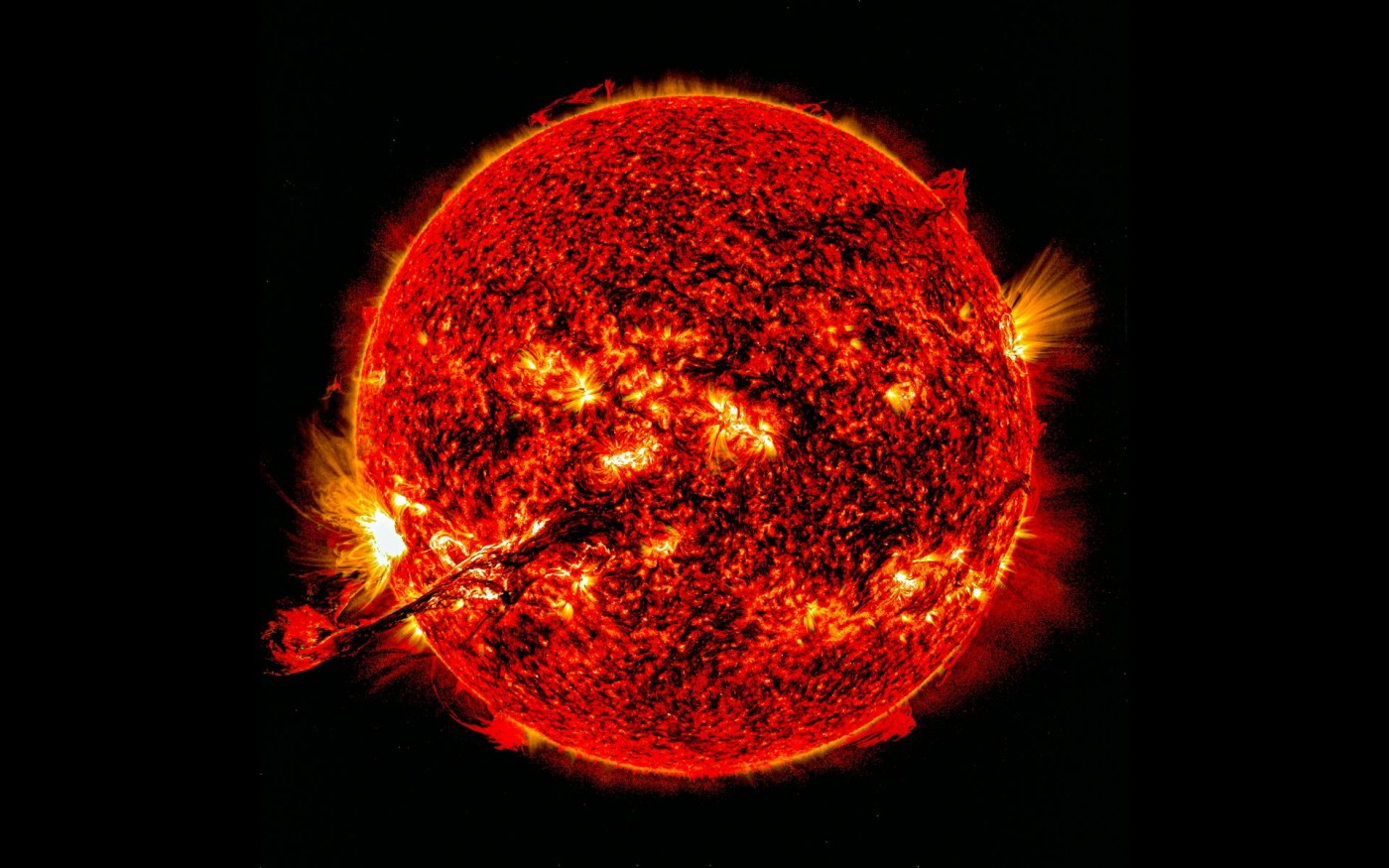
As you probably know, the sun is a ball of fire traversed by powerful magnetic fields. These fields move and bend and arc and twist like enormous rubber bands. Every now and then, in an extra-wild solar storm, one of these magnetic rubber-band-like fields becomes so stretched that it snaps. In the snapping, it scoops up a vast lump of sun, millions of tons in fact, and hurls all this electro-magnetic radiation into space. Off it goes, travelling at 2,500 kilometres per second.
What happens when the earth lies in the path of one of these solar catapults? As the mass of star we call the sun falls from what we call heaven, the sky turns blood-red. The collision with the earth’s own magnetic field compresses our atmosphere and creates a massive electrical current. This in turn creates a turbocharged power surge, with rather more zeroes than usual. Your teeny-tiny little surge protector is useless, and any electrical equipment hit by the blast is disrupted or destroyed.
The last big one was back in 1859. At that time, there were no electric lights and the telegraph had only just been invented. Astronomer Richard Carrington was peering through a telescope when he observed a strange flash of light. Then the sky turned blood-red, and the electricity in the atmosphere sent telegraph machines into action. Clickety clackety clack stop! clickety clackety clack, they spat out random unintelligible messages. Electricity lines arced, telegraph stations sparked, batteries exploded, and ghost crackles took over the radio waves. Many electrical systems were destroyed.
This phenomenon became known as the Carrington Effect. 1859 was a big one but usually, it’s much smaller; usually, it doesn’t affect the whole world. During Vietnam, a bunch of sea mines spontaneously detonated; during the Cold War, the early ballistic missile warning system went off; in 1989, in the middle of winter, Montreal’s power grid blew. But every now and again there is a big one. There is evidence of these storms all the way back to the Babylonians; big ones seem to occur every 150 to 200 years.
For the last 20 years, it’s been pretty quiet, no one knows why, though we dodged one by just nine days in 2012. And since the last big one 167 years ago, we have built an entire interconnected world utterly reliant on electrical impulses. Telecommunications, banking, supply chains, even the typing of this otherwise human-made sermon: it all relies on electricity. So who knows what will happen when the next small one occurs? As for the big one, we’re about due for it.
Are you scared yet? You should be.
‘The stars will be falling from heaven, and the powers in the heavens will be shaken,’ says Jesus. In his time, these were metaphors for the emperor and his henchmen, and the collapse of an empire meant utter chaos. From laws to household structures to where you lived to the gods you were permitted to worship: everything was disrupted and changed.
But in the way the Living Word finds new life in new contexts, I cannot imagine anything more world-shattering for us than the total collapse of the internet plus all other electrical infrastructure and equipment. For the last two weeks, I’ve struggled to access the internet in the Hub; it has made working onsite very difficult. I can barely imagine ordering worship without electricity, let alone a whole life.
In current conditions, pun intended, it would take years to rebuild from a major coronal mass ejection. In the meantime, we’d be without anything which makes the world as we know it function: no telecommunications, no supply chains, no satellites, no GPS, no internet, no electricity grid.
So would this be the end of all things? Would it mean Jesus’ return? Perhaps we should gaze anxiously at the sky and prepare for the end times. Or perhaps this is not actually the sign, and instead we should learn to decipher the ‘real’ meaning of climate change, AI, 5G, Covid-19 or the most recent genocide.
Except Jesus says no. There will be all sorts of signs, he says: wars and rumours of wars; earthquakes; famines. There will be persecution of the innocent, and all kinds of suffering, and maybe even the Carrington Effect. But he tells us that these things are merely the birth pangs of a new world being born. By implication, whatever weird, terrible or cataclysmic events happen, however much change is forced upon us, we don’t have to go all woo-woo pie-in-the-sky. Instead we can interpret these events and even the daily news cycle as the labour pains of the kingdom.
In other words, don’t panic. Don’t be swept up by fear of the future or by what is happening around the world. Don’t join a doomsday cult. Instead, be wise. Be woke. Stay awake. Nobody knows the time of the coming of the Human One, he says, not even Jesus himself. But on the other hand, he says that the coming of the Human One is very near, perhaps at the door: and this generation will not pass away until the Human One has arrived. Here, then, is a clue. Perhaps Jesus won’t turn up in some future cataclysmic event, but here and now. Perhaps he will be seen in small moments, in little glimpses, among ordinary people.
Nobody knows when the master of the dwelling will return, says Jesus: in the evening, or at midnight, or at cockcrow, or at dawn. Those familiar with Mark’s story might recall that, in the evening, Jesus breaks bread with his disciples. At midnight, he is praying in the garden. At cockcrow, he is denied by his closest disciple even as he is being condemned. And at dawn, the grave is found empty and he is to be sought among the living. Perhaps we will glimpse Jesus in places like these: among friends at the table; in prayer, in the garden; in those denied or condemned; in the mystery and strangeness of resurrection.
So don’t be fooled by wars or rumours of wars, or by my scaremongering around the Carrington Effect. Just look for Jesus in ordinary situations which resonate with the gospel story. Be alert to his presence in these ordinary places, as we go about our ordinary lives.
This all sounds very nice, but what if you struggle to see him in these places? What if, despite all your looking, you’ve not yet caught so much as a glimpse? Again, don’t panic! Even in Mark’s story, the disciples fail to keep their eyes open. For if we turn the page, we find them in the garden of Gethsemane. Jesus is desperately praying, he begs them to stay awake: but they cannot. Confused, overwhelmed, or just plain exhausted, three times his closest friends fall asleep.
I invite you to take a moment now to reflect. What blocks you from glimpsing the presence of Jesus in ordinary things? What numbs you and leads you to close your eyes? Take a moment to name these things to God now, or to allow God to reveal something to you.
…
I turn now to 1 Thessalonians. It’s the earliest document in the New Testament, and draws on similar source material as Mark. In this letter, Paul warns of coming destruction and troubles. He talks about labour pangs, and the coming of the Lord in the clouds, and the Lord returning like a thief in the night. He urges the faithful to live wisely and well, and to stay awake. It all sounds very familiar to Mark 13, but Paul ends with a beautiful twist.
‘For God has not destined us for wrath,’ he writes, ‘but for obtaining salvation through our Lord Jesus Christ, who died for us, so that whether we are awake or asleep we may live with him.’ Do you hear that? It’d be great if we could stay awake and we are urged to try but, awake or asleep, we live with Christ.
Paul continues, ‘Therefore, encourage one another and build each other up, as indeed you are already doing … Be kind, and encourage others to be kind. Be joyful. Pray always. Hold onto the good …’ In other words, whatever happens, whether war or plague or the total collapse of the internet, keep on doing what you are already doing so well. Encouragement. Kindness. Prayer. Then, in Paul’s words again, ‘may the God of peace sanctify you through and through, that your whole spirit, soul and body be kept blameless at the coming of our Lord Jesus Christ. And the one who calls you is faithful and will do it.’ (1 Th. 5:9-24, paraphrased selections).
So be encouraged now. Whatever happens, awake or asleep you live with Christ; and you will be kept blameless at the coming of the Lord.
For God’s goodness and grace and faithfulness, for God’s mercy and forbearance which pour out from the Son like a solar flare, let us offer our thanks and praise. Amen. Ω
Where & when: Wurundjeri country, moving into Gunyang (Kangaroo Apple) Season. The days are lengthening, kangaroo apple is ripening, and the weather is thundery and changeable.
A reflection on Mark 13:24-37 and other texts, shared with Manningham Uniting Church on 29 November 2026 (Advent 1, Year B) © Alison Sampson, 2026. The words ‘fragile baby … blood’ are from a prayer by Nathan Nettleton, The Liturgy of the Eucharist (Christmas) © 2000 South Yarra Community Baptist Church; most information about the Carrington Effect from the podcast ‘Just a minor sun explosion,’ Are We Doomed? hosted by Ben Bradford, published by NPR on 1 September 2026.

